By Mauricio Savarese*, 21 October 2014 (RT) — About a year ago everyone expected an easy ride for President Dilma Rousseff in her reelection campaign. Now, in the final week of Brazil’s election season, she is technically tied with opposition’s Aécio Neves.
About 20 percent of voters, who reject both candidates or seem too tired of politics to show up on October 26, are hearing desperate claims from the incumbent and her antagonist. It is likely Brazilians only know what will happen after the last vote is counted.
That uncertainty makes the country’s future a big mystery. And that includes a big chunk of South America’s powerhouse foreign policy. Neither Rousseff nor Neves want to give away much of what they intend to do if victorious.
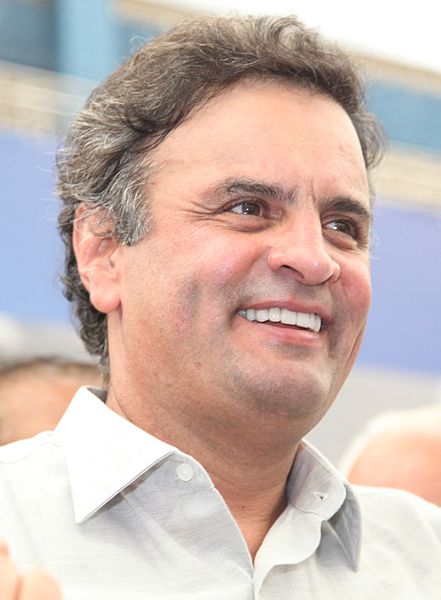
Aécio Neves | Author: PSDB MG | Wikimedia Commons
But the president’s closest allies have given hints. Rousseff’s foreign advisor Marco Aurélio Garcia says “South America is a big asset” and insists Mercosur – the region’s free trade zone – must be strong to keep Brazil’s position as a Latin American spokesman.
Neves’ aide Rubens Barbosa, a former ambassador to Washington, says Brazil does better by imploding Mercosur (which includes Venezuela, Brazil, Argentina, Paraguay and Uruguay), so there is a deal with the European Union and diplomacy that is friendlier to the US.
At the root of crises confronted by the United Nations usually lies a “complex web” of violations of economic, social, cultural, civil and political rights requiring solutions that can only come from more emphatic and comprehensive protections, the Organization’s top human rights official said on 22 October 2014.
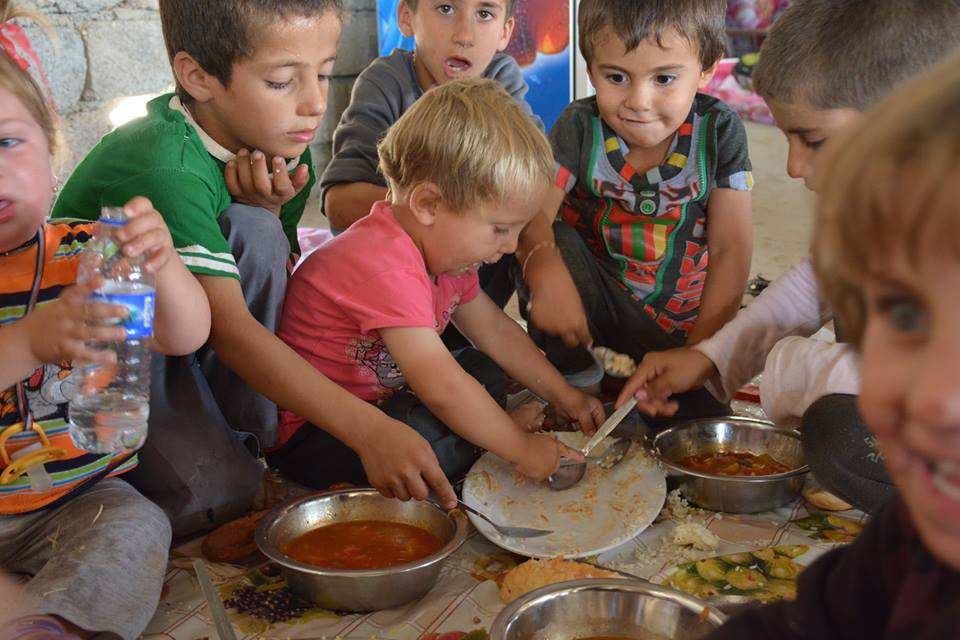
In Khanke village, Iraq Kurdistan Region, children from the Yazidi minority eat a meal of rice and tomato stew for lunch. Photo: UNHCR/N. Colt
Addressing the General Assembly’s main body dealing with social, humanitarian, and cultural issues (Third Committee), UN High Commissioners for Human Rights, Zeid Ra’ad Al Hussein, said the world is currently facing “deepening turmoil” amid “biting constraints” of funding.
The increasing use of armed drones within domestic law enforcement risks depersonalizing the use of force and infringing upon the rights of individual citizens, a United Nations independent human rights expert warned on 22 October 2014.
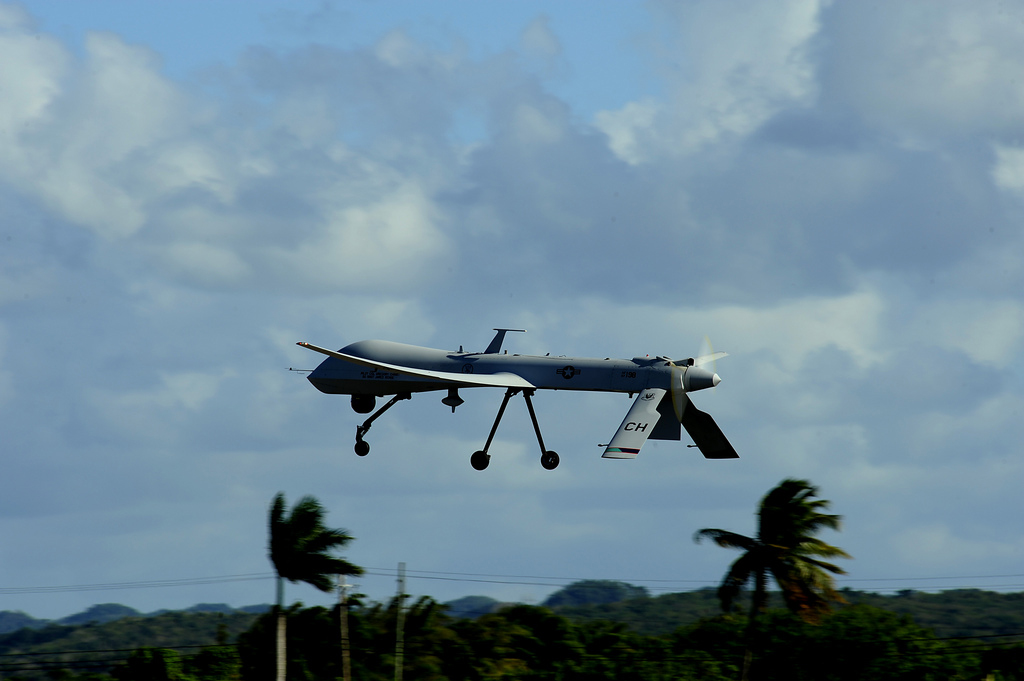
A US Air Force RQ-1 Predator unmanned aerial vehicle. Photo: US Department of Defense/James L. Harper Jr. | Source” UN News Centre
In presenting hisreport on the use of armed drones within law enforcement to the General Assembly body that deals with social, humanitarian and cultural issues (Third Committee), Christof Heyns, the UN Special Rapporteur on extrajudicial, summary or arbitrary executions, stressed that such mechanized systems, controlled by a human from a distance, “can hardly do what police officers are supposed to do” such as using the minimum force required by the circumstances and assisting those who need help.*
By Marcu Niculescu*,21 October 2014 (openDemocracy)— Owning a football club has increasingly become a means of securing political influence in many European countries. The recent Koriopolis scandal in Greece is just one example of this.
.
Wikimedia commons. Public domain. | Source: openDemocracy
.
Football is no longer a simple 90-minute affair. Between tickets, merchandise, broadcasting rights, sponsorships and betting, the beautiful game has become one of the most profitable industries in the world. Off the field, multimillion-dollar transfers and sponsorship deals are becoming more and more commonplace each season.
Bangkok, 21 October 2014 (IRIN)*– An increasing number of migrant children are being detained in countries where they are seeking asylum despite a growing body of scientific evidence that such incarceration leads to long-term psychological and developmental difficulties.
**Photo: Kristy Siegfried/IRIN | Children in detention can suffer long-term consequences
The UN Committee on the Rights of the Child in 2013 declared detaining migrant children is “never in [children’s] best interests and is not justifiable” and the UN Refugee Agency (UNHCR) says it should be conducted with an “ethic of care – and not enforcement”.
However, according to a June 2014 article in The Lancet, more than 60 countries detain migrant children, which causes “deleterious effects on children’s mental, developmental, and physical health”.
Kigali, 22 October 2014 (ILO)* – Kanyange’s (not her real name) baby is crying intermittently as they wait to meet a doctor at a health care centre in Kigali, the capital of Rwanda.
Source: ILO
“My baby has been like this over the last two days. This started just after I had returned to work after my six-week maternity leave had expired.”
.
The doctor’s instructions brought more concerns to the 35-year old mother who was told she needs to get more time to breastfeed the baby.
.
In charge of social affairs at the Rwandese local government, she had just reported back to work after six weeks of maternity leave because she feared losing 80 per cent of her salary.
.
The current labour law in Rwanda, adopted in 2009, stipulates that a mother is entitled to a maternity leave of 12 weeks. The first six weeks are automatic with full salary pay.
.
When a mother extends her leave by another six weeks she earns only 20 per cent of her salary. The employer covers the full cost of these maternity leave cash benefits.
With schools closed throughout the country as a result of the Ebola epidemic, Sierra Leone is bringing the classroom into students’ homes through the use of educational radio broadcasts.
By Yolanda Romero*, Freetown, Sierra Leone, 21 October 2014 — At the end of a labyrinth of small streets in Freetown’s New England neighborhood lies the home of 13-year-old Uleymatu Conteh.
Normally this morning she would have made her way to school dodging the motorbike taxis and the market women selling fruits, sweets and bread. Instead, she is sitting on the floor of her home, listening to the radio and taking notes while leaning against a wooden stool.
She’s listening to a science lesson about non-living and living things, with the help of an older relative, Moalem Siseh, 17.
The incidences of torture and ill-treatment around the world have not been diminishing and the need for effective prevention is “as great as it ever has been,” a United Nations human rights expert on 21 October 2014 said as he urged Member States to do more to tackle domestic corruption in order to prevent such episodes of abuses.
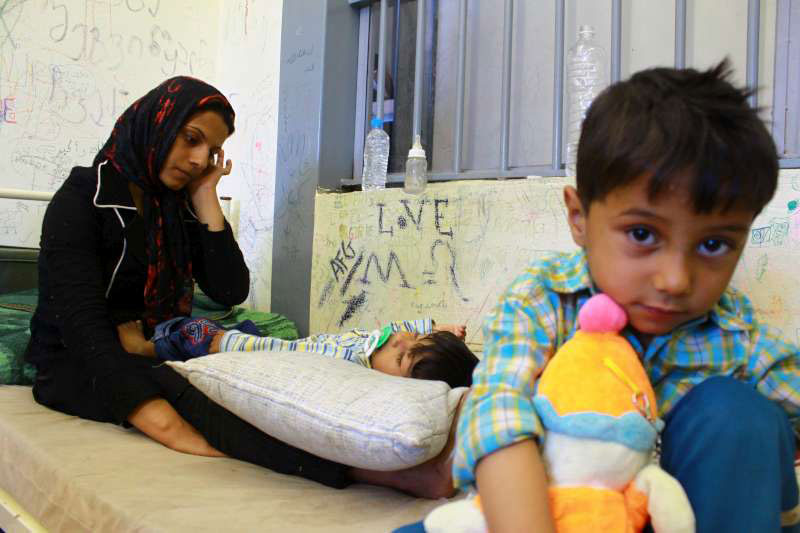
A mother and her children at a detention centre in Greece. Photo: UNHCR/J.Björgvinsson
“There is a clear connection between torture, ill-treatment and corrupt practices,” the chairperson of the UN Subcommittee on the Prevention of Torture (SPT), Malcolm Evans said as he presented the SPT’s annual report to the General Assembly’s main body dealing with social, humanitarian and cultural issues (Third Committee) in New York.
“Effective torture prevention must tackle corrupt practices too,” he added.
On the heels of last week’s visit to Gaza, United Nations Secretary-General Ban Ki-moon on 21 October 2014 told the Security Council today that promises made at a recent donor conference on rebuilding the war-ravaged enclave must “quickly materialize” into concrete assistance on the ground, especially as winter approaches.
UNRWA estimates around 17,000 destroyed or damaged homes, rendering 100,000 people homeless in Gaza. Photo: UNRWA Archives/Shareef Sarah
“Nothing could have prepared me for what I witnessed in Gaza. I saw mile after mile of wholesale destruction,” Ban recalled as hebriefed the 15-member body on his first visit to Gaza since this past summer’s conflict.*
By OXFAM* –– The widening gap between the richest and poorest is damaging economies and pushing more people into poverty. Too many still toil in extreme poverty. On the other extreme, wealth is increasingly concentrated in the hands of a few, who can use it to capture disproportionate power to shape the future. Here are some facts and figures on inequality. Want something more visual? Check out OXFAM‘sPoverty & Inequality Pinterest board.
The Paraisópolis favela borders the affluent district of Morumbi in São Paulo, Brazil. Photo: Tuca Vieira | Source: OXFAM International
General killer facts
Oxfam has calculated that in 2014 the richest 85 people on the planet owned as much as the poorest half of humanity.





 HUMAN WRONGS WATCH