10/10/2014
‘Forced to flee violence and struggling to feed her three children, a woman in South Sudan is one of thousands to get help from a UNICEF/WFP Rapid Response Mission – and one of millions still trying desperately to survive.’

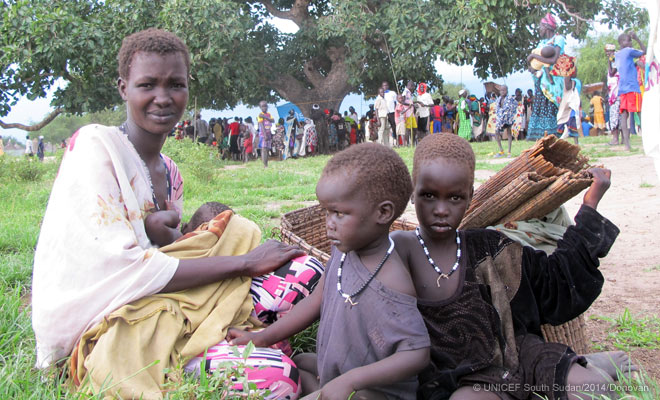
© UNICEF South Sudan/2014/Donovan | Cuaca, 22, with her daughters Nyadieng, Mawiek and Nyawech, waiting to receive food vouchers during a UNICEF/WFP Rapid Response Mission in Pathai, Jonglei State, South Sudan. She has already spent several hours waiting to register.
By Kate Donovan, Pathai, South Sudan, 10 October 2014 (UNICEF)* -– The remoteness of Cuaca’s new home makes it a hard place to raise her three children. There are no roads, markets, hospitals or schools. Two of the four wells in the village are broken, while the population that depends on this water has doubled.
“I fled because I am afraid of guns and afraid to be shot and killed,” says Cuaca, an elegant woman of 22 years who is waiting in line to register with UNICEF and the World Food Programme (WFP), who have arrived here by helicopter with life-saving supplies and services, the first humanitarian aid in nine months.
read more »
Posted in Africa, Mother Earth, The Peoples |
2 Comments »
09/10/2014
October 2014, UNESCO* — For Margaret Atieno Ochieng, teaching in Kibera Primary School presents new challenges every day, but she says she wouldn’t have it any other way.

Source: UNESCO
“I believe that being a teacher is an inspiration from the inside, in particular being a te acher in the slums,” she says. “I tell myself, I am where children need me most.” Watch the video
Kibera slum is situated five kilometres outside Nairobi, Kenya, and is the biggest slum in Africa with approximately one million people living there. The school serves the population of Kibera and children aged between 5 and 17 are taught there. The school is bursting at the seams with some 2,200 children studying there and enormous class sizes of up to 90 children in a lesson.
read more »
Posted in Africa, Asia, Latin America & Caribbean, Middle East, The Peoples |
Leave a Comment »
09/10/2014
Food markets are more stable and prices for most agricultural commodities are sharply lower than they have been in recent years, according to the latest edition of the biannual Food Outlook report released on 9 October 2014 by the United Nations Food and Agriculture Organization (FAO).

FAO says Good harvests and ample stockpiles continue to drive international food prices down. Credit: FAO
According to a statement released by the Rome-based FAO, bumper harvests and abundant stockpiles are key factors helping drive down international food prices.
World wheat production in 2014 is forecast to reach a new record while world cereal production in 2014 is anticipated to reach 2.5 billion tonnes – with stocks set to hit their highest level in 15 years by the end of the cropping season in 2015.
read more »
Posted in Africa, Asia, Latin America & Caribbean, Middle East, Mother Earth, Others-USA-Europe-etc., The Peoples |
Leave a Comment »
09/10/2014
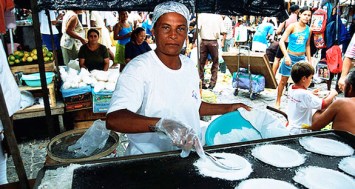
In Brazil, formal employment has risen by almost 14 per cent in a decade…SUPERSIMPLES is part of the reason. The forthcoming American Regional Meeting of the ILO will consider employment and social protection policies as boosters of productivity and formal employment.
.
Source: ILO
.
Brasilia, 09 October 2014 (ILO News*) — Wilker Barbosa is the owner of Eventhus Buffett, a small business in Brasilia that organizes parties, dinners, birthdays and weddings. From the food to the waiters, he provides clients with everything they need for a successful event.*
Barbosa’s business started out in the informal sector in May 2008, but only two months later his company became part of the formal economy. According to Barbosa, that change was mainly due to his decision to join SUPERSIMPLES, a government programme that has reduced taxes and simplified regulations for many small businesses in Brazil.
Posted in Latin America & Caribbean, Market Lords, The Peoples |
Leave a Comment »
09/10/2014
The global economy could be losing as much as $1 trillion annually by the end of the century if countries do not take urgent steps to stop ocean acidification, says a United Nations report launched on 8 October 2014 in Pyeongchang, Republic of Korea (ROK).

Coral Reef. Photo: World Bank/Carl Gustav | Source: UN News Centre
This figure reflects the economic loss for industries linked to coral reefs alone, which are some of the most vulnerable species to this phenomenon.*
The overall financial and environmental costs are still uncertain, states the report, An Updated Synthesis of the Impacts of Ocean Acidification on Marine Biodiversity, issued in Pyeongchang by the Convention on Biological Diversity (CBD) at the 12th meeting of the Conference of the Parties to the CBD (COP-12).
read more »
Posted in Africa, Asia, Latin America & Caribbean, Market Lords, Middle East, Mother Earth, Others-USA-Europe-etc., The Peoples |
Leave a Comment »
08/10/2014
Rome, 9 October 2014 — Seven key facts about fans and family farms appear, among other, in the UN Food and Agriculture Organization (FAO) Background paper for The State of Food and Agriculture 2014.

Photo source: FAO
These are:
• There are more than 570 million farms in the world and more than 500 million of these are owned by families. Family farms represent the vast majority of farms in the world, but less of the share of the world’s farmland, which means that they are, on average, smaller than non-family farms.
• Most of the world’s farms are very small. Worldwide more than 475 million farms are less than 2 hectares in size and more than 410 million farms are less than 1 hectare in size.
read more »
Posted in Africa, Asia, Latin America & Caribbean, Middle East, Mother Earth, Others-USA-Europe-etc., The Peoples |
1 Comment »
08/10/2014
Implementing measures that promote the sustainable use of biodiversity is a worthwhile investment that will bring multiple economic and environmental benefits to countries, according to a United Nations-backed report released on 7 October 2014.

The Green-crowned Brilliant in Costa Rica Photo: UNEP GRID Arendal/Peter Prokosch | Source UN News Centre
The report, released at the 12th meeting of the Conference of the Parties to the Convention on Biological Diversity (COP-12) in Pyeongchang, Republic of Korea, found that there is a gap across all countries and regions between investments needed to meet the 20 global biodiversity goals known as the Aichi targets, and the resources currently allocated to this endeavor.*
read more »
Posted in Africa, Asia, Latin America & Caribbean, Market Lords, Middle East, Mother Earth, Others-USA-Europe-etc., The Peoples |
Leave a Comment »
07/10/2014
The two main routes of smuggling of migrants to Europe and North America generate nearly $7 billion a year to the smuggling networks, according to an estimate on 6 October 2014 released by the United Nations Office on Drugs and Crime (UNODC).

Asylum-seekers and economic migrants take to the seas, waiting out the dangerous journey in the boat’s cramped cargo space. Photo: UNHCR/A. D’Amato
“Terrible tragedies are occurring daily as vulnerable women, children and men, place their trust in criminals to smuggle them across national borders,” UNODC Executive Director Yuri Fedotov said in Vienna at a conference focusing on the cooperation needed to confront criminals.
read more »
Posted in Africa, Asia, Latin America & Caribbean, Market Lords, Middle East, Mother Earth, Others-USA-Europe-etc., The Peoples |
3 Comments »
07/10/2014
The horrors of sexual violence in South Sudan did not end with the ceasefire agreement, a senior United Nations official on 6 October 2014 said calling on citizens of the world’s youngest country to stand together and say “enough is enough.”

A volunteer in the South Sudanese town of Bor arranges corpses, victims of repeated clashes between government forces and rebels. Photo: Hannah McNeish/IRIN
Speaking at a press conference on her first visit to the country, the Special Representative of the Secretary-General on sexual violence in conflict, Zainab Bangura, said that armed men – civilians and soldiers from all parties to the conflict – are responsible, and some carry on the acts.
“If allowed to continue, these rapes will haunt South Sudan for generations to come,” she said, adding that they will also “undermine the peace that South Sudan has fought for.” “I have come to South Sudan to demand that all parties of conflict end the raping and the violence,” Bangura underscored.
read more »
Posted in Africa, The Peoples |
Leave a Comment »
07/10/2014
Urgent action is needed to refocus urban planning and to provide safe, affordable housing that is appropriate and adequate for our citizens’ growing needs, senior United Nations officials on 6 October 2014 said marking World Habitat Day, which is observed annually on the first Monday of October. There are an estimated 863 million people living in slums, according to 2012 figures from UN-Habitat report, in contrast to 760 million in 2000 and 650 million in 1990.

Urban sprawl – a view of old Lijian city in China. Photo: UN-HABITAT
“Let us hear from people who live in slums what has worked and what has not — and what we need to do,” Secretary-General Ban Ki-moon said in his message for the Day.
This year’s theme is “Voices from the Slums” – an effort to highlight the hardships of slum living through the voices of the urban poor while also giving rise to their experiences and ideas about improving their living conditions.
read more »
Posted in Africa, Asia, Latin America & Caribbean, Middle East, Others-USA-Europe-etc., The Peoples |
1 Comment »


 HUMAN WRONGS WATCH