Human Wrongs Watch
Abu Dhabi, United Arab Emirates, 17-24 January 2015 — How the world’s smartest cities are re-imagining essential systems to solve the interlinked issues of water, energy and climate while also encouraging economic growth and resiliency will be discussed at next week’s World Future Energy Summit, the Middle East’s largest gathering of international leaders to drive viable solutions to address the world’s pressing energy challenges.
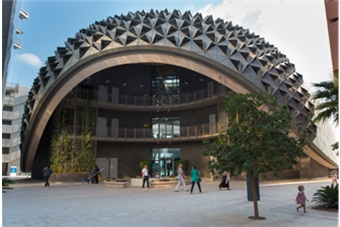
Source: World Future Energy Summit
Hosted by Masdar, Abu Dhabi’s renewable energy company, WFES is part of Abu Dhabi Sustainability Week (ADSW), January 17-24, a yearly platform to address the interconnected challenges of energy and water security, climate risk and sustainable development. Since its establishment, ADSW has helped reinforce Abu Dhabi’s position as an international energy hub – a true energy leader, promoting new and traditional sources of power.*
Greener, Healthier Cities
“Mayors across the globe are forging ahead with programs and policies that not only make their cities greener, healthier places to live, but also drive economic benefits,” said Mark Watts, executive director of C40 Cities Climate Leadership Group and moderator of the “Cities as Leaders on Climate Action” panel.
Encouraging the growth of smart cities has become one of the central features of WFES. This year’s panel will feature seven leaders from cities and local municipalities around the globe who will present groundbreaking, city-focused sustainability initiatives.
“Cities already account for 75 percent of global CO2 emissions,” said panelist Anthony Mallows, director, Masdar City. “With 60 percent of the world’s population expected to live in cities by 2030, some 5 billion people, the scale of the challenge is clear,
“As the world’s population becomes increasingly urbanized, we need to look at new ways to develop cities as viable living spaces and hubs of economic growth, while also reducing their carbon footprint,” Mallows said. “WFES plays an invaluable role in bringing together policy makers, industry leaders and leading innovators to drive this process forward.”
Masdar City
Masdar City is one of world’s most sustainable communities and an emerging technology cluster in Abu Dhabi. It also hosts the headquarters of the International Renewable Energy Agency and the Masdar Institute of Science and Technology, developed in cooperation with the Massachusetts Institute of Technology.
Watts added, “Our recent research demonstrates the enormous impact cities continue to have in the global climate change conversation – 228 cities across the world have already pledged to cut greenhouse gas emissions by a collective 2.8 gigatons by 2020. That’s about one-fifth of the so-called ’emissions gap’ to get the world on a pathway to avoid run-away climate change.”
Through offering a proactive forum for participants to engage with key clean energy stakeholders, WFES is consolidating its reputation as an enabler of the innovation and investment needed to meet future clean energy challenges. With 2015 designated as the UAE’s “Year of Innovation,” WFES is contributing to the country’s mission to establish itself as a scientific and intellectual leader.
In addition to WFES, ADSW also features the third edition of the International Water Summit (IWS) and the second edition of EcoWaste. The fifth assembly of the International Renewable Energy Agency and the seventh Zayed Future Energy Prize Awards ceremony will also take place during ADSW.
Growing Clean-Energy Market in Middle East

Source: World Future Energy Summit
The growing renewable energy investment opportunity in countries across the Middle East and North Africa (MENA) is garnering attention by international investors who will be at January’s World Future Energy Summit (WFES) to explore project opportunities. Through Masdar, Abu Dhabi’s renewable energy company and the host of WFES, the UAE is quickly becoming a leading renewable energy player regionally and globally.**
WFES is part of Abu Dhabi Sustainability Week (ADSW), January 17-24, a yearly platform that addresses the interconnected challenges of energy and water security, climate risk and sustainable development.
“Through its energy leadership, the UAE has helped galvanize the tremendous rollout of investment into renewables that we are seeing in countries across the Middle East,” said Dr. Ahmad Belhoul, CEO of Masdar. “As a platform that brokers partnerships, attracts investments and launches new innovations, WFES is an essential component in driving the region’s renewable energy growth.”
With 32,000 attendees expected from 170 countries over four days from 19-22 January in Abu Dhabi, WFES 2015 will bring together the key players – from industry, technology, finance and government – needed to accelerate commercial opportunities in the renewable energy and clean technology sectors.
The WFES agenda will offer delegates unmatched insight about the growing market opportunities in the Middle East and Africa, home to six of the world’s 10 fastest growing economies. As the region is attracting significant attention by international investors, several sessions are devoted to understanding the regulatory and institutional frameworks being put into place to encourage investments for renewable energy projects.
MENA Countries to Install Up to 37 Gigawatts of Renewable Energy Projects in 10 Years
MENA countries are planning to install up to 37 gigawatts of renewable energy projects within the next 10 years, and several major initiatives by the UAE are helping to realize this goal.
The UAE is already the largest renewables market in the Gulf Cooperation Council (GCC) region, with plans to grow. Abu Dhabi intends to source 7 percent of its domestic power needs from renewables by 2020.
Overall, the UAE has more than 120 megawatts of installed renewable energy capacity, the largest project being Masdar’s Shams 1, a 100 megawatt concentrated solar power (CSP) facility in Abu Dhabi. Masdar’s renewable energy projects extend around the world, with nearly two gigawatt of clean power in operation or under development in Jordan, Oman, the UK, and Spain, among other countries.
Other major renewables commitments in the MENA region include a $9 billion solar power project underway in Morocco; $2.1 billion worth of clean energy investments planned in Jordan, and $1 billion of investments planned for solar power in Egypt.
Hosted by Masdar, Abu Dhabi’s renewable energy company, WFES also receives support from ADNOC and Emirates Global Aluminium (EGA). In addition to WFES, ADSW will feature the third International Water Summit, the second edition of EcoWASTE, and the seventh Zayed Future Energy Prize Award Ceremony, as well as the Fifth General Assembly of the International Renewable Energy Agency.
*Source: World Future Energy Summit. Go to Original.
**Source: World Future Energy Summit. Go to Original.
2015 Human Wrongs Watch
Discover more from HUMAN WRONGS WATCH
Subscribe to get the latest posts sent to your email.
 Baher Kamal
 HUMAN WRONGS WATCH
Leave a comment