Human Wrongs Watch
The United Nations Secretary-General on 20 February 2015 said that the World Day for Social Justice comes at a pivotal moment for people and the planet, adding that this year’s commemoration focuses on the scourge of human trafficking and the plight of approximately 21 million women, men and children in various forms of modern slavery.

Forced labour often means unpaid wages, excessively long work hours without rest days, confiscation of ID documents, little freedom of movement, deception, intimidation and physical or sexual violence. ILO/A. Khemka
“New instruments such as the ILO (International Labour Organization) Protocol and Recommendation on forced labour and human trafficking are helping to strengthen global efforts to punish perpetrators and end impunity,” said Ban Ki-moon in a message marking the Day.
“We must continue to do more. We simply cannot achieve development for all if we leave behind those who are socially and economically exploited.”
In what he described as a crucial year for global development, he said more needed to be done to eradicate all forms of human exploitation.
Rising Call to Secure a Life of Dignity for All with Equal Rights
With Member States working to craft a post-2015 agenda and a new set of sustainable development goals, Mr. Ban called on the international community to build a world of social justice where all people can live and work in freedom, dignity and equality.
“Around the world, there is a rising call to secure a life of dignity for all with equal rights and respect for the diverse voices of the world’s peoples,” he said. “At the core of this movement lies the need for social justice.”
In a separate message on the Day, ILO Director-General, Guy Ryder, stressed: “There is no inevitability, no excuse: Forced labour can be stopped”
He pointed out that the economic gap continues to widen, with the richest 10 per cent earning 30 to 40 per cent of total income while the poorest 10 per cent earn between 2 and 7 per cent. In 2013, 939 million workers – 26.7 per cent of total employment, were still coping on $2 a day or less
“The situation is aggravated by the widespread absence of basic social protection. Millions of people are subjected to unacceptable conditions of work and the denial of fundamental rights,” Ryder emphasized.
Women and Children Particularly at Risk
According to the ILO, about 21 million women, men and children are forced to work under inhuman conditions on farms, in sweatshops, on board fishing vessels, in the sex industry or in private homes. Their sweat generates $150 billion in illegal profits annually.
And women and children are particularly at risk of being abducted and sold into slavery in times of violent conflict. Forced labour can also keep entire families in abject poverty for generations.
The ILO calls for ending forced labour calls with an integrated approach. Governments, employers, trade unions and civil society, each have a role to play in protecting, defending and empowering those who are vulnerable, as well as creating opportunities for decent work for all.
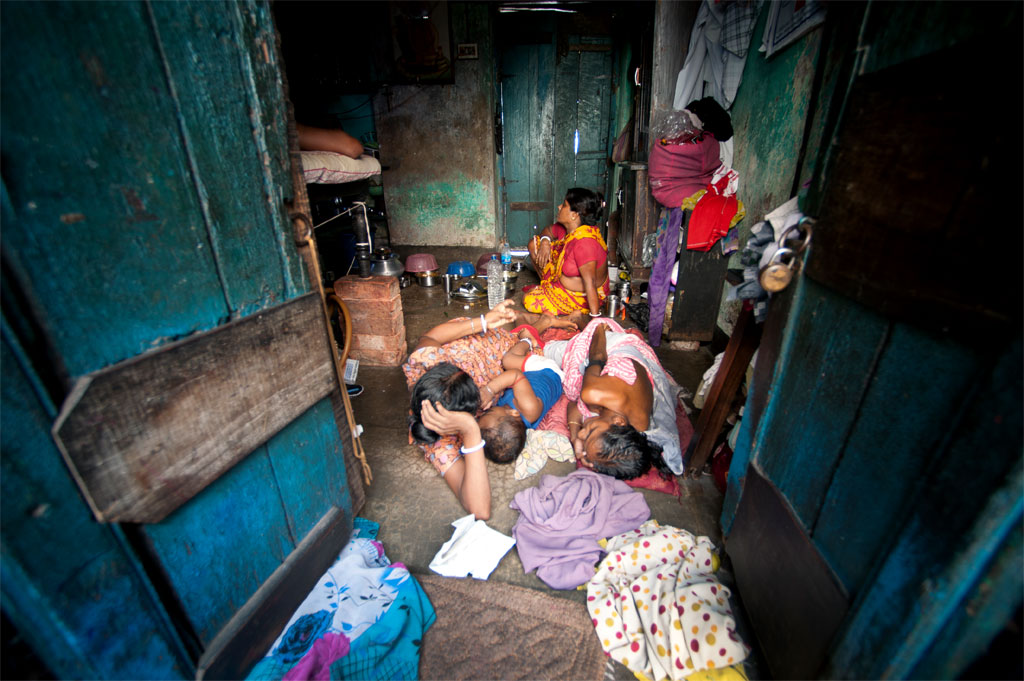
A family living in an urban slum in Sonagachi, Kolkata, India. UN Photo/Kibae Park
Urgent Action Needed to End Poverty, Overcome Inequality
UN officials are marking the World Day of Social Justice with strong calls on the international community to take practical steps to break down the barriers of inequality by doing more to empower individuals through decent work, provide adequate social protection, and ensure the voices of the poor are heard.
“The gap between the poorest and the wealthiest around the world is wide and growing. This situation is not only between countries but within them, including many of the most prosperous,” Secretary-General Ban Ki-moon said, declaring: “The World Day of Social Justice is observed to highlight the power of global solidarity to advance opportunity for all.”
We must serve the needs and harness the capacities of all members of our global family, especially women, the young, older persons and persons with disabilities, indigenous peoples and the poor and marginalized among us.
The UN General Assembly proclaimed 20 February as the World Day in 2007, inviting Member States to devote the day to promoting national activities in accordance with the objectives and goals of the 1995 World Summit for Social Development, at which leaders pledged to pledged to make poverty eradication, full employment and the fostering of social integration overriding objectives of global development.
In his message for the Day, Ban said that as inequalities widen, the social fabric of societies is both stretched and strained. This often leads to a downward spiral of economic and social uncertainty and even unrest. He said that violent conflict in many parts of the world is often rooted in deep inequality, discrimination, and widespread poverty.
Inequality, Not Inevitable
“Yet there is nothing inevitable about inequality. Our shared goal should aim at taking practical steps to remove this formidable barrier to development and human dignity,” he said, underscoring that as the international community continued efforts to achieve the Millennium Development Goals (MDGs) and shape a post-2015 agenda, social justice must be central to achieving equitable and sustainable growth for all.
Echoing the UN chief’s call to action, General Assembly President John Ashe declared that the principles of equity and social justice are essential to international relations in the twenty-first century.
Major strides had been made in that regard since 1995, including reducing by half the number of people living in extreme poverty and making major improvements in the areas of health and gender equality, including steady progress towards equal access of girls and boys to primary education.
Yet, while those accomplishments have been noteworthy, “we have more work to do if we want to reach the goals we set for ourselves,” he said, urging the international community to redouble collective efforts to complete the unfinished business of the MDGs.
“We must serve the needs and harness the capacities of all members of our global family…”
“However, our vision cannot stop there. We must look forward to shaping a global sustainable development agenda that will take us beyond 2015,” said Ashe, stressing that the new agenda, with the eradication of extreme poverty as its centre, must be inclusive of all actors, governmental and non-governmental alike, with the contributions of stakeholders from the private sector as well as the academic and scientific communities.
“We must serve the needs and harness the capacities of all members of our global family, especially women, the young, older persons and persons with disabilities, indigenous peoples and the poor and marginalized among us,” he said, expressing confidence the world could create a new development framework that will “eliminate the disparities that thus far have prevented us from realizing our shared aspirations.” (*Source: UN).
Read also:
“There is no inevitability, no excuse: forced labour can be stopped”
2015 Human Wrongs Watch
Discover more from HUMAN WRONGS WATCH
Subscribe to get the latest posts sent to your email.
 Baher Kamal
 HUMAN WRONGS WATCH
Leave a comment