Geneva — The political and economic crisis engulfing Yemen is having a dangerous impact on the country’s youths, the United Nations Children’s Fund (UNICEF) on , 13 February 2015 said as it warned that increasing numbers of children are suffering from malnourishment while fewer are attending school.
Children sit in a UNICEF-supported centre for vulnerable children, in the conflict-affected Hajjah Governorate, Yemen. Photo: UNICEF/Brent Stirton
Phoning in to a press briefing in Geneva, UNICEF representative in Yemen Julien Harneis said that the situation in the country had become “particularly worrying” with around 900,000 Yemeni children currently malnourished, out of whom some 210,000 were suffering from severe acute malnutrition.*
Although UNICEF had previously managed to help temper outbreaks of malnourishment, Mr. Harneis added that the UN agency was facing an uphill economic challenge due to a $60 million funding gap.
New York, 12 February 2015 – Amid a dangerous political and humanitarian crisis and a seething secessionist movement, Yemen sits on the brink of collapse, United Nations Secretary-General Ban Ki-moon warned the Security Council today, reminding the international community of its “solemn obligation” under the UN Charter to help the country prevent an escalation of the conflict and re-launch its political process.
Damage to property and infrastructure caused by fighting between Government troops and militants is estimated at 95 per cent in some areas of Yemen. Photo: OCHA/EmanAl-Awami
“We have all been following recent developments in Yemen with the deepest concern,” said Ban, as hebriefedthe 15-member Council alongside the UN Special Advisor, Jamal Benomar. “Let me be clear: Yemen is collapsing before our eyes. We cannot stand by and watch,” the UN chief warned.*
From Afghanistan to the Democratic Republic of the Congo (DRC), as the world’s conflicts become more brutal, intense and widespread, children are finding themselves increasingly vulnerable to recruitment and deployment by armed groups, the United Nations on 12 February 2015 warned.
This child soldier, demobilized in South Sudan in 2015, has never been to school and he really wants to go to school now. Photo: UNICEF/2015/South Sudan/Doune Porter
In a joint press release marking the International Day against the Use of Child Soldiers, observed every 12 February since 2002, the UN Children’s Fund (UNICEF) and the Special Representative of the UN Secretary-General for Children and Armed Conflict called for “urgent action to end grave violations against children” and appealed to all parties of conflicts to meet their obligations under International Law.*
Nairobi, 12 February 2015 (IRIN)* – Thousands of children are fighting with government and rebel forces in South Sudan, reversing a painstaking demobilization program and fanning calls for war crimes trials as a better way to protect minors from recruitment.
**Photo: UNICEF | Some 12,000 children are estimated to be in the ranks of various armed groups in South Sudan
To mark the International Day Against the Use of Child Soldiers, this article examines the dynamics of recruitment and the prospects for sustainable demobilization.
Many thousands of children have been killed, wounded, orphaned or displaced since December 2013, when a power struggle between President Salva Kiir and his former deputy Riek Machar split the ruling Sudan People’s Liberation Movement and Army (SPLM/A) and triggered a conflict that still shows little sign of ending.
Doune Porter, a spokeswoman for UNICEF, said armed groups including government troops and allied militias as well as an array of opposition forces are currently using more than 12,000 children, and that recruitment is ongoing.
New York — Urging global cooperation “to impair, isolate and incapacitate” terrorist threats, the United Nations Security Council on 12 February 2015 approved measures targeting sources of funding for the Islamic State of Iraq and the Levant (ISIL) and Al-Nusrah Front (ANF), condemning those buying oil from the groups, banning all trade in looted antiquities from Iraq and Syria, and calling on States to end ransom payments.
Ambassadors representing two countries under attack from ISIL, Bashar Ja’afari (right) of Syria, and Mohamed Ali Alhakim of Iraq, speak to journalists following the adoption of a Security Council resolution targeting sources of financing for the group. UN Photo/Mark Garten
Unanimously adopting a Russian-led resolution, the Council reiterated its deep concern that oilfields, as well as other infrastructure such as dams and power plants, controlled by ISIL, ANF and other Al-Qaida-associated groups, “are generating a significant portion of the groups’ income, alongside extortion, private foreign donations, kidnap ransoms and stolen money from the territory they control.”
11 February 2015 (RT)* — As EU politicians failed to reach a Greek debt deal in Brussels, thousands of people poured onto the streets of Athens and other large cities to protest austerity and voice support for the recently elected Syriza party.
Greece has confirmed there was no agreement, adding that “negotiations will continue with the goal of a mutually beneficial agreement.”
Eurozone finance ministers have made progress in discussions with Greece following hours of talks on Wednesday. The talks on whether to extend an international bailout to Athens will continue during the next scheduled meeting on Monday, as the sides could not agree on another meeting before then.
“We explored a number of issues, one of which was the current program,” Eurogroup chairman Jeroen Dijsselbloem said. “We discussed the possibility of an extension. For some that is clear that is preferred option but we haven’t come to that conclusion as yet.”
Greece has confirmed there was no agreement, adding that “negotiations will continue with the goal of a mutually beneficial agreement.”
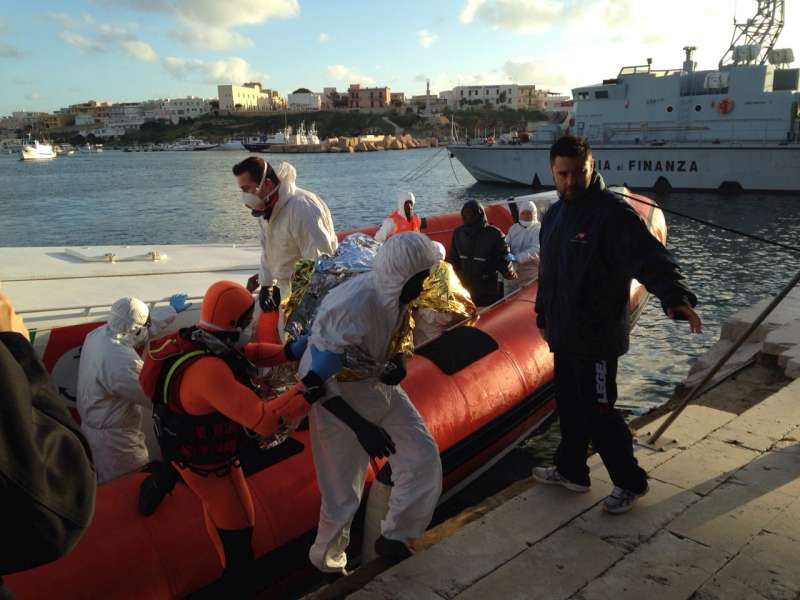
Geneva (UNHCR)*– The UN refugee agency on 11 February 2015 said it was “shocked” at evidence that some 300 migrants and refugees may have died after setting off from the coast of Libya in four dinghies at the weekend.
UNHCR had reported yesterday that at least 29 people died on Sunday on one of the boats, which was carrying 105 people and trying to reach Europe. “Reports gathered [since] by UNHCR from the Italian Coastguard and the survivors in Lampedusa now suggest some 300 people are confirmed missing,” the agency said in a statement, adding that they were mainly from Sub-Saharan Africa.
The other victims were on board two dinghies found on Monday, but a fourth dinghy mentioned by survivors is missing. A total 82 survivors have disembarked at Italy’s Lampedusa Island, after being rescued by Italian coastguards and a merchant vessel.
The recruitment and use of children in armed forces is a violation of international law, and children who are recruited and forced to fight and kill suffer profound physical and psychological damage. Children not Soldiers, launched in 2014 by Leila Zerrougui, the Special Representative of the Secretary-General for Children and Armed Conflict, and UNICEF, is a campaign to make all government armed forces child-free by 2016.
In the Democratic Republic of Congo, capoeira, a Brazilian martial arts form, has had a positive impact in helping children demobilized from armed forces to make the transition away from military life and reintegrate with their families and communities.
GOMA, Democratic Republic of Congo, 11 February 2015– “Aie! Aie! Isso!” Ninja gives the rally cry, and dozens of children rush forward at the instructor’s call. All of them already have their abadá, the white trousers of capoeira players. The boys are between 12 and 17, and their smiles show their enthusiasm.
African girls and boys continue to be subjected to distressing levels of physical, sexual and emotional violence despite the significant legal and policy measures adopted throughout the region, according to a new United Nations-backed report.
A group of boys displaced by violence in South Sudan, playing in a UNICEF-supported child friendly space. Photo: UNICEF/Brian Sokol
Launched on 11 February 2015 at UN Headquarters in New York, The African Report on Violence against Children is the first comprehensive report of its kind in the region and builds upon the commitment put forward by African Union Member States to promote a so-called “Africa Fit for Children.”*
A report produced jointly by the United Nations High Commission for Human Rights and the UN Support Mission in Libya (UNSMIL) “paints a bleak picture” of the human rights situation in the country during 2014, the High Commissioner’s spokesperson said on 10 February 2015 in Geneva.
A girl looks out of her house window in Benghazi, Libya. Photo: UNSMIL
The report, which will be presented to the UN Human Rights Council in March, depicts a country suffering from increasing turmoil and lawlessness, inflamed by a multitude of competing, heavily armed groups and a broadening political crisis. Against such a backdrop, it calls for bolstering State institutions, urges accountability for rights violations and support for the ongoing political dialogue.*




 HUMAN WRONGS WATCH