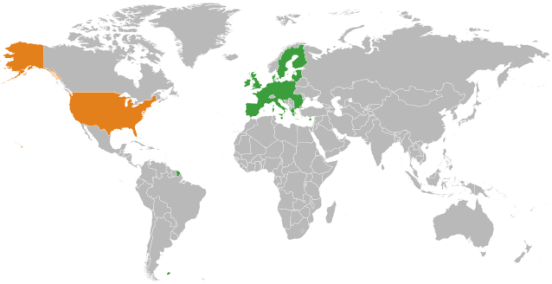
13 July 2015 – TRANSCEND Media Service – Unbelievable but true: Obama, other presidents and governments are seriously contemplating to hand their countries, people and all, over to business to create the largest “free trade areas” in history with NAFTA for North America, TPP for the Pacific, TTIP to the Atlantic and TiSA, services covering some 50 states all over.
**Map: The EU (green) and the USA (orange) shown on a world map. | Author: Ssolbergj | Wikimedia Commons
Pharmaceuticals, chemicals, textiles, chicken; communications, e-trade, financial services, insurance, what not, negotiate across the oceans how to market each other’s products across oceans, overriding domestic laws, even constitutions that stand in the way of business.
The State-Capital-People, or Government-Investors-Civil Society restructured against not only Civil Society, but Parliament and Law.
CAIRO, 10 July 2015 (IRIN)*– Ever since Islamic State-affiliated militants tried to take the town of Sheikh Zuwayed in North Sinai last week, the Egyptian media has talked of little else. “What mistakes were made?” “Where did they get their weapons from?” and “What can be done to rid the country of the scourge of Islamist militants?” have been common refrains.
.
**Contributor/IRIN | Destruction in the Sinai region (File photo)
But look closely and you will notice what is lacking – reporting of the human suffering on the ground. Reliable figures on the number of civilian dead and displaced don’t exist, while aid to those in need has been limited, if present at all.
Rome, 10 July 2015 – Eradicating world hunger sustainably by 2030 will require an estimated additional $267 billion per year on average for investments in rural and urban areas and in social protection, so poor people have access to food and can improve their livelihoods, a new UN report says. This would average $160 annually for each person living in extreme poverty over the 15 year period.
Women farmers in Myanmar. In rural areas, pro-poor investments should support family farmers and other small-holders in a variety of ways. | Source: FAO
Prepared by the UN Food and Agriculture Organization (FAO), the International Fund for Agriculture Development (IFAD) and the World Food Programme (WFP), the report, which was presented in Rome today, comes ahead of the Third International Conference on Financing for Development in Addis Ababa, Ethiopia on 13 – 16 July 2015.
KUALA CANGKOI, Indonesia, 10 July 2015 – Montas spent the first months of her pregnancy at sea, crowded onto a boat with hundreds of other migrants. The passengers had set out to find a better life – perhaps in Malaysia or Australia – but ended up more desperate than ever. The captain abandoned their boat, leaving them stranded on the open ocean.*
In May, local fishermen off the coast of Lhoksumawe, Indonesia, spotted Montas’s boat, along with a handful of others, also filled to capacity with men, women and children.
Unable to ignore the passengers’ pleas for help, the fishermen towed them to safety.
They were part of a group of nearly 2,000 ethnic Rohingya and Bangladeshi migrants who, according to data from the United Nations Refugee Agency, ended up in Indonesia after failing to reach Malaysia or Australia.
New York, UN, 11 July 2015 –Sarita Tamang was nine months pregnant when she was buried alive by the devastating earthquake in Nepal. Her house in Gorkha, near the epicentre of the quake, collapsed on top of her.
“I could not even get up from my bed, and I did not have hope that I could be alive,” she said. “I felt that my organs were not functioning and my body was trembling.”
Ms. Tamang’s brother-in-law dug her from the rubble, but the disaster destroyed the local health facility. She ended up giving birth in a tent she shared with four other families.
10 July 2015 – The United Nations has planed to raise awareness of the needs of women and girls in emergencies on World Population Day 2015 with campaigns including an outdoor event in the Kazakh capital of Almaty and a panel discussion in the Thai capital of Bangkok on this year’s theme ‘vulnerable populations in emergencies.*
Syrian refugees fleeing the fighting near the Syrian city of Kobani wait in a holding area before boarding buses in Turkey (September 2014). Photo: UNHCR /I. Prickett
“Not since the end of the Second World War have so many people been forced from their homes across the planet,” UN Secretary-General Ban Ki-moon said in his message on the Day, which is observed on July 11 as a day to focus attention on the urgency and importance of population issues.
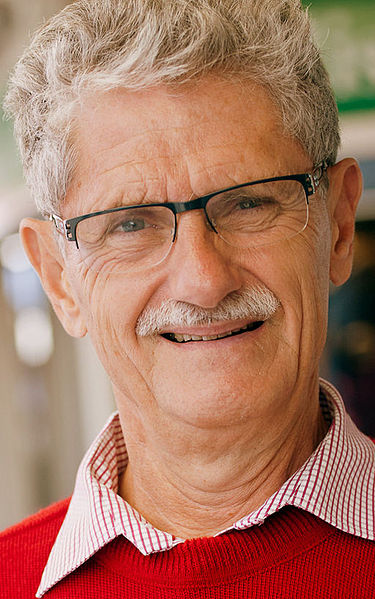
The election of Mogens Lykketoft as the new President of the United Nations General Assembly has opened the door to the solution of several of world’s most pressing problems. For example, it may now be possible to achieve a Nuclear Weapons Convention by a direct majority vote.
On June 15, the United Nations General Assembly unanimously elected Mogens Lykketoft, Denmark’s former parliament speaker and foreign minister, as president of its 70th anniversary session.
UN Secretary-General Ban Ki-moon said that this anniversary year offers Lykketoft “an extraordinary opportunity to shape history”.
In September, just before the annual General Assembly ministerial meeting, world leaders will hold a special summit to adopt new goals.
Their aims will be to further reduce poverty, promote economic development, and tackle the roots of climate change.
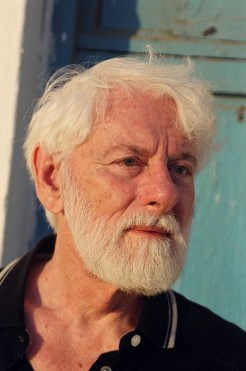
EVERYBODY HAS already voiced his (or her) opinion on the Greek crisis, whether he (or she) has an opinion or not. So I feel obliged to do the same.
Uri Avnery
The crisis is immensely complicated. However, it looks to me quite simple.
The Greeks spent more than they earned. The creditors, in their incredible impertinence, want their money back. The Greeks have no money, and anyhow, their pride does not allow them to pay.
So what to do? Every commentator, from Nobel prize-winning economists to my taxi driver in Tel Aviv, has a solution. Unfortunately, no one listens to them.
Angela Merkel and Alexis Tsipras go on fighting World War II. But the relations between the two nations played a role in my family long before that.
AS A boy, my father was a pupil in a German “humanist” high school. In these schools, pupils learned Latin and ancient Greek instead of English and French.
So I heard Latin and Greek sayings before I went to school and learned Latin myself – for half a year before we fortunately left Germany for Palestine in 1933.
Months of politically motivated violence in South Sudan has left thousands dead and caused a “man-made…catastrophe,” the United Nations Security Council on 9 July 2015 declared, expressing “profound disappointment” with President Salva Kiir, former Vice-President Riek Machar and other leaders “who have put their personal ambitions ahead of the good of their country and their people.”
Women and children have suffered devastating attacks in South Sudan’s Unity State. Photo: UNICEF/South Sudan/Sebastian Rich
In a press statement noting that 9 July begins of the fourth year of independence for the world’s youngest nation, Council members stressed that political sparring between South Sudan’s key leadership has “jeopardized the foundation of this fledgling State,” and appealed for an urgent return to a political process that would end the ongoing crisis.
8 July 2015 (ILO)*– On the occasion of the conference on ‘Regulating for Decent Work’ from 8-10 July 2015, the ILO is hosting an exhibition by Bangladeshi photojournalist Ismail Ferdous.
The photo exhibition “So we exist” tells the stories of people in unreachable communities around the world working in fields such as construction and the leather industry.
.
It also depicts the aftermath of the Rana Plaza factory collapse in Bangladesh, labour migration in the Persian Gulf and modern-day slavery in Central America and South East Asia.




 HUMAN WRONGS WATCH