NAIROBI, 23 December 2015 (IRIN)– El Niño is the largely unwanted Christmas gift – a warming of the tropical Pacific causing drought and floods that will peak at the end of this month, but will impact weather systems around the globe into 2016.
This year’s El Niño has been steadily gaining strength since March. It’s likely to be one of the most extreme events of this nature yet seen, with the UN’s emergency aid coordination body, OCHA, warning that “millions will be impacted”.
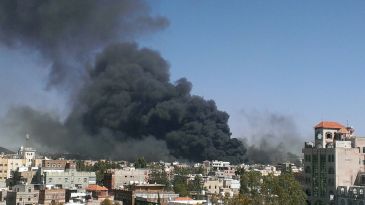
23 December, 2015 (IRIN)* – Already the Arabian Peninsula’s poorest country, the rise of the Houthi insurgency and Saudi Arabian-led airstrikes intended to oust them from power led to a full-blown humanitarian disaster.
.
And then in November, coastal regions were hit by the most powerful storm in decades, causing displacement and flooding.
The UN estimates that by the end of the year, 21.1 million people – 82 percent of the population – were in need of some sort of humanitarian assistance.
23 December 2015 (ICAN)*– It has been another busy and successful year for ICAN, with 121 nations pledging “to fill the legal gap” for the prohibition and elimination of nuclear weapons, and a UN working group established to advance this goal. Here are some of the highlights:
.
29 January: Latin American and Caribbean leaders call for a ban
The leaders of all 33 Latin American and Caribbean nations meet in Costa Rica and adopt a declaration supporting a treaty banning nuclear weapons. They also formally endorse the Austrian Pledge, later renamed the Humanitarian Pledge.
22 December 2015 (RT)– In January, the Syrian government will – ostensibly – sit across the negotiating table from ‘the Syrian opposition’ to decide on the structure and make-up of a transitional government that promises to end the 5-year Syrian conflict.
JAKARTA, December 2015 (IRIN) – Hundreds of Rohingya refugees have vanished from camps in the northern reaches of the Indonesian island of Sumatra in recent months, raising concerns that they are once again turning to dangerous smuggling rings in a bid to reach Malaysia.
22 December 2015 – TRANSCEND Media Service– From very high up three major countries-states stand out clearly: China, the most populous; Russia, the largest; USA, the most military. With three leaders, Xi, Putin, Obama, with much power on their hands.
Johan Galtung
And here is the key hypothesis, presumably more right than wrong: China-Xi: positive peace; Russia-Putin: negative peace; USA-Obama: war.
We have in mind China–also a region–building relations for reasonably mutual and equal benefit with China all over the world, spinning Asia-Europe-Africa together in a road-rail-ship-air Silk network available to all (with major mistakes in the South China Sea).
We have in mind Russia–itself also a region–calling to Russia leaders in violent conflict from all over the world, seeking cease-fires and accommodation (making itself a major mistake in Syria).
And we have in mind USA–more than a state, less than a region–since WWII ended killing more than 20 million people in 37 countries:
The number of refugees and migrants fleeing to Europe in 2015 has topped an unprecedented one million – at least 3,600 died or went missing in the crossings – the UN refugee agency (UNHCR) on 22 December 2015 reported, calling for much more to be done to receive and aid those uprooted by persecution, conflict and poverty.
Refugees, primarily from the Syrian Arab Republic, Afghanistan, and Iraq, pass through the Vinojug reception centre for refugees and migrants in Gevgelija, former Yugoslav Republic of Macedonia, on the border with Greece. Photo: UNICEF/Ashley Gilbertson VII
BY NOW EVERY ISRAELI has seen the TV clip several times – showing a 14-year old Arab girl being shot dead near the central market of Jewish Jerusalem.
Uri Avnery
The story is well known: two sisters, 14 and 16 years old, have decided to attack Israelis.
The clip, taken by a security camera, shows one of them, clad in traditional Arab garb, jumping around on the sidewalk, brandishing a pair of scissors.
The whole thing looks almost like a dance. She is jumping around aimlessly, waving the scissors, threatening no one in particular.
Then a soldier aims a pistol at her and shoots her. He runs to the girl and kills her while she is lying helplessly on the ground. The other girl is grievously wounded.
Violence and attacks against civilian populations in northeastern Nigeria and its neighboring countries have forced “a staggering” one million children out of school in a conflict that has dealt “a huge blow for education in the region,” the UN Children’s Fund (UNICEF) on 22 December 2015 reported.
Girls use their new school supplies during a class in an informal learning centre in a UNICEF-supported safe space for children in the Dalori camp for internally displaced people, in the north-eastern city of Maiduguri in Borno State. Photo: UNICEF/UNI193691/Andrew Esiebo
“Across Nigeria, Cameroon, Chad and Niger, over 2,000 schools remain closed due to the conflict – some of them for more than a year – and hundreds have been attacked, looted or set on fire,” UNICEF said.
“In far north Cameroon, only one out of the 135 schools closed in 2014 has re-opened this year.”






 HUMAN WRONGS WATCH