Human Wrongs Watch
By Azita Berar Awad and Ann Miles*
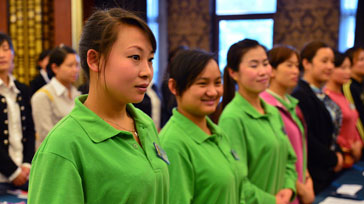
© Li Wenyong / World Bank | Source: ILO
The research shows an abundance of positive links. And yet it’s clear that another generation of young women remains outside the reach of what should be their full economic and self-empowerment potential.
Alarming statistics
The report, Young and female – A double strike? Gender analysis of school-to-work transition surveys in 32 developing countries , studied youth populations aged 15‒29 in 32 developing countries.

For those young women in the labour market, clear disadvantage is shown in many of the report’s key statistics: higher unemployment rates (in 2014, 13.6 per cent vs. 12.6 per cent globally), persistent wage gaps (young males earned between 1 and 36 per cent more within all sectors and occupations), higher shares in informal employment (75 per cent of female workers aged 15‒29 compared to 73.6 per cent of male workers in the same age band) and longer school-to-work transitions.
Moreover, when there are not enough higher skilled jobs created by economies to provide for all job seekers, it is young women who are most disadvantaged.
Causes and solutions
So, what is behind these disturbing results? Lack of access to resources, early marriages and pregnancies and unrecognized unpaid work are some of the culprits.
However, the report finds that most young women who dropped out of the labour market for family reasons (to have children or look after the household) continued outside the workforce at the time of the survey. Young men were much more likely to re-enter the workforce.
Looking at these figures we must conclude that while some progress has been made over time toward gender equality, in particular in access to education, the struggle for true equality in the world of work is still an uphill battle.
It is time to rethink, find the approaches that work and then move to scale them up.
.
Change can happen
We should also remember that the news is not all bad when it comes to improving opportunities for young women.
Countless storylines of what an empowered young woman can do to lift not only her household but entire communities out of the poverty cycle give us many sources of inspiration.
These approaches require tailored action to overcome the often unique circumstances young women face. They provide the comprehensive social support, like day care, women need to participate in education or training opportunities and set themselves on a path toward productive employment.
The report canvases ideas on overcoming some of the female-specific constraints in youth employment programming, from addressing the unequal distribution of household responsibilities to overcoming discrimination in recruitment and conditions of work and occupational segregation.
Scaling up interventions geared toward setting young women on the path to a better future is the shared responsibility of all parties, the public and private sectors, local development actors and families.
As the world, through the 2030 Agenda on sustainable development, aims for decent work and productive employment for all young people, the report reminds us that the world needs a more concerted effort to set young women on the right path to economic empowerment.
2016 Human Wrongs Watch
Discover more from HUMAN WRONGS WATCH
Subscribe to get the latest posts sent to your email.
 Baher Kamal
 HUMAN WRONGS WATCH
Leave a comment