Human Wrongs Watch
5 June 2018 (World Environment Day)* — Trash is not garbage. This is the motto of one of Peru’s most innovative recycling campaigns, one that has already turned a million plastic bottles into thousands of ponchilas.
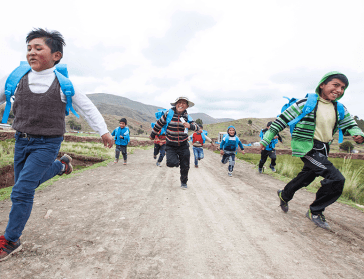
Trash is not garbage. This is the motto of one of Peru’s most innovative recycling campaigns, one that has already turned a million plastic bottles into thousands of ponchilas. | Photo from UN Environment.
In Peru, a ponchila– a combination of the Spanish words “poncho” and “mochila” – refers to a backpack with a built-in poncho. The items were designed to protect the poorest children in the Andes, many of whom must travel several kilometers a day, often in inclement weather, to get to school.
And ponchilas have one other important benefit: Each item is made out of 80 recycled plastic bottles.
“With this initiative, we are recovering a lot of plastic that could end up in landfills, dumps or in the oceans,” says Miguel Nárvaez, head of social and business responsibility at Cencosud, a supermarket chain and one of the companies that leads the campaign.

Each ponchila is made of 80 recycled plastic bottles (UN Environment).
The ponchilas project started in 2016 when Cencosud, Agua San Luis (owned by Coca-Cola) and Pacífico Seguros set out to collaborate to reduce school dropouts in the Andes highlands because of extreme temperatures and the long distances that children must travel to get to school.
The companies invited citizens to support the initiative by recycling their plastic drinking bottles during the summer, when consumption is high.
In 2017, the projected produced 6,000 ponchos; another 7,000 have already been made this year. The items were delivered to children in the provinces of Puno, Cusco, Arequipa, Huancavelica, Ayacucho and Apurímac before the beginning of the school year.
But this was not the only achievement. “Thanks to the campaign, almost 40 per cent of the customers of our supermarkets began to recycle plastic for the first time,” says Narváez. “For us that represents a relevant impact.”
In 2018, the Ministry of Environment of Peru joined the campaign, which actively works to promote sustainable consumption and innovative ways to reuse disposable plastics.
“With this initiative what we are doing is closing the circle, using our waste and giving them an added value through recycling,” says the Environment Minister, Fabiola Muñoz.

Ponchilas are intended to reduce dropout rates among children living in the Andes (UN Environment).
In Peru, 18,000 tons of waste are generated every day, of which 10 per cent is plastic; very little is recycled.
The national government is currently promoting a bill in Congress to boost the circular economy by reducing the consumption of plastics and promoting the use of recycled materials.
For Minister Muñoz, the ponchilas are an example that this idea is possible: “A bottle that served you can become something useful for someone else. We have the opportunity to convert something that apparently no longer has a use into a positive thing with a new use.”
Every minute, people around the world use one million plastic bottles, and most of them end up in the oceans, where they harm wildlife.
Peru is the host of the celebrations of the 2018 World Environment Daycelebrations for Latin America and the Caribbean. #BeatPlasticPollution is the theme of this year’s day.
Peru is a member of the UN Environment’s Clean Seas(Mares Limpios) campaign, which aims to drastically reduce marine debris and eradicate the use of microplastics. More than 40 countries around the world have joined the campaign, including 11 others in Latin America and the Caribbean: Barbados, Brazil, Chile, Colombia, Costa Rica, Grenada, Ecuador, Panama, the Dominican Republic, Saint Lucia and Uruguay.
*SOURCE: World Environment Day. Go to ORIGINAL.
.
Read also:
- Microplastic Particles in the Ocean Now Outnumber Stars in Our Galaxy — The World Is Being ‘Swamped’ by Harmful Plastic Waste
- Junk Planet: Is Earth the Largest Garbage Dump in the Universe?
- World Campaign to Clean Torrents of Plastic Dumped in the Oceans
- More Plastic than Fish or How Politicians Help Ocean Destruction
- Plastic No More… Also in Kenya
- UN Declares War on Ocean Plastic
- Ghost Fishing? 640.000 Tonnes of Fishing Gear Dumped in Oceans Every Year
- Once Upon a Time a Planet…
- Climate Change Summit a Step Further, Yes… But Where To?
- A Death Sea Called Mediterranean
- Why We Need to Save Our Oceans Now—Not Later
- Freshwater to Sea, the Resilience of Oceans
- Saving the Oceans, Saving the Future: Officials Tackle Marine Pollution
2018 Human Wrongs Watch
Discover more from HUMAN WRONGS WATCH
Subscribe to get the latest posts sent to your email.
 Baher Kamal
 HUMAN WRONGS WATCH
Leave a comment