Human Wrongs Watch
A failure to remain focused on the Rohingya refugee crisis in Bangladesh “would have tragic outcomes” for the nearly one million children, women and men living in Cox’s Bazar, on 17 July 2018 said William Lacy Swing, Director General of the International Organization for Migration (IOM).
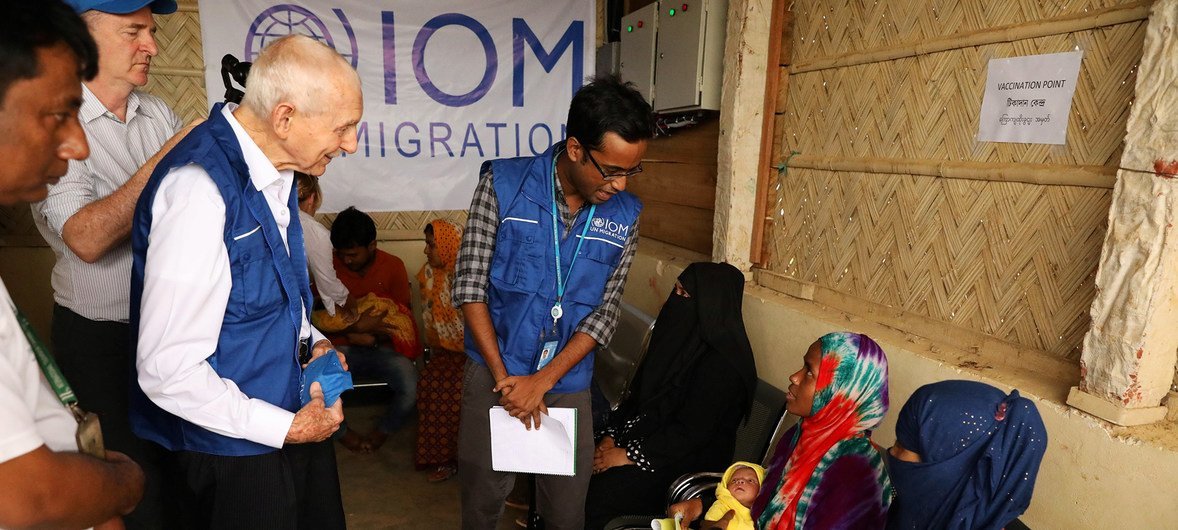
The Rohingya have suffered a pattern of persecution over decades — lacking even the most basic human rights, starting with citizenship — in their native Myanmar.
The IOM chief noted the major improvements made to the camp management in the Cox’s Bazar area, and infrastructure – including pathways, bridges, drainage, sanitation and shelters – carried out by the United Nations, non-governmental organisations (NGOs) and national partners, since his last visit in October 2017.
However, as monsoon rains turn many hillsides to mud, many Rohingya now live in desperately cramped conditions on bare sandy slopes, with only bamboo and tarpaulin shelters to protect them from the elements, in what has now become the world’s largest refugee camp.
The humanitarian response in Cox’s Bazar, which scaled up in August 2017, is now facing significant funding shortfalls. Swing warned that with only one quarter of the joint funding appeal for the entire response met so far, much of the progress made in recent months was at serious risk of collapsing.
That, he said, would create yet another life-threatening disaster for the Rohingya and the Bangladeshi host community whose resources are already stretched to the limit.
In parallel, the UN Special Envoy on Myanmar, Christine Schraner Burgener, who also visited Bangladesh this week, expressed her sincere appreciation to all the people of the country, in particular host communities, for the help they have offered Rohingya refugees. She echoed the need for greater international assistance.
Calling for accountability for the human rights violations committed, the Special Envoy expressed her support for the implementation of the November 2017 agreement between Bangladesh and Myanmar, and last month’s agreement between Myanmar, the UN Refugee Agency (UNHCR) and the UN Development Programme (UNDP), paving the way towards a conducive environment allowing for the voluntary, safe, dignified and sustainable return of the people to their place of origin or choice. (SOURCE: UN).
2018 Human Wrongs Watch
Discover more from HUMAN WRONGS WATCH
Subscribe to get the latest posts sent to your email.
 Baher Kamal
 HUMAN WRONGS WATCH
Leave a comment