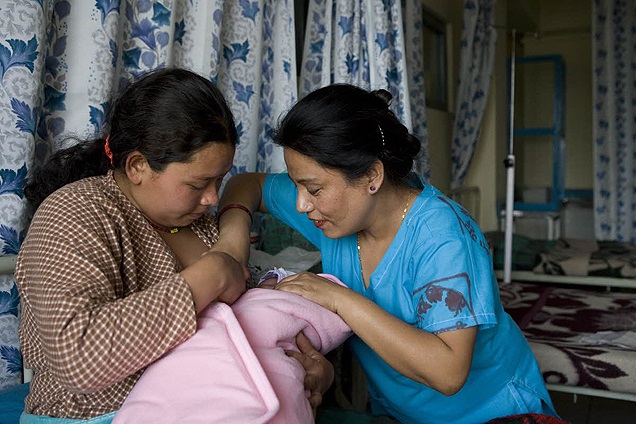
 WHO/C. Black | A health worker helps a mother breastfeed her newborn in Nepal
The theme of this year’s World Breastfeeding Week is “Empower Parents, Enable Breastfeeding.”
Family-friendly policies – such as paid parental leave – enable breastfeeding and help parents nurture and bond with their children in early life, when it matters most.
The evidence is clear that during early childhood, the optimal nutrition provided by breastfeeding, along with nurturing care and stimulation, can strengthen children’s brain development with impacts that endure over a lifetime.
Family-friendly policies are particularly important for working parents. Mothers need time off from work to recover from birth and get breastfeeding off to a successful start.
When a breastfeeding mother returns to work, her ability to continue breastfeeding depends on having access to breastfeeding breaks; a safe, private, and hygienic space for expressing and storing breastmilk; and affordable childcare at or near her workplace.
Time off work is also important for fathers: Paid paternity leave allows fathers to bond with their babies and promotes gender-equality, including through the sharing of childrearing and household responsibilities.
Returning to work too soon is a barrier to the early initiation of breastfeeding, exclusive breastfeeding in the first six months and continued breastfeeding until age 2 or longer – practices that can boost children’s immune systems, shield them from disease, and provide protection from noncommunicable diseases later in life.

Breastfeeding also protects maternal health — women who breastfeed reduce their risk of breast and ovarian cancers.
In addition to their impact on children, family-friendly policies support women’s participation in the workforce, improve their physical and mental health, and enhance family well-being. They also advance business objectives and strengthen the economy.
Such policies have been shown to increase employee retention, improve job satisfaction, and result in fewer absences. In short, family-friendly policies are good for families, babies and business.
As the world marks World Breastfeeding Week, WHO and UNICEF call on governments and all employers to adopt family-friendly policies – including paid maternity leave for a minimum of 18 weeks, and preferably, for a period of six months – as well as paid paternity leave.
In line with the policy actions advocated by the WHO-UNICEF-led Global Breastfeeding Collective, we also call for greater investments in comprehensive breastfeeding programmes, improved breastfeeding counselling and support for women in health facilities and the community, and an end to the promotion of breast-milk substitutes to enable parents to make informed decisions on the best way to feed their infants.
Together, with the support of governments, employers and communities, we have the power to enable breastfeeding and support families in fostering a nurturing environment where all children thrive.

World Breastfeeding Week is celebrated every year from 1 to 7 August to encourage breastfeeding and improve the health of babies around the world. It commemorates the Innocenti Declaration signed in August 1990 by government policymakers, WHO, UNICEF and other organizations to protect, promote and support breastfeeding.*
This year, WHO is working with UNICEF and partners to promote the importance of family-friendly policies to enable breastfeeding and help parents nurture and bond with their children in early life, when it matters most.
This includes enacting paid maternity leave for a minimum of 18 weeks, and paid paternity leave to encourage shared responsibility of caring for their children on an equal basis.
Mothers also need access to a parent friendly workplace to protect and support their ability to continue breastfeeding upon return to work by having access to breastfeeding breaks; a safe, private, and hygienic space for expressing and storing breastmilk; and affordable childcare.

Breastfeeding promotes better health for mothers and children alike. Increasing breastfeeding to near-universal levels could save more than 800 000 lives every year, the majority being children under 6 months. Breastfeeding decreases the risk of mothers developing breast cancer, ovarian cancer, type 2 diabetes, and heart disease.
It is estimated that increased breastfeeding could avert 20 000 maternal deaths each year due to breast cancer.
WHO recommends exclusive breastfeeding starting within one hour after birth until a baby is 6 months old. Nutritious complementary foods should then be added while continuing to breastfeed for up to 2 years or beyond. (*Source: WHO).
2019 Human Wrongs Watch
Discover more from HUMAN WRONGS WATCH
Subscribe to get the latest posts sent to your email.
 Baher Kamal
 HUMAN WRONGS WATCH
Leave a comment