Human Wrongs Watch
Text: Kristine Grønhaug | Photos: Beate Simarud | Design: Rami Touma
2 November 2023 — She leans her veiled head against her hand holding a walking stick. Is she 80 or 90? She doesn’t know. But her hands are as weathered as time itself.
Her name is Ndamukunzi. It means “without friends”.
.

.
In North Kivu province, in the eastern part of the Democratic Republic of the Congo (DR Congo), over 1.2 million people have been displaced since March 2022 when a wave of violence erupted among armed groups fighting over power and resources.
“I have time on my hands,
I am in the hands of time.” From the novel By the Sea, by Abdulrazak Gurnah
She sits at a desk in a classroom at Kayembe Primary School. In the currently empty classroom, we can talk undisturbed.
The school is located in Kanyaruchinya, a site for internally displaced people. The site is located outside the provincial capital of Goma in North Kivu, eastern DR Congo.
The room has small windows and no electricity. White writing on a chalkboard can be seen through the dim light. When there’s no teaching going on, the room serves as temporary housing for people with no shelter, which is why there are some personal belongings scattered around the room: a couple of pots, a plastic bag full of clothes, some toothbrushes, a mattress and a blanket.
And in the middle of the floor, a yellow plastic child’s shoe.
Left behind.
Ndamukunzi has lived a long life.
A little daylight seeps through the cracks in the classroom walls.
Ndamukunzi looks back on her life. She has lost so much.
“When I think about it, I get sad. I had a house with a tin roof in our village, Rogani. I no longer needed to work in the fields because people in the village knew I had bad knees. They did the work for me, and we shared the harvest. Food was not a problem. Everything changed when the men came and drove us away. My son said we had to leave to avoid being killed. We’ve heard that the men are now living in our village.”
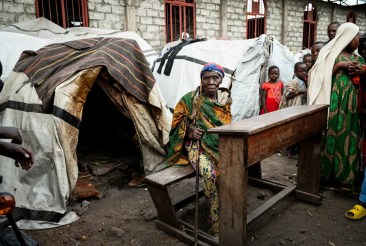
Tents upon tents
Outside, the displacement site is like a sea of tents. People live very close to each other. Privacy does not exist. This is barren, volcanic earth. There is no water here, nothing can grow.
The people living in the sites had previously lived off farming and were self-sufficient, but now they are entirely dependent on assistance from humanitarian aid organisations.
And these organisations lack funding.
Last stop?
Like the rest of us, Ndamukunzi will only journey through this world once.
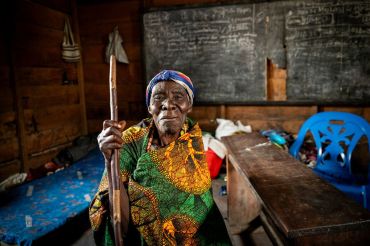
Now she must live here in this site for internally displaced people.
Will this be the last stop on her journey?
She continues:
“When I don’t have food, I can’t sleep either. There’s almost nothing to eat in the camp. We only get water. An aid organisation gave me a water jug, and I fill it with five litres of water at a time. I carry the jug to my tent myself. That’s as heavy as I can carry.
“The last time an aid organisation was here with food – I remember it was maize flour and rice – was in March 2023, almost four months ago. These days, I eat what others share with me.
“I have almost no teeth, and my mouth often hurts. So, I prefer to eat soft things like rice, maize, cabbage, fish and oil. Yesterday, I didn’t eat anything. I don’t know if I’ll get anything today either. I feel weak. It feels like I could die. People have died of hunger here.”
One of Ndamukunzi’s neighbours has got hold of cassava, a root vegetable.
Ndamukunzi says that this is not the first time she has been displaced.
“The first time, and I don’t remember exactly when, we went to Kibumba (also in North Kivu), where we stayed for a long time before returning home. They distributed maize flour, beans, oil and rice there. Each household received five litres of oil. At that time, there was no food shortage. We arrived here in Kanyaruchinya in March last year. When I say ‘we’, I mean myself, my son, his wife and their eight children. My husband fell ill and died in January last year.”
Ndamukunzi spends most of her days sitting on a school bench outside her tent.
“We go into Goma city to look for food, and we usually eat beans,” says 16-year-old Justine. She lives in a tent with her extended family, close to Ndamukunzi’s tent.
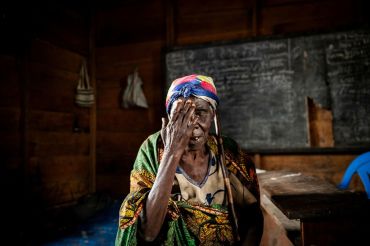
Her first life
Ndamukunzi closes her eyes.
When she opens them again, she smiles.
“When I was growing up, life was good. We cultivated the land. We had food and clothes. I went to school until Year 5. I wanted to continue my education, but the school was too far away and it was expensive.
“My father was dead by then. My uncle, in consultation with my mother, wanted me to get married. I was beautiful. I had many suitors. They all brought beer when they came visiting, as is customary. The man who became my husband also brought beer. The whole family was gathered, and everyone drank. That’s how the wedding ceremony was. Then we went to the church for a religious ceremony. And we were married.
“Beforehand, the older women had prepared me for what would happen, and they gave me advice on what to do. It was a happy day in my life. Everyone was happy. We cried a little too because it was an emotional event.
“For me, it was fine. I became pregnant quickly, and having a child was a great joy. I moved in with my in-laws.
“I truly loved my husband. He was a good man. He provided us with everything – clothes, food and protection. Plus, he was good-looking. He gave me eight children: six boys and two girls.
Now, I only have one son left. Fortunately, he has eight children.
Thank goodness.
Once again, we are many.
I have no friends here.
But I have my son and my grandchildren.
We are together.”
Flowers growing along the road.
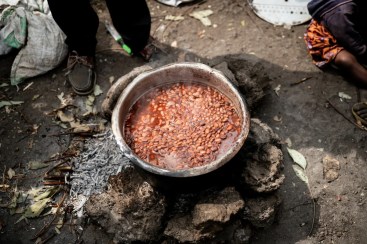
“We go into Goma city to look for food, and we usually eat beans,” says 16-year-old Justine. She lives in a tent with her extended family, close to Ndamukunzi’s tent.
No money – no help
As things stand, DR Congo is lacking about 70 per cent of what it needs in aid, according to the UN Refugee Agency. Humanitarian aid organisations have therefore had to significantly reduce support to people who have fled the violence in eastern DR Congo.
What the world does not see
Today, DR Congo constitutes one of the largest and most enduring humanitarian crises in the world, and the country is on the list of the world’s most neglected crises.
An astonishing 26.4 million people need assistance in 2023 – nearly a third of the population. DR Congo possesses vast deposits of minerals, ranging from gold and diamonds to cobalt and copper.
All of DR Congo’s natural resources, particularly minerals, have made the country highly attractive for foreign interests, from colonial times to the present day.
This has led to immense human suffering. Instead of prosperity, the civilian population has been left with war, abuses and poverty – and millions of people have been displaced.
It is said that there are at least seven international armed groups operating in DR Congo, in addition to all the other armed groups in the country. In the eastern part of the country alone, 150 armed groups have been identified.
In the eastern provinces of Ituri, North Kivu and South Kivu, more than 3.3 million people have been forced to flee their homes.
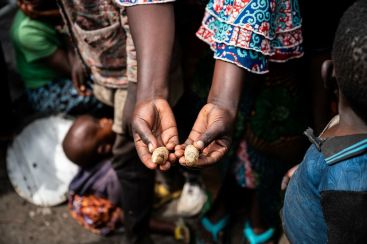
One of Ndamukunzi’s neighbours has got hold of cassava, a root vegetable.
Suffering from hunger, many attempt to return home after a while – despite the looming threat of violence. Many face the risk of being displaced again. Around 1.7 million people have returned home, and they also require assistance.
Pain
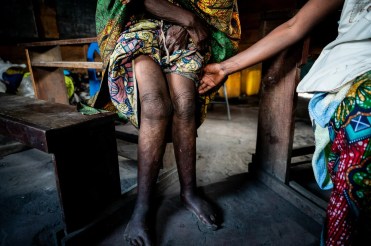
Ndamukunzi stands up slowly. She bends down, takes hold of the hem of her skirt and lifts it, exposing her bare knees.
She says:
“My knees hurt.”
She lets down her skirt again. And says:
“It hurts in my lower abdomen when I urinate, and I have to urinate often.”
She opens her mouth wide and points inside her nearly toothless mouth:
“My mouth hurts, too.”
Then she sits down calmly again. And adds:
“But above all, I am hungry.”
Ndamukunzi has pain in her knees.
Death
“Am I afraid of death?”
Ndamukunzi smiles broadly.
“No, dying is normal. I can die at any time. I am a Christian, and I leave it to God. One day, God will put an end to the terrible things that happen – it’s in God’s hands. He will judge us all.”
She laughs and claps her hands:
“Today, I’ve had a great day. Sometimes, kind words are more important than food. I feel happy.
“Now I’m going home to rest.”
Ongoing conflict and escalating violence means that DR Congo is facing one of the biggest internal displacement and humanitarian crises in the world right now. Almost 7 million people have been displaced as a result of conflict and violence.
The Norwegian Refugee Council (NRC) has been supporting displaced people in DR Congo since 2001. Last year, we assisted more than 370,000 people.
*SOURCE: Norwegian Refugee Council. Go to ORIGINAL: https://www.nrc.no/feature/2023/my-heart-beats-heavily/
2023 Human Wrongs Watch
Discover more from HUMAN WRONGS WATCH
Subscribe to get the latest posts sent to your email.
 Baher Kamal
 HUMAN WRONGS WATCH
Leave a comment