Human Wrongs Watch
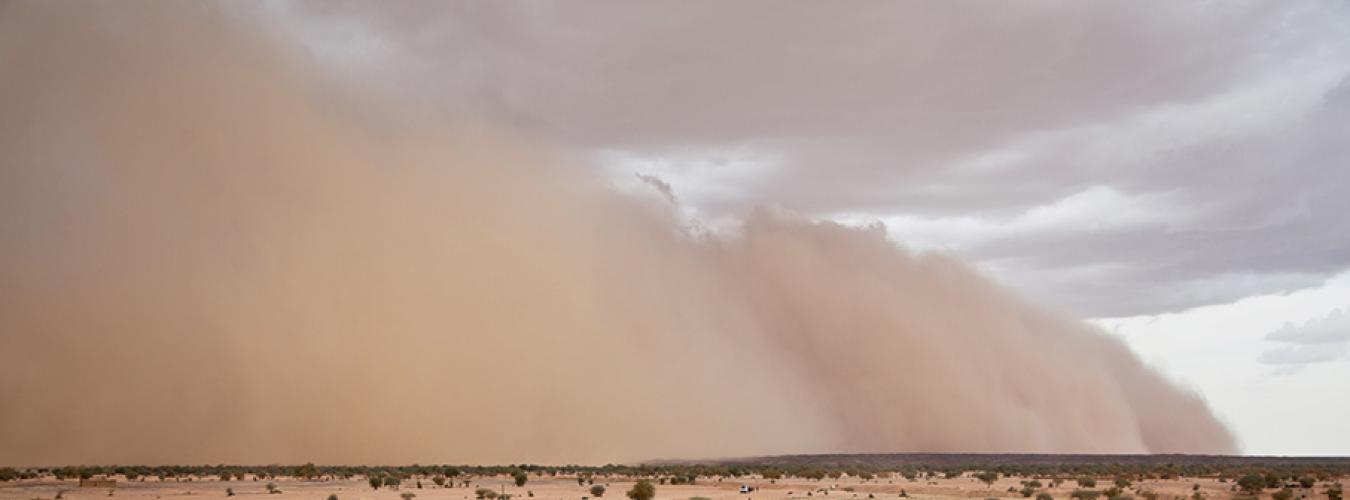
(United Nations)* — Some of the most intimidating sights in nature are rolling dark clouds of sand and dust that engulf everything in their path, a phenomenon that turns day into night and wreaks havoc everywhere from Northern China to sub-Saharan Africa.
Sand and dust storms (SDS) present a formidable and wide-spread challenge to achieving sustainable development in its economic, social and environmental dimensions.
They have become a serious global concern in recent decades due to their significant impacts on the environment, health, agriculture, livelihoods, and socio-economic well-being.
Sand and dust storms are an essential element of the Earth’s natural bio-chemical cycles, but are also caused in part by human-induced drivers, including climate change, and unsustainable land management and water use.
In turn, sand and dust storms contribute to climate change and air pollution.
Facts & Figures
- Approximately 2 million tonnes of sand and dust enter the atmosphere annually.
- SDS mostly occur in dry and desert regions, but can be carried long distances to impact regions much further away.
- Dust particles, circulated by SDS, provide nutrients to marine ecosystems, but can also contribute to coral mortality and hurricane formation.
- SDS can cause respiratory diseases, heart disorders, and eye and skin irritation and can also spread other diseases, such as meningitis.
- Aviation and ground transportation can be disrupted by SDS.
- Agricultural practices and productivity can be impacted by SDS, which can also contribute to desertification processes.
Source: UN Environment Management Group
Sand and dust storms’ impacts are felt in all regions of the world, both in developed and developing countries, and pose severe challenges to achieving 11 of the 17 Sustainable Development Goals, especially:
- SDG-2 — Goal 2: Zero hunger
- SDG-3 — Goal 3: Health
- SDG-6 — Goal 6: Water and sanitation
- SDG-8 — Goal 8: Economic growth
- SDG-11 — Goal 11: Cities
- SDG-13 — Goal 13: Climate action, and
- SDG-15 — Goal 15: Biodiversity forests and desertification.
At least 25 per cent of global dust emissions originate from human activities, and in some areas, desert dust has doubled in the 20th century.
The impact of this phenomena is difficult to control, as human activity in one part of the world can cause sand and dust storms in another region.
However, just as sand and dust storms are caused by human activities, these storms can also be reduced through human actions.
United Nations Coalition on Combating Sand and Dust Storms (UNCCD)
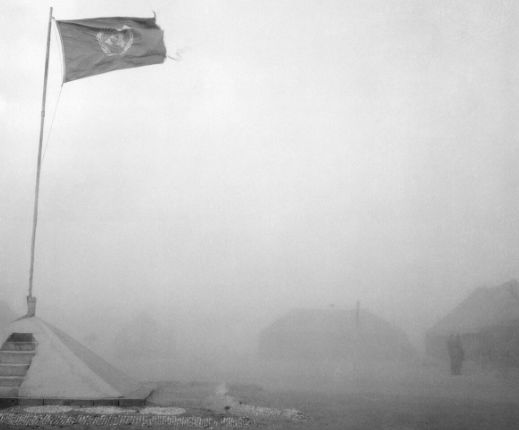
In response to several recent General Assembly resolutions on Combating sand and dust storms, United Nations Convention to Combat Desertification (UNCCD) Parties officially launched the UN Coalition on Combating Sand and Dust Storms, committing the UN System to a proactive approach to combat Sand and dust storms (SDS), and to enhance cooperation and coordination on SDS at global, regional and sub-regional levels.
The mandate of the UN Coalition on Combating SDS, as defined by the participating entities is as follows:
- Promote and coordinate a collaborative UN System response to SDS;
- Facilitate exchange of knowledge, data and best practices among Coalition members to promote effective and coherent actions on SDS across the UN system and beyond;
- Encourage and promote collaboration on initiatives and actions among members of the Coalition, including advocacy and funding initiatives;
- Facilitate dialogue and collaboration amongst affected countries and the UN system in addressing SDS issues collectively;
- Facilitate the capacity-building of Member States, raise their awareness and enhance their preparedness and response to SDS in critical regions.
Protecting People from Sand and Dust Storms (WMO)
World Meteorological Organization (WMO) informational video on Sand and Dust Storms and their effects on health.
Sand and Dust Storms Compendium
The aim of the Sand and Dust Storms Compendium is to provide information and guidance on how to assess and address the risks posed by sand and dust storms and plan actions to combat sand and dust storms. The Compendium brings together this information from a wide range of sources.
UNEP: Impacts of Sand and Dust Storms on Oceans
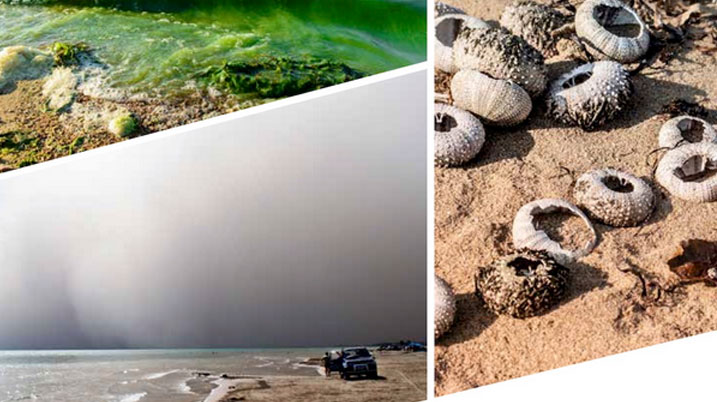
Each year, an estimated two billion tonnes of dust is raised into the atmosphere.
According to the report, Impacts of Sand and Dust Storms on Oceans: A Scientific Environmental Assessment for Policy Makers, even the smallest elements can have substantive effects on ecosystem functioning – and on the Earth system, at large.

Emission processes are affected by several soil features such as soil moisture, soil texture, surface crust, roughness elements and vegetation.
Once strong winds emit dust particles, fine dust particles are carried by turbulent diffusion and convection to higher tropospheric levels and then large-scale winds can transport them over long distances.
Dust particles in the atmosphere scatter and absorb solar radiation and modify clouds and their radiative and precipitation processes.
Click on the image for a larger view of the infographic. More information is available in the Summary for Decision Makers paper [PDF].
*SOURCE: The United Nations. Go to ORIGINAL: https://www.un.org/en/observances/day-of-combating-sand-and-dust-storms
2025 Human Wrongs Watch
Discover more from HUMAN WRONGS WATCH
Subscribe to get the latest posts sent to your email.
 Baher Kamal
 HUMAN WRONGS WATCH
Leave a comment