Human Wrongs Watch
By Rayya Almuheisen, Senior Communications Assistant | The International Organization for Migration*
 .
.Photo: IOM 2025
Displaced by relentless airstrikes and military orders, Salem fled south from Gaza City.
After weeks of displacement, he realized there was nowhere safe to go, so he returned to the only place that still felt like home – a pile of rubble surrounded by destruction.
“This used to be our neighborhood,” he says. “Now it feels like the middle of nowhere.”
From the wreckage, Salem salvaged what he could: a mattress for his children, a few kitchen items, and broken furniture.
“Even if all that’s left is wreckage, it’s still my home,” Salem says, standing tall on the rubble. For him, a home is more than just four walls – it is safety, identity and memory.

According to the Shelter Cluster, most tents and shelter materials distributed in Gaza have a lifespan of just three to six months.
Ongoing hostilities, constant movement, and extreme weather conditions quickly deteriorate these materials. Wear and water damage are common, leaving families exposed and unprotected.
This crisis has been compounded by successive waves of forced displacement, which often result in the loss or abandonment of already limited resources.
Despite several rounds of aid deliveries before the current blockade, urgent shelter needs remain critical throughout the Gaza Strip.
Entire neighborhoods have been flattened. Without landmarks, families like Salem’s rely on memory to identify what remains of their land. In the absence of formal boundaries, community trust is often the only proof of ownership.
With no electricity, Salem uses a solar panel to charge basic items. He walks several kilometres to fetch water, accompanied by a donkey he can no longer feed.
“He used to be twice this size,” he explains. “I can no longer afford barley, so I let him roam and eat whatever he can find.”
Despite his efforts to provide for his family, some challenges are now beyond his control.

A group of Palestinians works together to pitch a tent at a makeshift site, where several others wait to be set up nearby. Photo: IOM 2025
“What I can’t protect them from are the flies and mosquitoes,” he says. “We’re seeing illnesses we’ve never heard of, combined with malnutrition.”
During the full aid blockade, food has grown scarcer by the day. Salem and his family survive on crushed thyme and stale bread – whatever it takes to get them through the day.
For nearly 20 months, Palestinians in Gaza have endured staggering levels of suffering. According to the Shelter Cluster, more than 90 per cent of homes have been damaged or destroyed.
As of May, the Cluster estimated that 1.1 million people across the Gaza Strip were in need of emergency shelter support, while approximately 800,000 also required essential household supplies.
Displacement sites are dangerously overcrowded. Sanitation systems are failing, and safe water, hygiene, and basic services are nearly impossible to access.
Since the aid blockade began on 2 March 2025, hunger and malnutrition have worsened dramatically. The temporary ceasefire brought modest improvements, but they were quickly reversed.
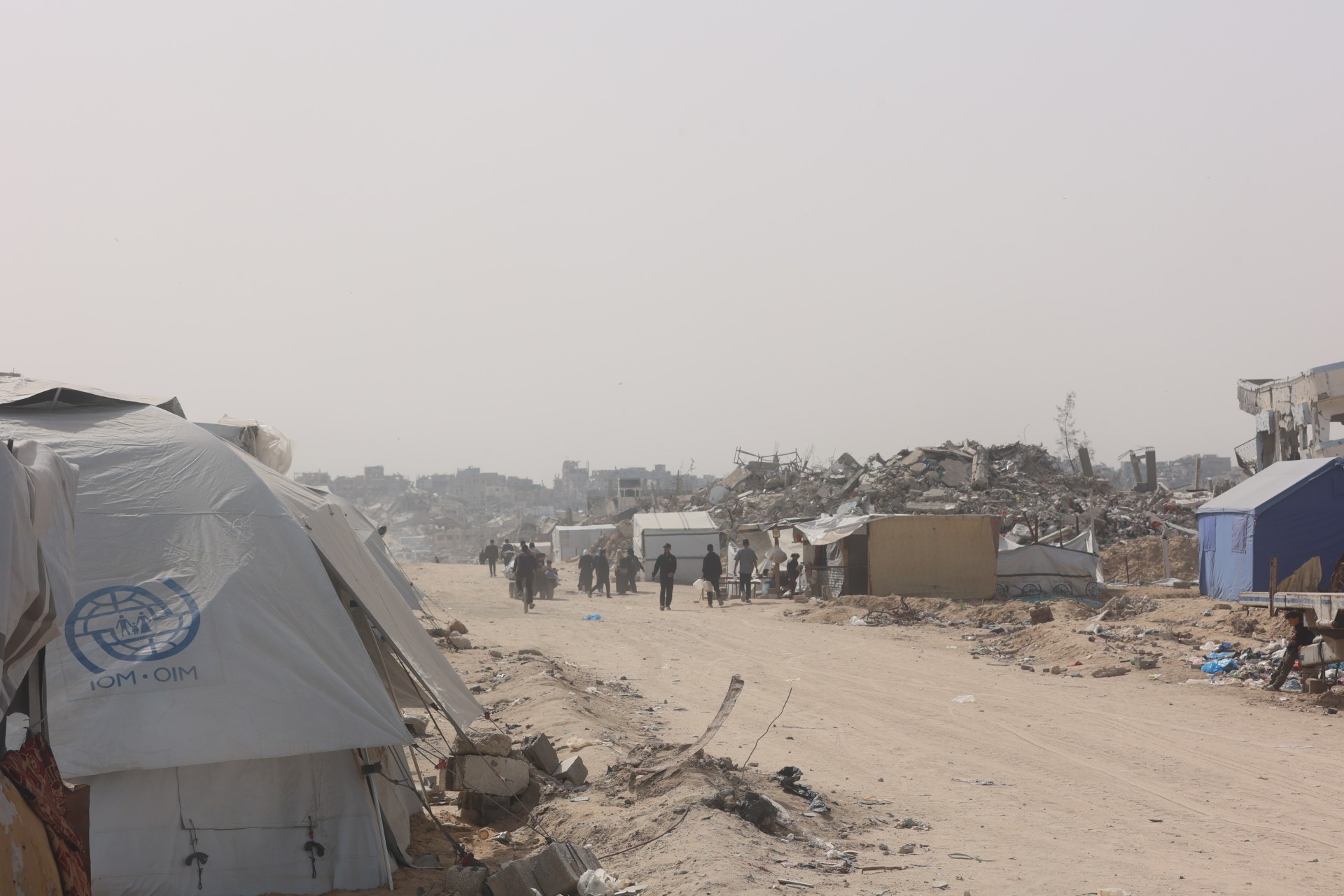
Families like Salem’s continue to face impossible choices. They watch their children fall sick and grow weaker. Even though a trickle of food, medicine, and aid began entering in the last week of May, the volume is nowhere near enough.
Lifesaving items, especially tents and hygiene supplies, remain blocked at entry points. Rapid, safe, and unimpeded aid delivery is urgently needed across Gaza to reach all civilians, wherever they are.
Salem remains on the rubble of his former home, charging a few basic items with his solar panel, walking for water, and trying to protect his children from hunger and illness. But some needs are simply too great to meet alone.
This story was written by Rayya Almuheisen, Senior Communications Assistant with IOM Gaza Response.
MORE:

Discover more from HUMAN WRONGS WATCH
Subscribe to get the latest posts sent to your email.
 Baher Kamal
 HUMAN WRONGS WATCH
Leave a comment