Human Wrongs Watch
By the International Organization for Migration (IOM)*
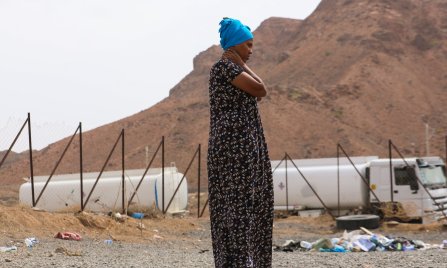 The Dewele Migration Response Centre in eastern Ethiopia offers returning migrants a moment of rest before they continue their journey home. Photo: IOM/Aïssatou Sy
Dewele, Ethiopia, 15 August 2025 – In the dry borderlands near Dewele in eastern Ethiopia, the air hangs heavy with heat as trucks thunder past, ferrying goods across the eastern corridor.
Amidst the dust, tired figures walk slowly beside the road, mostly young men, carrying nothing but a worn backpack, a bottle of water, and a stubborn belief that something better lies ahead.
Ibrahim* remembers that walk all too well – five days on foot across harsh terrain, each step marked by exhaustion and uncertainty.
Like many others, Ibrahim had heard whispers of job opportunities in Djibouti. With nothing left for him in Ethiopia after years of hardship, the promise of work across the border sounded like a chance to turn things around.
But the journey was not going to be easy. To reach the border in Galafi, he had to cover more than 500 kilometers. He set out with only a few biscuits, a bottle of water, and just 2,000 birr – about 15 USD – and a body determined to make it.
He crossed into Djibouti hoping for change. Instead, he found work that brought no reward. He scrubbed tables and swept floors in a café for eight months without seeing a single coin. Another job followed and another year passed. Two years in all, carried not by hope but by the kindness of strangers who were just as lost.
“I depended on help from fellow Ethiopians just to survive,” he says.
Now seated beneath the faint shade of a tin roof at IOM’s Migration Response Centre (MRC) in Dewele, he wraps his hands around a cup of water. The murmur of other men and women, like him, arriving with blistered feet and empty pockets, buzzes softly in the background.
The MRC, a modest compound, provides temporary refuge for returnees like Ibrahim. In the midday sun, dozens of migrants gather in the few patches of shade around the premises, seeking relief.
“I never expected this kind of help,” he says. “Here, I am offered food, clean water, clothes, and a place to rest.”
His voice carries a tiredness that runs deeper than exhaustion. He’s not looking for pity. Just a break. A place to sit and breathe. He had forgotten what it felt like to be cared for, with no strings attached.
He’s going back, he says. Back to farming, back to Wollo. “It’s all I know.”

In Dewele, eastern Ethiopia, near the border with Djibouti, trucks pass through daily along one of the region’s busiest trade routes. Photo: IOM/Aïssatou Sy
Nearby, Azmera*, a 25-year-old from North Shewa in Ethiopia’s Amhara region, waits quietly, clutching a worn cloth bag.
“I left my baby behind when I first set out,” she says, her voice heavy with a mother’s ache. “I never wanted to go far – just to Djibouti.”
Originally a farmer, Azmera left Ethiopia after violence and insecurity made life unbearable for her family.
Travelling with a smuggler and a small group of migrants, including five women, she arrived in Djibouti with no documents and very little money.
“I thought I could earn money and send it home,” she says. “I worked as a domestic helper, but they refused to pay me. They made me work and gave me nothing in return.”
After two long years, she’s now going back in Ethiopia.
“I can’t wait to finally see my child,” she says, smiling for the first time.
Azmera’s story is one of many. Between 25 April and 19 June this year, nearly 15,000 Ethiopian migrants returned through Dewele. Many arrive hungry, dehydrated, and in urgent need of care.

Along the road from Dire Dawa to Dewele, traces of migrants’ journeys remain: bags, shoes, and scattered belongings left behind. Photo: IOM/Aïssatou Sy
Of these, nearly 3,000 returnees, including pregnant and lactating women, unaccompanied children, and older persons, received support at IOM’s MRC in Dewele or were referred to the MRC in nearby Dire Dawa City.
Located along the Eastern route, these facilities provide a temporary lifeline: food, clean water, health care, and onward transportation support so that migrants can return home safely and with dignity.
But the MRC is not the end of the road. It’s a bridge, a place where interrupted journeys find a moment of respite and where stories like Azmera’s and Ibrahim’s remind us that behind every number is a person who once dreamed of greener pastures and now simply hopes to rebuild their life at home.
The MRCs across Ethiopia are supported by the Ministry of Foreign Affairs of the Netherlands through the COMPASS initiative, with additional funding from the Swedish International Development Cooperation Agency (Sida), Norway, Canada, and the European Union.
The facilities operate in close collaboration with the Government of Ethiopia, ensuring that the vital support provided to Ethiopian returnees and stranded migrants is delivered in a sustainable manner.
*Names have been changed to protect their identity
This story was written by Aïssatou Sy, Media and Communications Coordinator with IOM Ethiopia.
*SOURCE: the International Organization for Migration (IOM). Go to ORIGINAL: https://storyteller.iom.int/stories/ethiopias-edge-where-blistered-feet-rest-and-road-home-begins
2025 Human Wrongs Watch
Discover more from HUMAN WRONGS WATCH
Subscribe to get the latest posts sent to your email.
 Baher Kamal
 HUMAN WRONGS WATCH
Leave a comment