Human Wrongs Watch
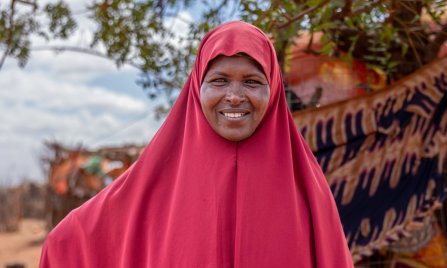 Huria stands among those leading efforts to restore the land and protect their homes from future floods. Photo: IOM 2025/Yusuf Abdirahman
For years, this small village in Somalia’s Middle Shabelle region, north of Mogadishu, was caught in a brutal cycle. Rains came hard and erratic, washing through the valley and tearing apart homes and fields.
Then, as the sky emptied and months of dry wind set in, sandstorms scoured the land, stripping away topsoil and erasing what little had survived the floods. The land grew bare, its decline accelerated by overgrazing and deforestation.
Today, residents say the cycle has been broken, not by luck but through a series of small, deliberate choices. With support from the International Organization for Migration (IOM) and Somali non-profit Shaqadoon, Harqabobe has spent recent seasons building defences that do not fight the water but work with it.
“Flood regulation structures were built to help reduce flooding along the wadi bank,” explains Mahdi, a community member who helped organize the works. The wadi, a usually dry riverbed that fills rapidly during heavy rain, often overflows and threatens nearby homes and farms.
These new structures now guide the water toward farmland, helping crops grow and keeping floodwaters away from homes. Where the valley once rushed with destructive force, it now carries life.
What happened next is what residents are most proud of. They joined the training and helped carry out the work themselves. After IOM’s initial support, Shaqadoon helped them plant a belt of drought-hardy trees between the village and the valley.
“We planted trees that didn’t even need watering,” says Mahdi. The new windbreak now softens the sandstorms that once battered their homes.
At the same time, residents gained new skills to protect their land and use natural resources wisely. “We learned about leadership, tree planting, wind control, and water management,” says Mahdi. “Now we know how to use water efficiently and prevent erosion.”
These lessons soon turned into action. Community members dug half-moon basins, semi-circular trenches that slow and absorb rainwater, helping to reduce runoff and erosion while improving soil moisture and crop yields.
They also began restoring vegetation with drought-resistant species that hold the silty soil in place.
With IOM and Shaqadoon’s support, a pilot site was built and fenced, using small channels called bioswales to capture rainwater and prevent soil erosion. These features help the land stay fertile and support new vegetation.
Just as intentional was the community process behind these works. Women, youth, and older persons all took part in the planning, ensuring decisions were made together.
What once caused disputes over water or land now brought them closer. In a place where one farmer’s water diversion could mean another’s drought, that collaboration made all the difference.
“We have high hopes that this project will help our community stay strong and protect our environment,” says Mohamed, a resident of Harqabobe. His words reflect what many in Harqabobe feel: a sense of relief after years of uncertainty.
“In the past, we always feared the floods would drive us away again. Now, we feel hope instead,” he adds.
In Harqabobe, people have learned to read the land and work with it. They observe how water flows, how wind shapes the soil, and how plants hold the earth together.
Their solutions are simple, with no walls or machines, only soil, roots, and hands guiding the valley’s force in a new direction.
The changes are easy to see. Floods still come, but people no longer meet the rain with fear. Water now spreads gently across the fields, helping crops grow.
The trees calm the wind and keep the dust down, and the half-moon basins hold enough moisture to carry the land through the dry season. Fields are no longer washed away and homes, once abandoned, now stand firm.
“Before, the wind carried away our soil, our homes, and our peace,” says Huria. “During the rains, floods swept everything away. But now, we’ve returned to the homes we once left. There is peace. There is stability. We believe the rains won’t bring fear anymore.”
This initiative also reflects a shift in how aid is delivered, investing in prevention rather than paying repeatedly for response.
In many areas hit by extreme weather, assistance often means rebuilding the same bridge or replacing the same seeds year after year. In Harqabobe, that cycle has been broken. Training turned residents into stewards. Earthworks turned floods into harvests.
The residents of Harqabobe still watch the sky, as everyone in the Horn of Africa does, with a mix of caution and hope.
However, their questions have changed. Instead of asking, “Will the flood come?” they now ask, “Where should we guide it?”
In that shift lies the village’s transformation. As Mohamed puts it, “Now there is hope again.”
This initiative was funded by the European Union and implemented by IOM in partnership with Shaqadoon.
This story was written by Yusuf Abdirahman, Communications Assistant, and Raber Aziz, Media and Communications Officer, with IOM Somalia.
*SOURCE: International Organization for Migration (IOM). Go to ORIGINAL: https://storyteller.iom.int/stories/village-somalia-learns-live-rain
2025 Human Wrongs Watch
Discover more from HUMAN WRONGS WATCH
Subscribe to get the latest posts sent to your email.
 Baher Kamal
 HUMAN WRONGS WATCH
Leave a comment