Human Wrongs Watch
By the International Organization for Migration*
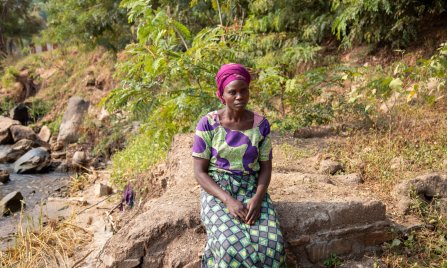
Alphonsine sits on the spot where her home once stood before the floods tore through her community in Rumonge. Photo: IOM 2025/Kenny B. Irakoze
“We woke up completely submerged and surrounded by water,” recalls Alphonsine. “We ran for our lives. A few days later, our house was gone – completely destroyed and swept away as if it had never existed. We lost everything.”
Alphonsine and her family fled in a hurry, finding refuge at a displacement site in Rumonge, where hundreds of other families had gathered after the floods.
“We had to leave our home and find somewhere safe. It wasn’t easy, but we managed to stay together,” she says.

That was the beginning of a new life marked by uncertainty. They lived in precarious conditions, without essential household items, clean water, sanitation, or adequate shelter, facing the daily struggles of displacement. It was September 2024.
Across Burundi, more than 102,000 people were forced from their homes as the floods swept through Rumonge and the provinces of Cibitoke, Bubanza, Kirundo, Makamba, and Bujumbura.
The floods were caused by El Niño, a recurring climate phenomenon whose effects are increasingly magnified by human-induced climate change.

As the floodwaters receded, another fear loomed – the risk of disease. With so many families crowded together and clean water scarce, the threat of waterborne illnesses like cholera and polio became real.
In response, the International Organization for Migration (IOM) in Burundi provided assistance to Alphonsine and other displaced families. The support included materials for shelter construction and repair, rental assistance, household items, hygiene kits, and protection services.
“Thanks to the support we received, we finally have a roof over our heads. We can sleep peacefully at night and keep clean. The children are happier because, even though we lost our home, life finally feels a bit normal again,” says Alphonsine.
IOM also provided mental health and psychosocial support to help families cope with the challenges of displacement. “Talking to Beatrice, one of the counsellors, helped me a lot,” says Alphonsine. “She gave me hope and the strength to keep going for my children, to believe that tomorrow will be better.”
A year after the floods, more than 60,000 people – including Alphonsine and her family – have received support. Women and girls were provided with dignity kits to help meet their basic hygiene needs
 Displaced families and members of host communities took part in cash-for-work activities to repair homes, build climate-resilient latrines, and earn an income. Hygiene promotion campaigns also helped prevent outbreaks of cholera, polio, and other waterborne diseases.
“Rebuilding isn’t just about repairing shelters,” says Irene Nahayo, Shelter and Non-Food Items Project Manager. “It’s about helping people regain their sense of safety and dignity and improving their living conditions after so much loss.”
But a year later, several provinces continue to bear the impact of displacement. More than 89,000 people remain uprooted by the floods, most of them women and children. Climate-related disasters now account for 92 per cent of all displacements in Burundi.
According to IOM’s Displacement Tracking Matrix, over 90 per cent of displaced families are hosted by already vulnerable communities, where access to safe water, sanitation, and basic services is extremely limited.
With the new rainy season underway, the risks are rising once again. Families without safe shelter or clean water face greater threats of waterborne diseases, renewed displacement, and the loss of their livelihoods.
Humanitarian actors have identified priority needs amounting to USD 61.1 million to strengthen emergency response, expand shelter and protection assistance, and build resilience in disaster-prone areas.
Long-term investment in climate adaptation and disaster risk reduction remains vital to reducing vulnerabilities and preventing future displacement.

An IOM staff member assesses the needs of displaced families to ensure they receive timely and appropriate assistance. Photo: IOM 2024/Alexander Bee
Today, Alphonsine and her children sleep safely under a roof. They laugh, play, and dream – as every family should. “Life finally feels normal again,” she says. “We’ve come a long way since that night. My children are safe, and that’s what matters most.”
Yet for thousands of families still displaced – and for those who may be forced to flee again – normal life remains out of reach. With continued support, they too can rebuild, recover, and find stability in the face of an uncertain future.
The emergency response to the El Niño floods in Burundi was made possible thanks to the generous support of the Government of Japan, the German Federal Foreign Office, the UN Central Emergency Response Fund (CERF), and the Government of the Republic of Korea.
This story was written by Kenny B. Irakoze, Communications Assistant with IOM Burundi.
*SOURCE: International Organization for Migration. Go to ORIGINAL: https://storyteller.iom.int/stories/night-floods-took-everything-mother-burundi
2025 Human Wrongs Watch
Discover more from HUMAN WRONGS WATCH
Subscribe to get the latest posts sent to your email.
 Baher Kamal
 HUMAN WRONGS WATCH
Leave a comment