1 April 2019 (UN Environment)* — When an entrepreneur designs, makes and markets handbags made of donkey skin, and they become hugely popular, that’s good for business and employment, right? But if the donkey leather is sourced from developing countries with weak environmental laws, what is the socio-economic and environmental impact?
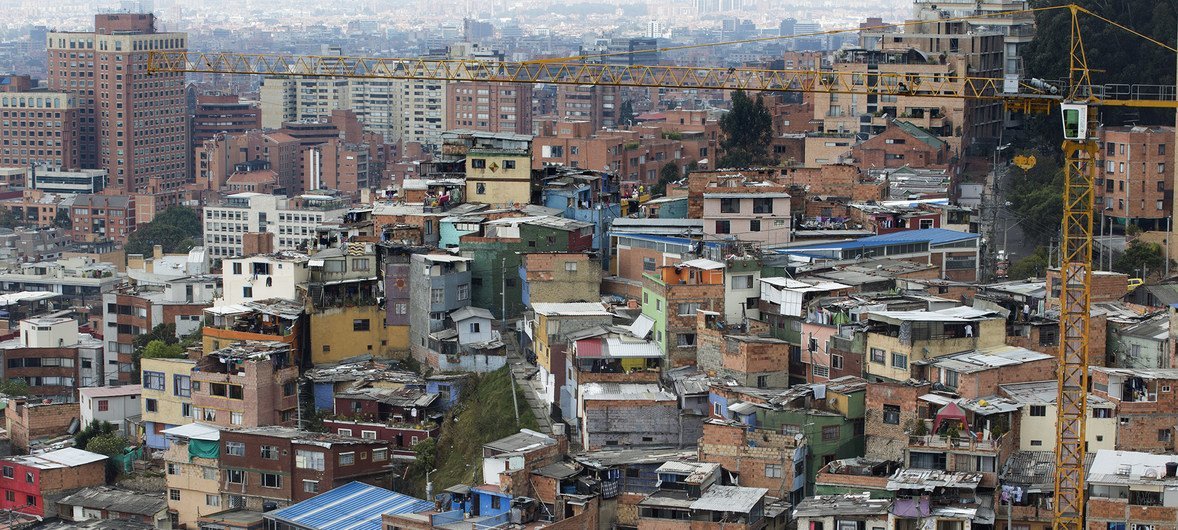
The United Nations is highlighting the important role that population trends play in promoting sustainable development, during the annual Commission on Population and Development, which began at UN Headquarters in New York on Monday [1 April 2019].
Dominic Chavez/World Bank | A view of the city of Bogotá, Colombia.| Photo from UN News.
This year’s Commission is also an opportunity to take stock and review progress made since the landmark International Conference on Population and Development (ICPD), which took place 25 years ago in the Egyptian capital, Cairo.
It takes up to 7,500 litres of water to make just one pair
It takes around 7,500 litres of water to make just one single pair of jeans | Photo by Wall Street International.
1 April 2019 (Wall Street International)* — Paris, Milan, New York, Tokyo… These are just some of the world’s most prestigious fashion catwalks.
There, and elsewhere, perfectly – and often unrealistically – silhouetted young women and men graciously parade to impress elite guests and TV watchers with surprising, fabulous creativity of the most renowned fashion designers and dressmakers.
If you are able read just one book in 2019, I urge it to be Joan Mellen’s Blood in the Water: How the U.S. and Israel Conspired to Ambush the USS Liberty.
Richard Falk
The author on the basis of meticulous research probes every detail to establish beyond a shadow of a doubt that the sinking of USS Liberty in the midst of the 1967 War is the greatest moral and political scandal in all of American history.
In what was long described as a ‘mistake’ or ‘accident’ Israeli planes and submarines attacked the Liberty, killing 34, wounding 174 American naval personnel.
Subsequent critical writing had established convincingly that the United States Government refused to authorize an inquiry that would have established that Israel deliberately attacked the ship of its ally.
Does history repeat itself? Is it cyclic, or is it unidirectional? Certainly many aspects of history are repetitive – the rise and fall of empires, cycles of war and peace, cycles of construction and destruction.
But on the other hand, if we look at the long-term history of human progress, we can see that it is clearly unidirectional.
An explosion of knowledge has created the modern world. Never before has the world had a population of 7 billion people, to which a billion are added every decade.
1 April 2019 (Norwegian Refugee Council)* — Overcrowded displacement camps coupled with a lack of basic sanitation facilities and hygiene will cause another cholera outbreak in northeast Nigeria if action is not taken now to prevent it, warns the Norwegian Refugee Council (NRC).
.
Photo: Chima Onwe/NRC
A record high number of 10,000 cases of cholera was recorded in northeast Nigeria in 2018, with more than 175 registered deaths, although the actual number may be higher.
29 March 2019 (UN Environment)* — You just woke up, and step into the shower, letting the water flow gently to wake you up and help you relax into the new day. Alas, your spa-like experience has a cost: you’ve just flushed 95 litres of drinking water straight down the drain.
We start and end our days wasting vast amounts of water, washing our face, teeth and bodies. With one shower of about 10 minutes a day, an average person consumes the equivalent of over 100,000 glasses of drinking water every year.
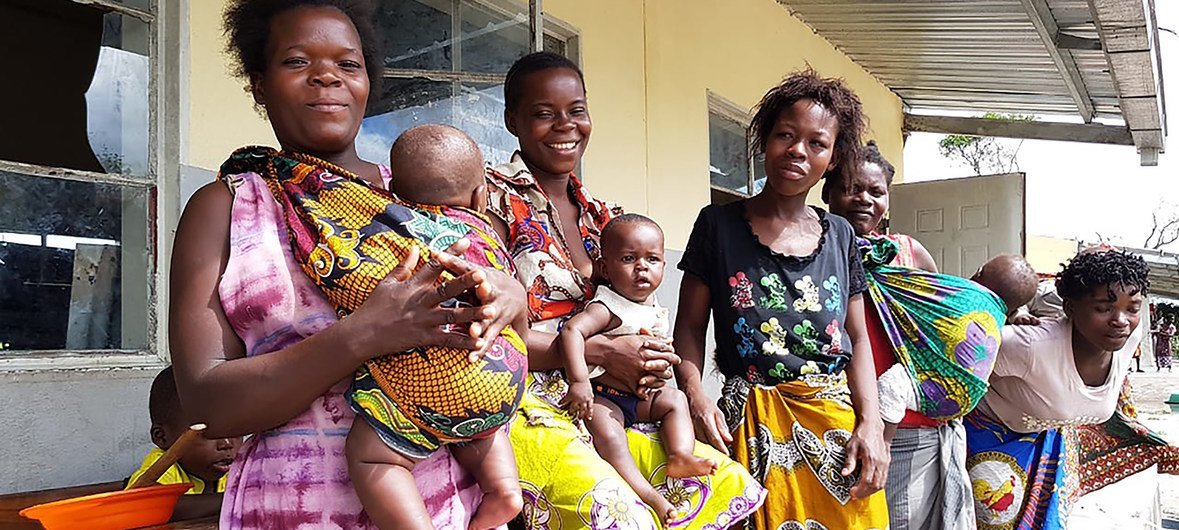
As the full extent of destruction caused by Cyclone Idai across southern Africa continues to be assessed, the United Nations Population Fund (UNFPA) said on Wednesday [27 March 2019] it was in “a race against time” to protect women who bore the brunt of the storm as they tried to save their households and livelihoods.
OCHA/Rita Maingi | Displaced women and their babies in Beira, the port city in Mozambique that was slammed by Cyclone Idai.
.UNFPA Representative in Mozambique, Andrea Wojnar, said their main challenge was “to provide women and adolescent girls, especially those who are pregnant and lactating, with lifesaving sexual and reproductive health services”.
26 March 2019 (UN Environment)* — Walk into pretty much any corner shop, market or supermarket in the world, and there is one product you are guaranteed to find: rice.
Inexpensive, filling and versatile, rice is a daily staple for around half of the world’s population, accounting for 19 per cent of dietary energy globally.
But, cheap as rice is, there is a higher price to pay.
A single kilo of rice needs an average 2,500 litres of water to produce; in fact, rice production uses over a third of the world’s irrigation water. Moreover, rice contributes to climate change, with methane emitted by flooded paddy fields responsible for 10 per cent of total global methane emissions.





 HUMAN WRONGS WATCH