7 September 2020 (WMO)* — The first comprehensive assessment of where the Earth’s excess heat is accumulating has been released by the Global Climate Observing System, co-sponsored by the World Meteorological Organization, Intergovernmental Oceanographic Commission-UNESCO, International Science Council and United Nations Environment Programme.


10/09/2020
Plants: You Owe them Your Life

Plants don’t just look pretty – they are the source of 98 percent of the air we breathe and 80 percent of the food we eat. ©FAO/Giuseppe Bizzarri
(FAO)* — Plants aren’t just a nice addition to your windowsill: they are the source of 98 percent of the air we breathe and 80 percent of the food we eat. Sadly, we often forget how much we owe them. Neglecting plant health can have devastating results, not just for plants themselves, but also for humans and our environment.
read more »
08/09/2020
Most Grateful!
Human Wrongs Watch
Dear Friends, Colleagues,
Human Wrongs Watch is sincerely grateful for your patience and understanding as well as the very kind good wishes that so many friends and colleagues have been expressing.

These generous good wishes did work as the eyesight surgeries have been successful.
While recovering slowly, Human Wrongs Watch has today 8 September 2020 started resuming its provision of “unseen” news and views.
And it will gradually continue doing so.
Thank you very much indeed!
Related:
Apologies!
2020 Human Wrongs Watch

08/09/2020
Escalating Oil and Gas Exploration Game

African oil in Bunyoro-Kitara | Image from Wall Street International.
7 September 2020 (Wall Street International)* — The African continent is home to five of the top 30 oil-producing countries in the world, which means it accounted for more than 7.9 million barrels per day in 2019 (about 9.6% of world output).
read more »
23/08/2020
Apologies!
Dear Friends, Colleagues,
.
Just to greet you and to kindly ask you to please bear with Human Wrongs Watch for not having been able to regularly update its services as a source of “unseen” news and views.
.
Human Wrongs Watch is a one-old-man-band, who has to undergo a surgery in both eyes.
.
This voluntary, non-commercial, non-profit, advertising-free service will resume soon.
.
With sincere appreciation for you kind understanding.
2020 Human Wrongs Watch
.
20/07/2020
Filmmaker Michael Moore Voices Support for Cuba’s Doctors
The Fahrenheit 9/11 director lauded Cuba’s medical professionals for their collaborative efforts around the world.
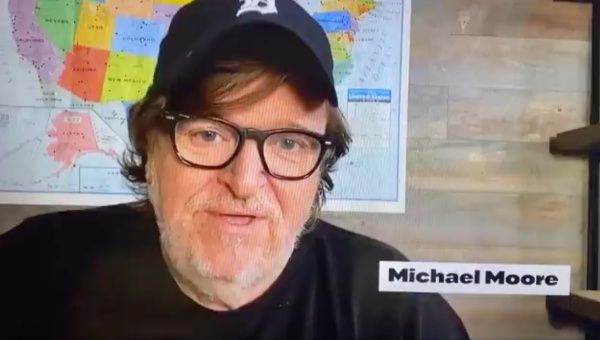 Filmmaker Michael Moore sends a message to Concert for Cuba. July 18, 2020. | Photo: Twitter / @JoseRCabanas
19/07/2020
First Person: COVID-19 Stories from the World of Work
Human Wrongs Watch
By ILO – International Labour Organization*
The COVID-19 pandemic has changed our world in ways we could hardly have imagined. Everyone has been affected and everyone has a story to share. At the International Labour Organization, we wanted to hear first-hand from people in the world of work. So, we contacted them and asked: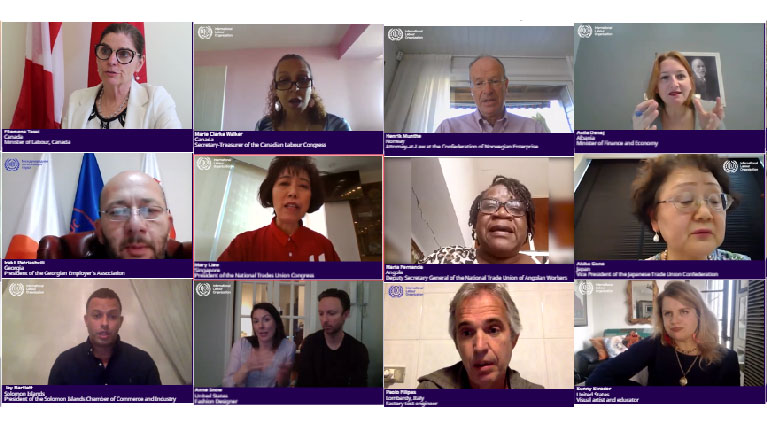
How has the virus affected their work?
How are their countries responding?
What have they learned from this experience so far?
We spoke to government officials, business owners and essential workers, those working from home and those who have lost their jobs, young people just starting their first job and retirees-turned-volunteers. Their stories paint a gripping picture of how COVID-19 has affected the world of work and what the response has been.
read more »
13/07/2020
The “Me” Generations – Can “Me” Become “We”?

A Green-Brown-Black New Deal could be the first step to help America heal | Image from Wall Street International.
.
We might even consider completing the French revolution, giving equality and fraternity the same priority as individual freedom (Prilleltensky 2020). We may find our lost morality and build community (Brooks 2020). Let us try to understand how the me generations evolved over the last 60 years.
read more »
 HUMAN WRONGS WATCH