We, in the United States, have yet to realize both the futility and immense consequences of war even as we develop, store, sell, and use hideous weapons. The number of children killed is rising.
Kathy Kelly
At 9:30 in the morning of March 26, the entrance to a rural hospital in northwest Yemen, supported by Save the Children, was teeming as patients waited to be seen and employees arrived at work.
Suddenly, missiles from an airstrike hit the hospital, killing seven people, four of them children.
Jason Lee of Save the Children, told The New York Times that the Saudi-led coalition, now in its fifth year of waging war in Yemen, knew the coordinates of the hospital and should have been able to avoid the strike. He called what happened “a gross violation of humanitarian law.”
1 April 2019 (UN Environment)* — When an entrepreneur designs, makes and markets handbags made of donkey skin, and they become hugely popular, that’s good for business and employment, right? But if the donkey leather is sourced from developing countries with weak environmental laws, what is the socio-economic and environmental impact?
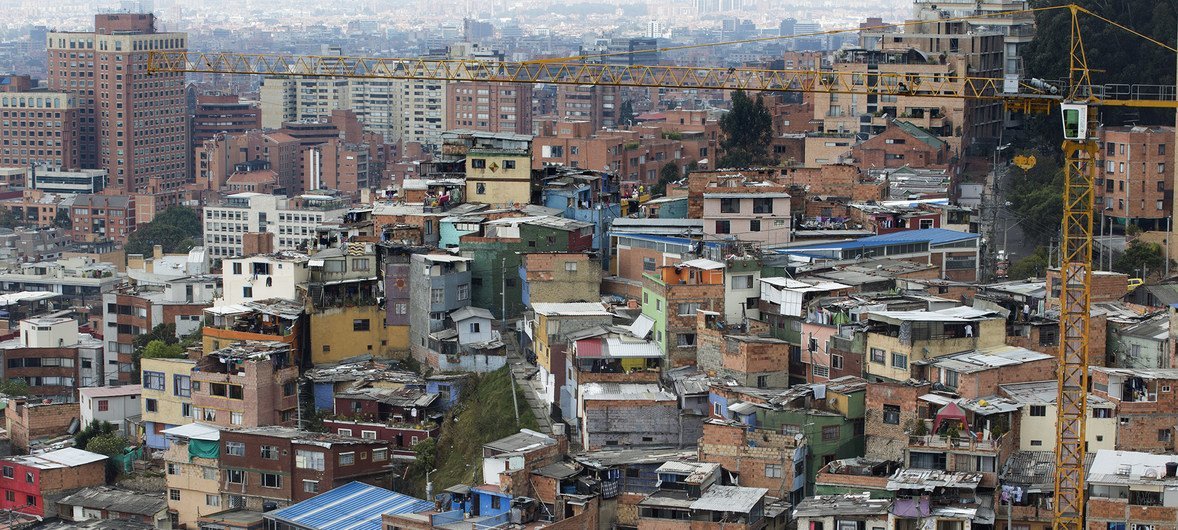
The United Nations is highlighting the important role that population trends play in promoting sustainable development, during the annual Commission on Population and Development, which began at UN Headquarters in New York on Monday [1 April 2019].
Dominic Chavez/World Bank | A view of the city of Bogotá, Colombia.| Photo from UN News.
This year’s Commission is also an opportunity to take stock and review progress made since the landmark International Conference on Population and Development (ICPD), which took place 25 years ago in the Egyptian capital, Cairo.
It takes up to 7,500 litres of water to make just one pair
It takes around 7,500 litres of water to make just one single pair of jeans | Photo by Wall Street International.
1 April 2019 (Wall Street International)* — Paris, Milan, New York, Tokyo… These are just some of the world’s most prestigious fashion catwalks.
There, and elsewhere, perfectly – and often unrealistically – silhouetted young women and men graciously parade to impress elite guests and TV watchers with surprising, fabulous creativity of the most renowned fashion designers and dressmakers.
Does history repeat itself? Is it cyclic, or is it unidirectional? Certainly many aspects of history are repetitive – the rise and fall of empires, cycles of war and peace, cycles of construction and destruction.
But on the other hand, if we look at the long-term history of human progress, we can see that it is clearly unidirectional.
An explosion of knowledge has created the modern world. Never before has the world had a population of 7 billion people, to which a billion are added every decade.
29 March 2019 (UN Environment)* — You just woke up, and step into the shower, letting the water flow gently to wake you up and help you relax into the new day. Alas, your spa-like experience has a cost: you’ve just flushed 95 litres of drinking water straight down the drain.
We start and end our days wasting vast amounts of water, washing our face, teeth and bodies. With one shower of about 10 minutes a day, an average person consumes the equivalent of over 100,000 glasses of drinking water every year.
RIO DE JANEIRO, Mar 29 2019 (IPS)* – Two military-inspired initiatives are leading Brazil’s new government, which includes a number of generals, down the path of mega-projects, which have had disastrous results in the last four decades.
Aerial image of the area where the third nuclear power plant is to be built in Angra, next to the Angra 1 and Angra 2 plants, in a coastal area near the city of Angra dos Reis, south of Rio de Janeiro, in southeastern Brazil. Credit: Divulgação Eletronuclear
26 March 2019 (UN Environment)* — Walk into pretty much any corner shop, market or supermarket in the world, and there is one product you are guaranteed to find: rice.
Inexpensive, filling and versatile, rice is a daily staple for around half of the world’s population, accounting for 19 per cent of dietary energy globally.
But, cheap as rice is, there is a higher price to pay.
A single kilo of rice needs an average 2,500 litres of water to produce; in fact, rice production uses over a third of the world’s irrigation water. Moreover, rice contributes to climate change, with methane emitted by flooded paddy fields responsible for 10 per cent of total global methane emissions.
30 March 2019 — While male circumcision is spread mainly among Muslim and Jews communities, and it is apparently accepted by some medical spheres, more than 200 million child-girls have already fallen prey to a dangerous practice, which is carried out in the name of traditions or even religions: Female Genital Mutilation (FGM).
Fatima, 7, sits on a bed in her home in Afar region, Ethiopia. She was subjected to FGM/C when she was 1 year old. Photo: UNICEF/ Holt
Such a human rights violation is not legally typified as a “crime”. Furthermore, it is far from being stopped—in fact some 70 million more girls are right now at risk of being mutilated by the year 2030.




 HUMAN WRONGS WATCH