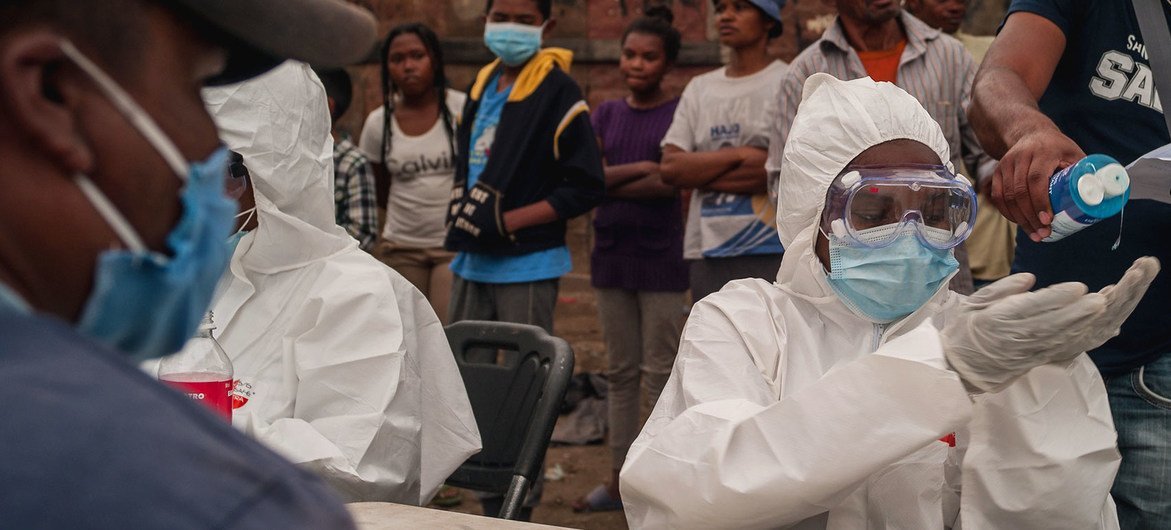
(UN News)* — A surge in demand for medical products to combat COVID-19 has led to a jump in the trafficking of substandard and faulty merchandise, according to new UN research published on 8 July 2020.
World Bank/Henitsoa Rafalia | Health workers in Madagascar test citizens for COVID-19.
“Health and lives are at risk with criminals exploiting the COVID-19 crisis to cash in on public anxiety and increased demand for PPE and medications”, said Ghada Waly, Executive Director of the UN Office on Drugs and Crime (UNODC).
Among its countless other impacts, the coronavirus has further highlighted the shortcomings in regulatory and legal frameworks aimed at preventing the manufacturing and selling of these products, points out the UNODC research brief, entitled “COVID-19-related Trafficking of Medical Products as a Threat to Public Health”.
(UN News)* — Annual global temperature is likely to be at least 1°C warmer than pre-industrial levels in each of the coming five years, putting globally agreed climate change targets in jeopardy, new data from the World Meteorological Organization (WMO) reveals.
UNICEF/Pirozzi | An 11-year-old boy finds relief from the summer heat by playing in a fountain in a historic part of the city of Samarkand, Uzbekistan. (file)
The prediction is among the findings in the UN agency’s latest Global Annual to Decadal Climate Update, released on 8 July 2020 in Geneva, which also shows that temperature could exceed 1.5°C in at least one year between now and 2024.
Geneva, 9 July 2020 (WMO)* – The annual mean global temperature is likely to be at least 1° Celsius above pre-industrial levels (1850-1900) in each of the coming five years (2020-2024) and there is a 20% chance that it will exceed 1.5°C in at least one year, according to new climate predictions issued by the World Meteorological Organization (WMO).
The Global Annual to Decadal Climate Update, led by the United Kingdom’s Met Office, provides a climate outlook for the next five years, updated annually.
8 July 2020 (WMO)* — June 2020 was just 0.01°C below the record-breaking temperatures of June 2019, with exceptional heat in Arctic Siberia, according to the Copernicus Climate Change Service (C3S). Globally, temperatures last month were 0.53°C warmer than the average June from 1981-2010.
Over Arctic Siberia, average temperatures reached as high as 10 °C above normal for June, fuelling severe wildfires. During both June and for the last 12 months, Siberia stands out as the region with the largest anomalies.
UNITED NATIONS, Jul 8 2020 (IPS)* – The coronavirus—which has claimed the lives of over 538,000 people and infected more than 11.6 million worldwide—has destabilized virtually every facet of human life ever since its outbreak in late December.
Credit: United Nations
Providing a grim economic scenario of the devastation caused by the pandemic– including rising poverty, hunger and unemployment– UN Secretary-General Antonio Guterres warned last week of the possibility of an even worse disaster: the risks of bioterrorist attacks deploying deadly germs.
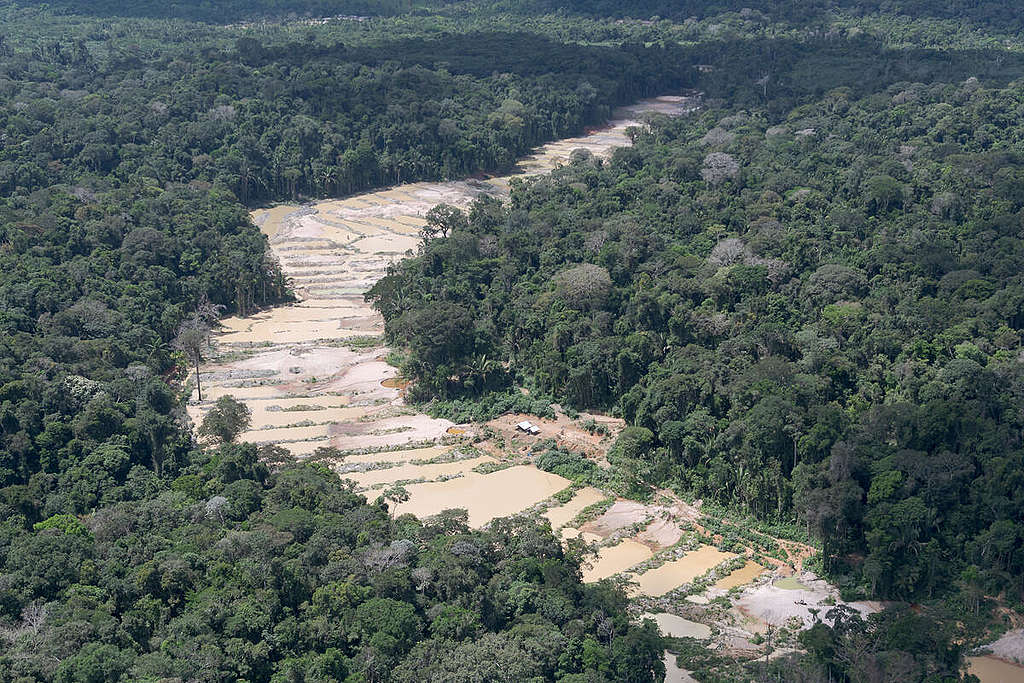
The rampant spread of the coronavirus in Brazil has already taken the lives of more than 57 thousand people. Meanwhile, illegal miners are going further and further into Indigenous lands in the Amazon, threatening not only the forest, but also exposing Indigenous People to COVID-19.
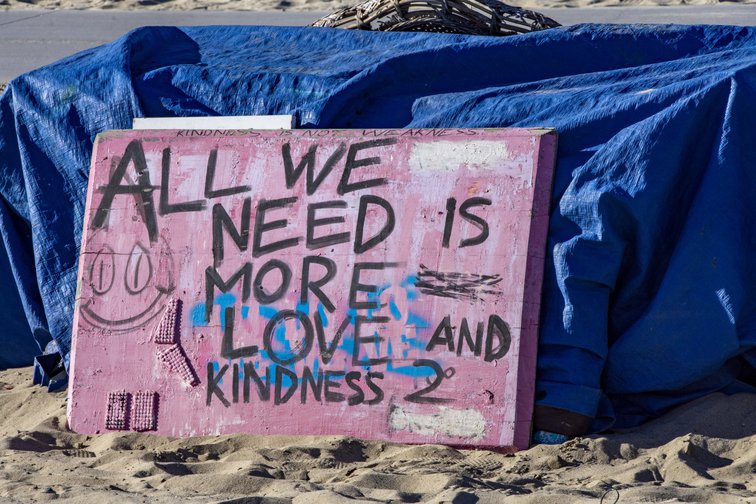
“Can we dare to think people are kind, and shape organisations around this view?”
7 July 2020 (openDemocracy)* — That’s the question Rutger Bregman examines in his latest book Humankind, and it’s one that anyone involved in youth and community work like me wrestles with on a daily basis. But is Bregman’s optimistic analysis grounded in reality?
To succeed, the struggle against racism needs to be understood in the context of the struggle against the culture of war.
In my history of the culture of war, I quote Malcolm X at length:
“”Book after book showed me how the white man had brought upon the world’s black, brown, red, and yellow peoples every variety of the sufferings of exploitation. I saw how since the sixteenth century, the so-called “Christian trader” white man began to ply the seas in his lust for Asian and African empires, and plunder, and power… First, always “religiously,” he branded “heathen” and “pagan” labels upon ancient non-white cultures and civilizations. The stage thus set, he then turned upon his non-white victims his weapons of war.”
SYDNEY and KUALA LUMPUR, Jul 7 2020 (IPS)* – In his early February annual State of the Union address, US President Donald Trump typically hailed his own policies for increasing wages and jobs to achieve record low US unemployment. Directly appealing to labour for a second term, Trump claimed exclusive credit for the US “blue-collar boom”.
Anis Chowdhury
‘Blue-collar boom’
During his previous two State of the Union speeches, Trump also directly appealed to blue-collar Americans who put him in the White House in November 2016.
As Trump claims manufacturing workers have been the main beneficiaries of his economic policies, including his trade and other policies, this seemed likely to dominate his re-election campaign.
In fact, US manufacturing growth had slowed to its lowest level in August 2019 when the purchasing managers’ index fell for the first time since September 2009. Despite his bombast, Trump has failed to reverse the continuing decline in manufacturing’s share of GDP.
By Sarah Schafer in New York and Matthew Mpoke Bigg in London. With contributions from Kristy Siegfried in Oxford, UK, and Gabriella Reis in Brasília. |UNHCR*
The police brutality that sparked protests in the United States and beyond reminds some refugees of the bigotry they fled — and sometimes still encounter in places they now call home. Here are some of their voices.






 HUMAN WRONGS WATCH