(United Nations)* — The International Day of the Tropics (29 June) celebrates the extraordinary diversity of the tropics while highlighting unique challenges and opportunities nations of the Tropics face. It provides an opportunity to take stock of progress across the tropics, to share tropical stories and expertise and to acknowledge the diversity and potential of the region.
.
The Tropics account for 40 per cent of the world’s total surface area and are host to approximately 80 per cent of the world’s biodiversity and much of its language and cultural diversity. Photo: FAO/IPPC
The Tropics are a region of the Earth, roughly defined as the area between the tropic of Cancer and the tropic of Capricorn. Although topography and other factors contribute to climatic variation, tropical locations are typically warm and experience little seasonal change in day-to-day temperature.
Report Highlights Shortcomings in Recruitment Practices and Accountability
25 June 2020 (Human Rights Watch)* — Uzbekistan has made important strides in reducing the use of forced labor in its cotton sector but has yet to eliminate it completely, according to new research released this week.
Uzbek Forum, an international nongovernmental organization, investigated six regions of Uzbekistan to assess the prevalence of forced labor in the 2019 cotton harvest.
Two independent human rights activists also conducted interviews and fact-finding missions in two other regions.
They found the central government continues to be involved in mobilizing employees of public institutions and enterprises to work on cotton farms, with the fear of job or benefit loss or other reprisals if they refuse.
(UN News)* — The decision by the United States to authorize sanctions targeting staff at the International Criminal Court (ICC) is “a direct attack to the institution’s judicial independence”, UN human rights experts said on Thursday [25 June 2020].
Washington announced this month that it would launch an economic and legal offensive against ICC officials investigating alleged war crimes committed by all sides in the conflict in Afghanistan, including US troops.
“The implementation of such policies by the US has the sole aim of exerting pressure on an institution whose role is to seek justice against crimes of genocide, war crimes, crimes against humanity, and the crime of aggression”, saidDiego García-Sayán, UN Special Rapporteur on the independence of judges and lawyers, speaking on behalf of the 34 experts.
KUALA LUMPUR, Malaysia, Jun 25 2020 (IPS)* – Katharina Pistor’s recent book, The Code of Capital: How the law creates wealth and inequality shows how law has been crucial to the creation of capital, and how capital continues to survive, evolve and enhance its ability to ‘make money’, or secure wealth legally, i.e., through the law.
Legal coding makes capital
In her magnum opus, the Columbia Law School professor explains how legal systems create capital and how law enables wealth creation through what she terms ‘legal coding’.
Notions of property and property rights have changed over the ages, reflecting and redefining social and economic relations more generally.
Pistor sees ‘legal coding’ — e.g., via collateral, trust, corporate governance, bankruptcy, contracts and other property laws — as means for assets to become capital, creating wealth for their holders. When “coded in law”, even “dirt” can become a valuable asset, capable of enriching its owners.
The internet and new digital tools are being manipulated as never before to infringe on people’s right to free assembly, the UN’s top rights official said on Thursday [25 June 2020], in a call for a moratorium on the use of facial recognition technology during peaceful demonstrations.*
Unsplash/Ian Usher | A drone flies over Mount Tamalpais in the United States.
Amid global protests against systemic racism, corruption and economic woes exacerbated by the COVID-19 crisis, High Commissioner for Human Rights Michelle Bachelet also expressed concern about the use of non-lethal weapons against demonstrators.
(UN News)* — The COVID-19 pandemic is not just a health emergency, but a multi-dimensional crisis for Afghanistan, dealing its people a painful blow just as Kabul and the Taliban prepare for peace talks in Qatar, the top UN official in the country says.
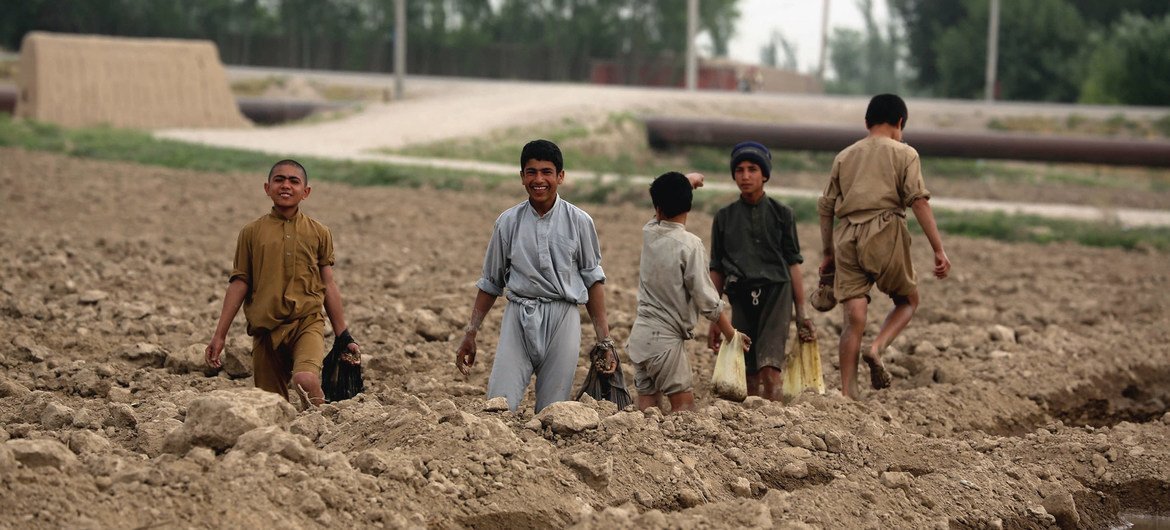
World Bank/Ghullam Abbas Farzami | Child farmers help to level fields in Balkh Province, Afghanistan.
Deborah Lyons, Head of the United Nations Assistance Mission in Afghanistan (UNAMA), told the Security Council on Thursday [25 June 2020] that the novel coronavirus outbreak is casting “a huge shadow” over Afghan daily life.
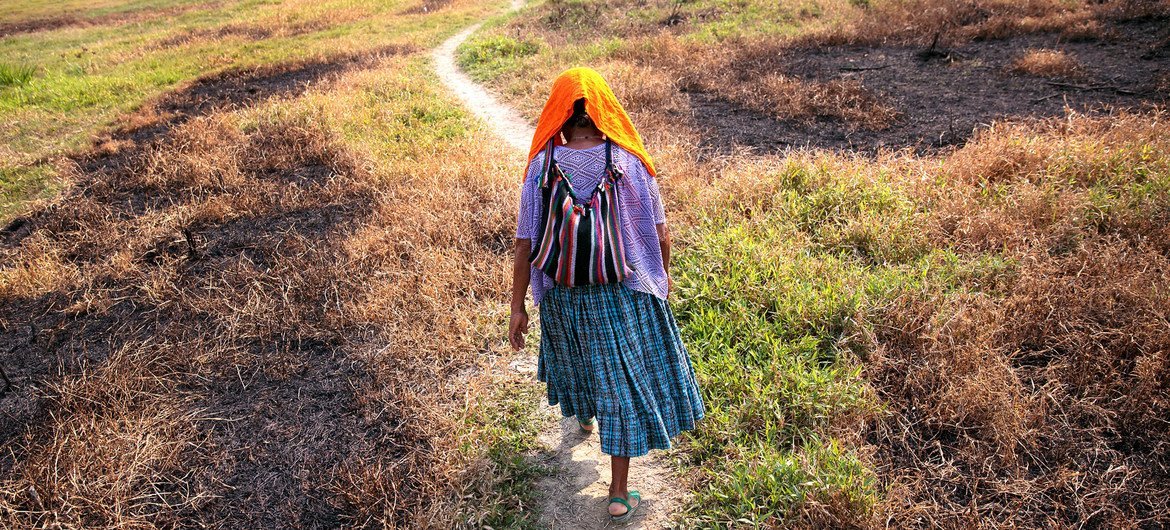
UN Women/Ryan Brown | After surviving military enslavement in Guatemala, Maria Ba Caal received help through an emergency grant from the UN Voluntary Fund for Victims of Torture.
Although international law “unequivocally prohibits torture in all instances”, the UN chief pointed out that it nevertheless continues in many countries, “even those where it is criminalized”.
Artwork by a victim of torture supported by the UN Torture Fund (Atelier peinture de Claire Harel, Association Mana, France)
.
26 June 2020 (United Nations)* — Torture seeks to annihilate the victim’s personality and denies the inherent dignity of the human being. Despite the absolute prohibition of torture under international law, torture persist in all regions of the world.
Concerns about protecting national security and borders are increasingly used to allow torture and other forms of cruel, degrading and inhuman treatment. Its pervasive consequences often go beyond the isolated act on an individual; and can be transmitted through generations and lead to cycles of violence.
This month, the United Nations Environment Programme (UNEP) released a brand-new animation to explain the increasingly popular concept of ecosystem-based adaptation (EbA).
25 June 2020 (UN Environment)* — Restoring and protecting nature is one of the greatest strategies for tackling climate change, but not just for the obvious reason that it sucks carbon out the air. Forests, wetlands, and other ecosystems act as buffers against extreme weather, protecting houses, crops, water supplies and vital infrastructure.
Heidegger’s philosophy has legitimised the far right’s regional environmentalism, populism and cultural racism.
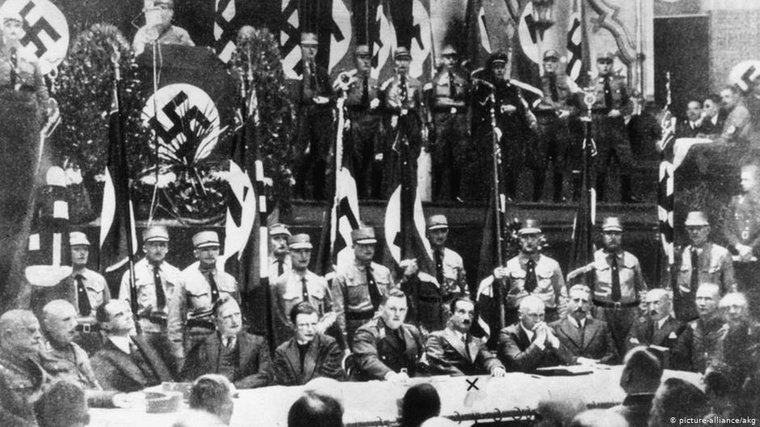
Heidegger among other university rectors at a NSDAP election rally on 11 November 1933
23 June 2020 (openDemocracy)* — On 28 May 2020, Björn Höcke, the leader of Germany’s far-right party Alternative für Deutschland in the state of Thuringia published a glossy picture of himself on his Facebook profile.
On the photo, one can see him sitting on a park bench reading a magazine called Die Kehre (Magazine for the Protection of Nature) a new far-right magazine whose first issue was published in spring 2020.





 HUMAN WRONGS WATCH