24/03/2021
(UN News)* — Turkey’s decision to withdraw from an important treaty on protecting women is “a very worrying step backwards”, a group of independent UN human rights experts said on 23 March 2021.
UNDP Turkey / Levent Kulu | Two women walk in the Taksim district of Istanbul, Turkey.
“This decision…sends a dangerous message that violence against women is not important, with the risk of encouraging perpetrators and weakening measures to prevent it”, said Dubravka Šimonović, the UN Special Rapporteur on violence against women.
read more »
Posted in Asia, Market Lords, Middle East |
Leave a Comment »
24/03/2021
ROME (FAO)* – Acute hunger is set to soar in over 20 countries in the coming months without urgent and scaled-up assistance, warn the UN’s Food and Agriculture Organization (FAO) and World Food Programme (WFP) in a new report issued on 23 March 2021.
 Agong and her child in South Sudan, where over 7 million people are projected to fall into crisis or worse levels of acute food insecurity.
Posted in Africa, Asia, Climate Crisis, Latin America & Caribbean, Market Lords, Middle East, Migrants and Refugees, Mother Earth, Others-USA-Europe-etc., The Peoples, War Lords |
Leave a Comment »
23/03/2021
Nairobi/Stockholm, 22 March 2021 (UNEP)* – A book by Stockholm Environment Institute (SEI) and the United Nations Environment Programme (UNEP), launched on World Water Day, reports that the sanitation waste of 50% of the global population is still disposed of without having been treated – posing enormous risks to both public health and the environment.
.
Posted in Africa, Asia, Climate Crisis, Latin America & Caribbean, Market Lords, Middle East, Migrants and Refugees, Mother Earth, Others-USA-Europe-etc. |
Leave a Comment »
23/03/2021
Geneva, 23 March 2021 (WMO)* – The ocean drives the world’s weather and climate and anchors the global economy and food security. Climate change is hitting the ocean hard, but also increasing hazards for hundreds of millions of people.
read more »
Posted in Africa, Asia, Climate Crisis, Latin America & Caribbean, Market Lords, Middle East, Migrants and Refugees, Mother Earth, Others-USA-Europe-etc., The Peoples |
Leave a Comment »
23/03/2021
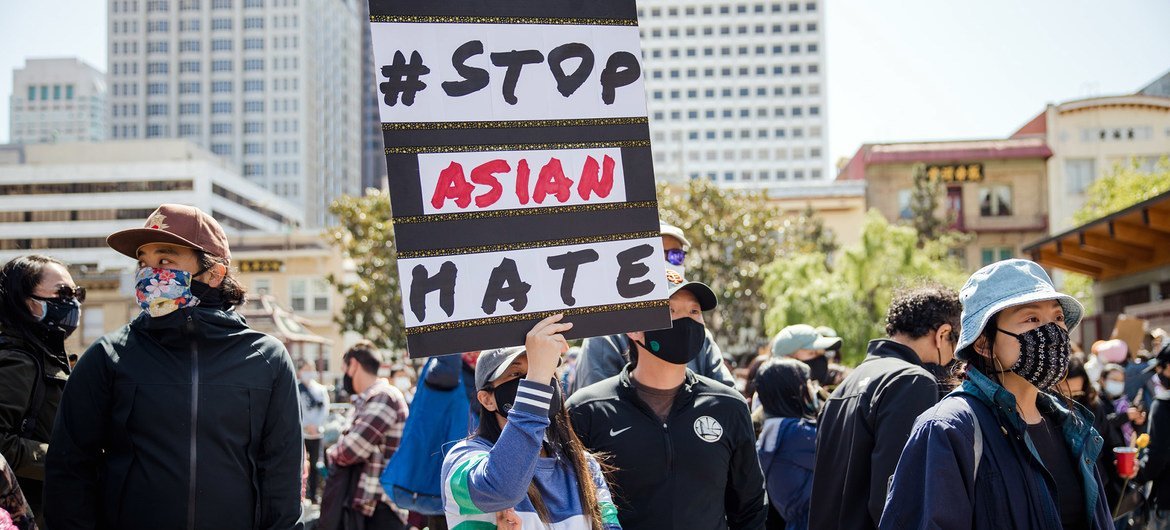
UN chief ‘profoundly concerned’ over rise in violence against Asians
Unsplash/Jason Leung | In San Francisco in the United States, demonstrators take to the streets to protest against the rise of race-related hate crimes against people of Asian descent.
.
22 March 2021 (UN News)* — The UN
Secretary-General António Guterres has issued
a statement expressing his profound concern over the rise in violence against Asians, and people of Asian descent, during the course of the COVID-19 pandemic.
Posted in Africa, Asia, Latin America & Caribbean, Market Lords, Middle East, Migrants and Refugees, Others-USA-Europe-etc., The Peoples, War Lords |
Leave a Comment »
23/03/2021
Collective commitment needed to end the ‘poison’ of racism: UN cultural chief says
UN News/Shirin Yaseen | Anti-racism protesters in Brooklyn, New York, demonstrate demanding justice for the killing of African American, George Floyd.
(UN News)* — With the COVID-19 pandemic providing fertile ground for the resurgence of racism and discrimination, the head of the UN’s educational and cultural agency, UNESCO, on 22 March 2021 called for countries to stand united in what she described as “these testing times”.
read more »
Posted in Africa, Asia, Latin America & Caribbean, Market Lords, Middle East, Migrants and Refugees, Others-USA-Europe-etc., The Peoples, War Lords |
Leave a Comment »
22/03/2021
International Day of Nowruz, 21 March
Celebration of Nowruz shared by several countries: Afghanistan, Azerbaijan, India, Iran (Islamic Republic of), Iraq, Kazakhstan, Kyrgyzstan, Uzbekistan, Pakistan, Tajikistan, Turkmenistan and Turkey.© UNESCO
21 March 2021 (UNESCO)* — Do you know what Nowruz, Nauryz or Nevruz mean? These words signify ‘new day’ for more than 300 million people around the world, and correspond to celebrations in large parts of Asia (Central, West and South) and from Southeast Europe to the Caucasus and Ural Mountain Range.
read more »
Posted in Africa, Asia, Market Lords, Middle East, Migrants and Refugees, Others-USA-Europe-etc., The Peoples, War Lords |
Leave a Comment »
21/03/2021
19 March 2021 (UNEP)* — Globally, over 3 billion people are at risk of disease because the water quality of their rivers, lakes and groundwater is unknown, due to a lack of data.

UNEP / Lisa Murray / 19 Mar 2021
Meanwhile, a fifth of the world’s river basins are experiencing dramatic fluctuations in water availability, and 2.3 billion people are living in countries categorized as “water-stressed,” including 721 million in areas where the water situation is “critical,” according to recent research carried out by the United Nations Environment Programme (UNEP) and partners.
read more »
Posted in Africa, Asia, Climate Crisis, Latin America & Caribbean, Market Lords, Middle East, Migrants and Refugees, Mother Earth, Others-USA-Europe-etc., The Peoples, War Lords |
Leave a Comment »
21/03/2021
The world needs to get water smart. Everyone has a role to play, and we cannot afford to wait.
18 March 2021 (UNICEF)* — Climate change is disrupting weather patterns, leading to extreme weather events, unpredictable water availability, exacerbating water scarcity and contaminating water supplies. Such impacts can drastically affect the quantity and quality of water that children need to survive.
Today, a change in climate is felt primarily through a change in water. Millions of children are at risk.
read more »
Posted in Africa, Asia, Climate Crisis, Latin America & Caribbean, Market Lords, Middle East, Migrants and Refugees, Mother Earth, Others-USA-Europe-etc., The Peoples, War Lords |
Leave a Comment »
21/03/2021
UNICEF launches new initiative, Water Security for All, to mobilize global support and resources to reach children in water vulnerable hotspots
NEW YORK, 18 March 2021 (UNICEF)* – Globally, more than 1.42 billion people, including 450 million children, live in areas of high, or extremely high, water vulnerability, according to a new analysis released by UNICEF.
This means that 1 in 5 children worldwide does not have enough water to meet their everyday needs.
read more »
Posted in Africa, Asia, Climate Crisis, Latin America & Caribbean, Market Lords, Middle East, Migrants and Refugees, Mother Earth, Others-USA-Europe-etc., The Peoples, War Lords |
Leave a Comment »




![[alt]](https://ich.unesco.org/img/photo/thumb/15361-BIG.jpg)


 HUMAN WRONGS WATCH