SYDNEY and KUALA LUMPUR, Nov 2 2020 (IPS)* – US third quarter GDP numbers released two weeks ago delighted stock markets and President Trump. Output had picked up by 7.4%, annualised as 33.1%, the largest quarterly economic growth on record, almost double the old record of 3.9% (annualised as 16.7%) in the first quarter of 1950, seven decades ago.
Anis Chowdhury
Spinning numbers
This news could not have come at a better time for Trump, who is struggling for re-election, as his Council of Economic Advisers (CEA) declared that this affirmed Trump’s claim, “we’re coming back, and we’re coming back strong”.
The CEA spun the White House press release headline accordingly, “The Great American Recovery: Third Quarter GDP Blows Past Expectations”.
6 November 2020 (Human Rights Watch) — The US elections took place amid a recession, record unemployment, and rising poverty. The economy was the top issue for voters in the election; one in two voters said that economic inequality was very important in their decision about who to support in the presidential election. But decisions that affect poverty and inequality are not only taken at the federal level.
The coronavirus pandemic has swept across a world that was already profoundly unequal. The failure to tackle inequality has left the majority of countries far more vulnerable and unprepared for both the health and economic impacts of the disease.
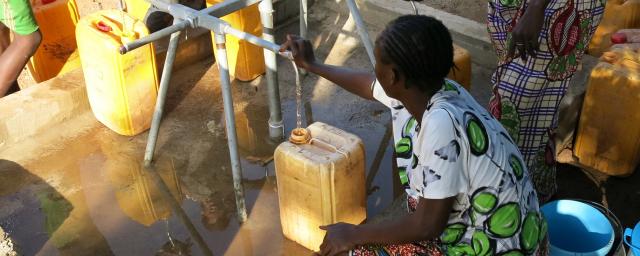
In the Central African Republic, the Covid-19 represents a health crisis which is added to an already alarming humanitarian crisis. One in two people in need of humanitarian assistance, and about 70% of health services are provided by humanitarian organizations. Photo: Aurelie Godet/Oxfam
Millions of people have died or been pushed into hunger and poverty because governments have not invested in public healthcare, protected workers’ rights, or provided safety nets for people who can’t work.
She lives in a settlement for displaced people outside Kabul, Afghanistan’s capital city. Fifteen people share her makeshift two-room home, including Shayista’s daughter and her children.
What exactly are we talking about when we refer to the “dust cycle”?
The dust cycle describes the movement of trillions of tiny particles through the Earth System. Sand and dust is raised by strong winds from areas of bare or sparsely vegetated ground.
A Nepalese peacekeeper with the African Union-UN Hybrid Operation in Darfur (UNAMID) plants a tree outside UNAMID Headquarters in El Fasher, Sudan. | PHOTO:UN Photo/Albert Gonzalez Farran
5 November 2020 (United Nations)* — Though humanity has always counted its war casualties in terms of dead and wounded soldiers and civilians, destroyed cities and livelihoods, the environment has often remained the unpublicized victim of war. Water wells have been polluted, crops torched, forests cut down, soils poisoned, and animals killed to gain military advantage.
4 November 2020 (UNESCO)* — Though they may be rare, tsunamis are among the most devastating natural disasters. They know no coastal borders. Coastal communities – often concentrated in low-lying and highly populated areas – are the most potentially vulnerable to coastal hazards including tsunamis, with heavy human and economic losses.
International cooperation is key for deeper political and public understanding; as well as involvement in reducing our risks from these coastal natural hazards.
In December 2015, the United Nations General Assembly designated 5 November as World Tsunami Awareness Day to promote a global culture of tsunami awareness.
I would like to announce the publication of a new book. It discusses the role of what might be called decision trees in science, in linguistics, in philosophy and literature, and in our daily lives. The book may be downloaded and circulated free of charge from the following link:
During each human life, a child starts with many possible destinations. He or she then makes decisions, and each decision more closely defines who the person is and what it is possible for the person to become.
30 October 2020 (THE CONVERSATION)*— Growing up in the United States, I remember on Halloween my mother used to say, “Honey, this is not just a day for costumes and candy. You must also remember your relatives. Know their names.” She would show me pictures of great-aunts, uncles and other deceased relatives.




 HUMAN WRONGS WATCH