By Walid Saleh and Warda Al-Jawahiry in Tripoli, Lebanon | UNHCR*
In Lebanon, the capacity of local community and Syrian refugees to provide mutual support is being stretched to breaking point by economic turmoil and the COVID-19 crisis. |Español | Français| عربي
Behind the counter of her small convenience store in a rundown neighbourhood of Tripoli, northern Lebanon, 35-year-old Kawkab Mustafa keeps a list of debts owed to her by customers she has allowed to buy goods on credit. In recent months, the list has grown so long she needs four separate notebooks to record all the entries.
SYDNEY and KUALA LUMPUR, Jun 30 2020 (IPS)* – Seventy-five years ago, on 26 June 1945, before the Japanese surrender ending the Second World War, fifty nations gathered at San Francisco’s Opera House to sign the United Nations (UN) Charter.
UN Charter
Nations pledged “to practice tolerance and live together in peace …, and to ensure … that armed force shall not be used, save in the common interest, and to employ international machinery for the promotion of the economic and social advancement of all peoples”.
They sought “to save succeeding generations from the scourge of war, … and to reaffirm faith in fundamental human rights, in the dignity and worth of the human person, in the equal rights of men and women and of nations large and small, and to … promote social progress and better standards of life in larger freedom”.
She is sick, she is frail and separated from her family. Emmanuelle Ochaya, 56, has been sleeping in a scanty makeshift hut, in the middle of a forest on cold, bare ground for almost one month. The nighttime temperature here drops to 10°C and her only belongings are the clothes she is wearing.
1 July 2020 (UNHCR)* — Emmanuelle is among an estimated 45,000 of people who fled attacks in eastern Democratic Republic of the Congo (DRC) that erupted in May. According to community representatives, armed groups began a violent rampage in War-Palara chiefdom, Mahagi Territory, including killings, sexual violence and looting.
2 July 2020 — In his recently revised and updated book The Invisible Rainbow: A History of Electricity and Life, scientist Arthur Firstenberg has made both science and history comprehensible by explaining the importance and significance to life on Earth of a vital consideration that has long been ‘invisible’: electricity.
Robert J. Burrowes,
Indeed, as Firstenberg makes clear, if we want to understand life on Earth, we cannot do so without understanding the role that electricity plays in making life possible, healing it and, if abused, threatening us all.
Firstenberg’s book is unusual on at least two counts. Based on decades of scientific research, he carefully explains each point in language accessible to the non-scientist while documenting his case with exceptional clarity and detail complemented by a 138-page bibliography.
If you want to really understand this issue, and what is at stake, you will be doing yourself a favor by reading this book.
(UN News)*— The Security Council on Wednesday [1 July 2020] echoed the Secretary-General’s call for a worldwide ceasefire, to combat the coronavirus pandemic that has already claimed more than half a million lives. The UN chief welcomed the long-awaited move, calling for countries to “redouble their efforts for peace”.
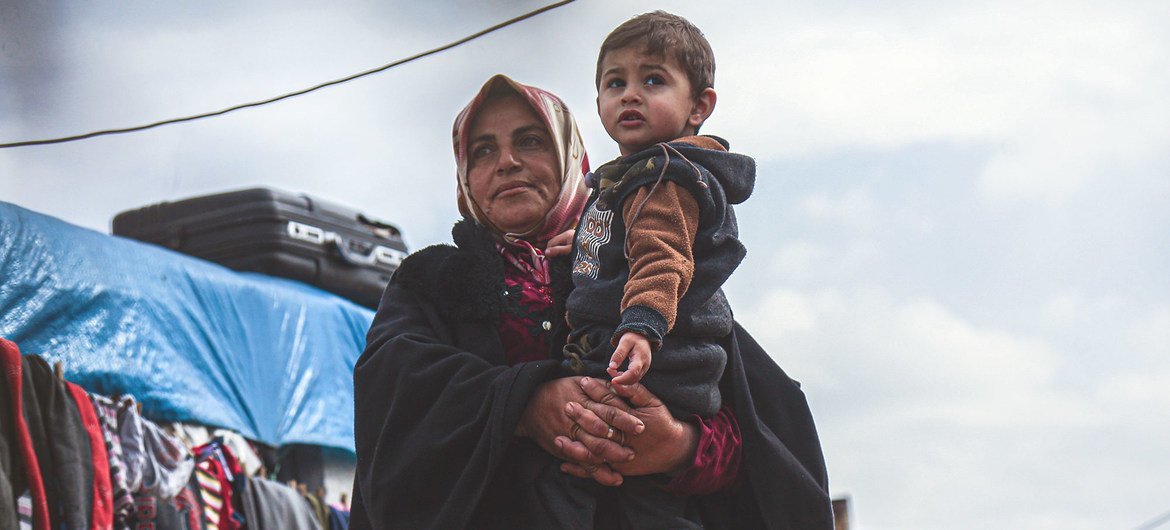
OCHA/Steve Hafez | A widow holds her grandson in a displaced persons camp in northern Idleb Governorate, Syria.
Unanimously adopting resolution 2532 (2020) on Wednesday [1 July 2020], the 15-member peace and security body demanded “a general and immediate cessation of hostilities in all situations, on its agenda.”
The King’s apology came amidst a global anti-racism demonstration.
DRC’s independence is celebrating its 60th anniversary this year. | Photo: AFP
(teleSUR)* — The King of Belgium Philip Leopold sent a letter to the Democratic Republic of Congo (DRC) President Felix Antoine Tshisekedi Tshilombo on Tuesday [30 June 2020] to apologize for the violent events which occurred while it colonized the region.
For over a century, Belgium turned the Congo into a slave state governed by Leopold II.
The world has literally ‘lost it’ over the horrible word capitalism.
Naresh Jotwani
This may seem like an overstatement, but it can be justified easily. All it needs is some clear thinking based on a few words which – unlike capitalism – are rooted in reality.
First of all, any ‘-ism’ cannot be trusted blindly because – over time – it becomes a hindrance to individual growth. Anyone promoting or even naively adopting an ‘-ism’ is likely living or hiding ‘in a box’, which state blocks his or her individual progress.
Simple question: In a society where the basic vocabulary stunts individual progress, can we EVER expect overall well-being? Can one get nectar out of bird feathers?
It is only when we discard ALL ‘-isms’ – including the ever-so-venerable Buddhism! – that we are forced to go back to basics, to reality, and in particular to the reality of suffering. Nothing else is then left to build a world view that makes sense. A new day dawns!
UNITED NATIONS, Jul 1 2020 (IPS)* – The ongoing battle between China and the United States is threatening to paralyze the most powerful body at the United Nations – the 15-member Security Council (UNSC)—which has virtually gone MIA (missing in action) on some of the key politically-sensitive issues of the day.
UN Security Council in session. Credit: United Nations
The International Labour Organization’s latest analysis of the labour market impact of COVID-19 finds its impact on the world of work was more severe than previously estimated, and offers three scenarios for the second half of 2020.
GENEVA 30 June 2020 (ILO)* – The number of working hours lost across the world in the first half of 2020 was significantly worse than previously estimated, while the highly uncertain recovery in the second half of the year will not be enough to go back to pre-pandemic levels, even in the best scenario, and risks seeing continuing large scale job losses, warns the International Labour Organization (ILO).
 Kawkab Mustafa pictured inside her shop in the Bab al-Tabbaneh neighbourhood of Tripoli, Lebanon. © UNHCR/Diego Ibarra Sánchez





 HUMAN WRONGS WATCH