I. The countdown to World War Trump has begun1. As I argued in my previous September 2019 WSI article, the US approach toward Iran, coupled with NATO/EU enlargement, the 1999 war “over” Kosovo, and the deployment of US/NATO Missile Defense systems in eastern Europe, and now the Trump administration decision to dump the 1987 INF Treaty and possibly deploy war-fighting intermediate range missiles, has helped to generate a post-Cold War “insecurity-security dialectic” throughout the wider Middle East and the world in which Russia and China have reached out for closer political-economic and military ties with both Iran and Turkey—in the formation of a new Sino-Russian axis.
A Buddhist humanist from Burma, Maung Zarni is a member of the TRANSCEND Network for Peace Development Environment, former Visiting Lecturer with Harvard Medical School, specializing in racism and violence in Burma and Sri Lanka, and Non-resident Scholar in Genocide Studies with Documentation Center – Cambodia.
Zarni is coordinator for Strategic Affairs for Free Rohingya Coalition and an adviser to the European Centre for the Study of Extremism, Cambridge, UK.
After nearly two weeks of fighting in northeast Syria, the UN’s huhumanitarian wing has estimated that around 180,000 have been forced to leave their homes or sheltermanitarian wing has estimated that around 180,000 have been forced to leave their homes or shelters, including 80,000 children, all in desperate need of humanitarian assistance.*
The UN Office for the Coordination of Humanitarian Affairs (OCHA) reported on Tuesday [22 October 2019] that despite a shaky five-day ceasefire, airstrikes and a ground offensive launched by Turkey on 9 October, targeting Kurdish held areas across the border, has had a “significant humanitarian impact.”
$4 Billion Humanitarian Appeal Nearly 50 Per Cent Unfunded Heading into Final Auarter of 2019
UNICEF/UNI214259/Souleiman
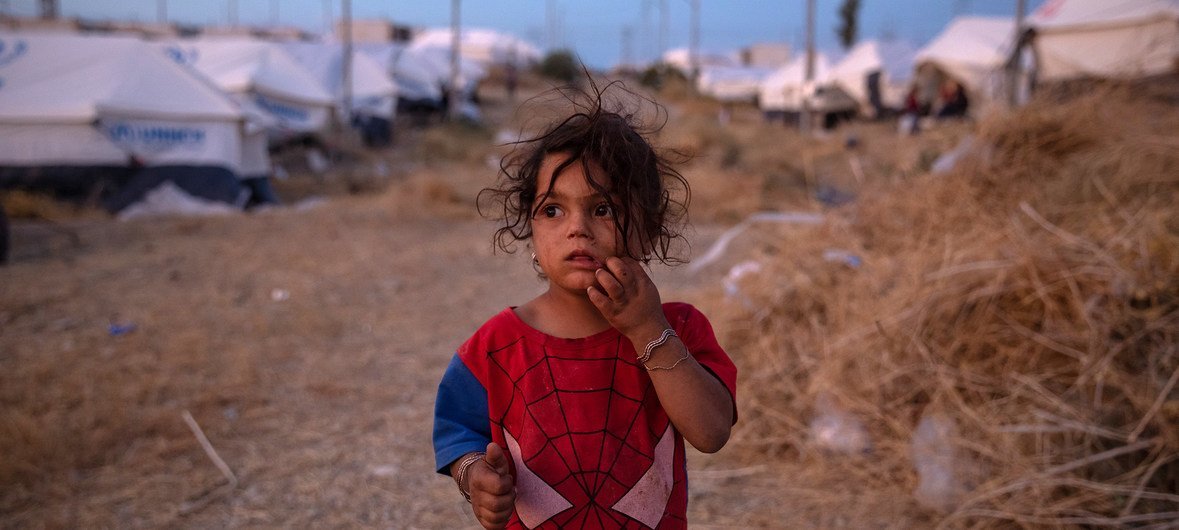
NEW YORK (UNICEF)* – Millions of children living in areas affected by conflict and disaster are at risk because of substantial shortages in funding for lifesaving humanitarian programmes, UNICEF said today [22 October 2019].
22 October 2019 (Norwegian Refugee Council)* — Over 300,000 people have been displaced due to drought and conflict in Somalia so far this year. The Norwegian Refugee Council (NRC) said insecurity is making it virtually impossible for humanitarians to provide aid in rural areas and is resulting in vulnerable people moving to overcrowded camps in urban areas for assistance.
“The crushing effect of drought has stripped rural communities of their crops, livestock and water sources, while armed conflict closes in on their homes. We are now likely to see 2.1 million Somali people suffering from hunger by December and into 2020,” said Victor Moses, Country Director for NRC.
Today, our emotions seem to be driving us towards disaster. At first this seems to be a paradox. Our emotions have been produced by evolution, and Darwinian natural selection is supposed to produce traits that lead to survival, rather than to destruction.
IPS Correspondent Ed Holt speaks to PAULINE ADES-MEVEL, Head of European Union & Balkan desk at RSF*
Pauline Ades-Mevel, Head of European Union and Balkan desk at Reporters Without Borders, warns that press freedom in Europe is declining. Courtesy: Reporters Without Borders
Rising populism, anti-media rhetoric from politicians, cyber-harassment of journalists and physical attacks are among the reasons why press freedom in Europe is on the decline, according to the global media watchdog Reporters Without Borders (RSF).
16 October 2019 (Norwegian Refugee Council)* – As thousands of civilians flee air strikes and shelling in North East Syria, aid agencies witness an escalation of the humanitarian crisis. UN estimates that more than 160,000 people have been displaced so far and believes up to 400,000 people could be displaced in the area if the violence keeps escalating.
Syrian families fleeing air strikes and shelling in north-east Syria. Photo: Delil SOULEIMAN / AFP NTB Scanpix | Photo posted here from NRC.
18 October 2019 (UN Women)* –Olena Halkanova fled her home in the city of Pervomaisk after the start of the armed conflict in eastern Ukraine. Now living on the contact line between government-controlled and non-government-controlled areas of Luhansk region, she has become a community mobilizer after UN Women-led training.






 HUMAN WRONGS WATCH