17/11/2014
The world’s estimated 232 million international migrants (2013 UN estimate) generated some US$400 billion in remittances for their families and communities back home in 2013, three times more than total overseas development assistance in the same year, according to the World Bank.
.

**Photo: Ibrahim Diallo Manzo/IRIN | Smuggled migrants on edge of Sahara desert
BANGKOK, November 2014 (IRIN)* – As the Millennium Development Goals (MDGs) expire at the end of 2015, campaigners are calling for the inclusion of migrant worker protections in the post-2015 Sustainable Development Goals (SDGs), noting that migrants contribute billions to reducing poverty – often at great cost to their personal safety and well-being.
read more »
Posted in Africa, Asia, Latin America & Caribbean, Market Lords, Middle East, Mother Earth, Others-USA-Europe-etc., The Peoples |
Leave a Comment »
17/11/2014
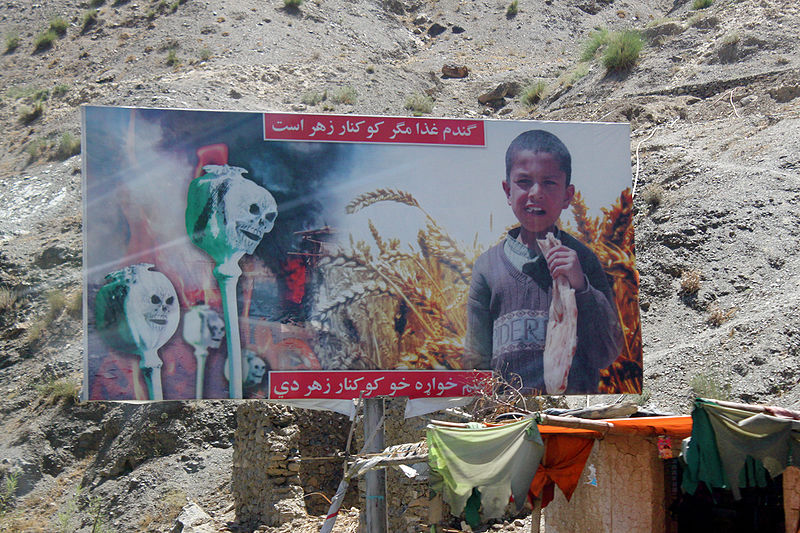
Vienna/Kabul, November 2014 — Opium poppy cultivation in Afghanistan rose seven per cent from 209,000 hectares in 2013 to 224,000 hectares, according to the 2014 Afghanistan Opium Survey released in Vienna and Kabul by the Afghan Ministry of Counter Narcotics and the United Nations Office on Drugs and Crime (UNODC). Meanwhile, opium production may potentially increase 17 per cent, with yields estimated to reach 6,400 tons in 2014 compared to the previous year’s total of 5,500 tons.
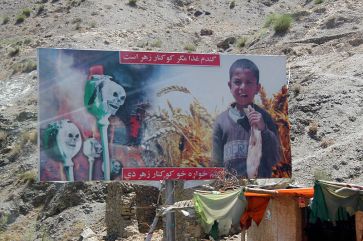
**Anti-poppy propaganda poster. An approximate translation of the text is “Poppies are the crop of death. Grow wheat instead so children can eat and live” | Author: Todd Huffman | Source: originally posted to Flickr as No Poppies | Wikimedia Commons.
The Executive Director of UNODC, Yury Fedotov, said that Afghanistan’s narcotics problem remained a global challenge and shared responsibility “We cannot afford to see the long-term stability of Afghanistan – and the wider region – derailed by the threat of opiates. What is needed is greater resolve towards addressing narcotics in a serious and tangible manner within the economic, development and security agendas.”
Afghanistan produces some 90 per cent of the world’s illicit opiates. These increases come after record highs were noted in 2013, when cultivation rose 36 per cent and production by almost a half since 2012.
read more »
Posted in Asia, Market Lords, Others-USA-Europe-etc., The Peoples, War Lords |
Leave a Comment »
17/11/2014
Over the past ten years, the average annual volume of pesticide imports into Mozambique has increased by 500 percent. Agricultural pesticides are used mainly on cash crops like cashew, tobacco, sugar cane, cotton, banana and vegetables. The annual value of pesticide sales is about US$16.6 million. However, some of the products currently in use are highly hazardous.*
.

Mozambique and FAO working together to prohibit Highly Hazardous Pesticides and protect people and the environment. | Source: FAO
Mozambique has taken important regulatory measures to protect its people and the environment by cancelling the registration of 79 Highly Hazardous Pesticides. Working with the National Directorate of the Agrarian Services, in the Ministry of Agriculture, FAO helped bring the prohibition about and promote an ecosystem-based approach to pest and pesticide management.
Highly Hazardous Pesticides (HHPs) are products that present particularly high levels of acute or chronic hazards to human health or the environment due to their inherent chemical properties and that are listed in internationally accepted classification systems or relevant binding international conventions.
In addition, pesticides that appear to cause severe or irreversible harm to human health or the environment under the prevailing conditions of use in a country may be considered as highly hazardous.
read more »
Posted in Africa, Asia, Latin America & Caribbean, Market Lords, Middle East, Mother Earth, Others-USA-Europe-etc., The Peoples |
Leave a Comment »
17/11/2014
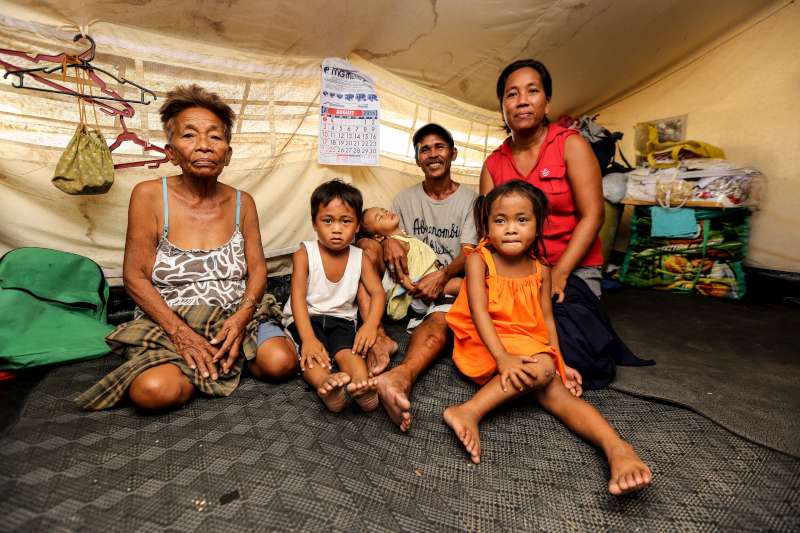
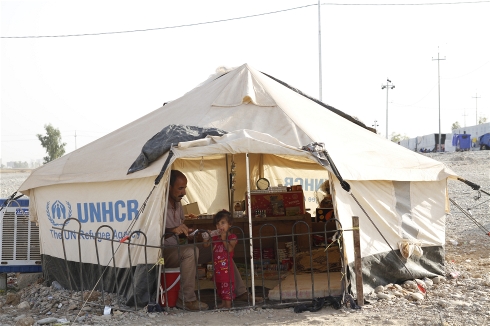
By Marjanna Bergman in Tanauan, the Philippines, November 2014 (UNHCR)* — Merlyn Aguilar may live with 12 family members in a tent among hundreds of others in UNHCR’s tent city in the central Philippines town of Tanauan, but she has every reason to feel proud.
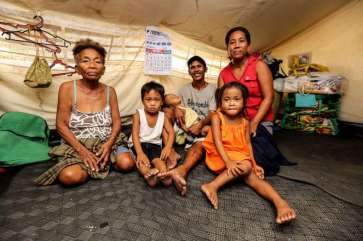
© UNHCR/P.Behan | Three generations of the Aguilar family pose for a photo in their UNHCR tent.
Since the devastating Typhoon Haiyan smashed into the central Philippines a year ago, her family has pulled together with the help of the UN refugee agency and its corporate partner, United Parcel Services (UPS).
When the biggest typhoon ever to hit the Philippines made landfall early on November 8, Merlyn and the children were sheltering at the local gym. Even before arriving at the shelter, the strong winds and heavy rain forced them to abandon the bags of clothing they had packed for evacuation.
“I didn’t sleep for three days because I was trying to sleep sitting up. There was nowhere to lie down,” says 36-year-old Merlyn. “I gathered 10 chairs, and placed plywood on top so that at least eight of my children had somewhere to sleep.”
read more »
Posted in Asia, Mother Earth, The Peoples |
Leave a Comment »
17/11/2014
The UN Educational, Scientific and Cultural Organization (UNESCO) has launched the UNESCO World Library of Science (WLoS), a newly created, free online science education resource for a global community of users.

World Library of Science poster
Developed through the joint efforts of UNESCO, Nature Education and Roche, the WLoS was created to give students around the world, especially those in disadvantaged regions, access to the latest science information as well as the opportunity to share their experiences and learning through discussion with their peers in a shared learning environment.*
Launched on 10 November 2014 on the occasion of World Science Day for Peace and Development 2014 the WLoS is a science resource library stocked with over 300 top-quality articles, 25 eBooks, and over 70 videos from the publishers of Nature, the most cited scientific journal in the world. It is also a state-of-the-art digital platform that provides a community hub for learning.
Users can join classes, build groups and connect with other learners.
Specifically, the WLoS seeks to make science learning accessible to students everywhere in the world by:
read more »
Posted in Africa, Asia, Latin America & Caribbean, Middle East, Others-USA-Europe-etc., The Peoples |
1 Comment »
17/11/2014
Making International Day of Tolerance, United Nations Secretary-General Ban Ki-moon on 16 November 2014 urged world leaders to protect people from persecution and to encourage tolerance for all regardless of nationality, religion, language, race, sexuality or any other distinction that obscures our common humanity.

Children from Cape Town, South Africa in the 1980s, when inter-racial marriage was illegal in the country | Source: UN News Centre
“We live in an era of rising and violent extremism, radicalism and widening conflicts that are characterized by a fundamental disregard for human life,” Ban Ki-moon said in his message for the Day, observed annually on 16 November.*
There are more people displaced by fighting today than at any period since the end of the Second World War, he added.
Innocent lives are being lost in senseless clashes around the world. The youngest victims are robbed of their childhoods, conscripted and abused, or even kidnapped simply for wanting an education.
read more »
Posted in Africa, Asia, Latin America & Caribbean, Market Lords, Middle East, Mother Earth, Others-USA-Europe-etc., The Peoples |
Leave a Comment »
16/11/2014
.
By Louise Redvers, Erbil, 13 November 2014 (IRIN)* — At Harsham camp on the northern edge of Erbil, internally displaced Iraqi families who fled Mosul and its surrounding villages to escape Islamist militants stock their tents with donated blankets and warm clothes in preparation for the fast-advancing winter.

**Photo: Cathy Otten/IRIN | Syrian refugees and Iraqi displaced often receive separate services despite similar needs
At the Kawergosk camp, 25km away, Syrian refugees are doing the same. Yet their winter kits and food parcels will mostly likely contain different items and be delivered by different teams funded by different donors.
Both groups are fleeing what the international community now views as the same crisis, yet due to UN protocols and how funding is allocated, internally displaced persons (IDPs) from Iraq and refugees from Syria are being supported by, in some cases, completely separate programmes – despite their similar needs and geographical proximity.
This duplication is prompting experts to call for a rethink on how organizations in Iraq – and elsewhere – respond to dual caseloads of IDPs and refugees, with a strong push to prioritize based upon need rather than status.
read more »
Posted in Africa, Asia, Latin America & Caribbean, Middle East, Others-USA-Europe-etc., The Peoples, War Lords |
Leave a Comment »
16/11/2014
Human Wrongs Watch
By Johan Galtung*, November 2014 – TRANSCEND Media Service
Protestant Liechtenstein recently held a conference on making banking shariah compatible, to attract capital from Muslim countries. And no doubt also because the big survivors of the 2008 crisis were China and Muslim countries; China because the focus is not only growth but lifting the bottom up–increasing domestic demand and less dependence on trade in 1991-2004–Muslim countries because of Islamic banking.

Johan Galtung
A common Western misunderstanding is that Islam forbids interest; what is forbidden are relations that are only monetary; they should be economic, social, more human, in a broad sense. Just to make money available against interest is out.
Purely financial deals selling and buying financial objects–derivatives at any level–for commissions are also out. Banks and other companies have to be in it together.
There is more to it. A bank has to be trustworthy, not at the brink of collapse. A leading Islamic banker in Malaysia said that his capital was 60% debt–deposits–20% securities, 20% liquidity; he felt confident that he could survive future crises with that portfolio and the solidity of “being in it together”.
Calculations for the big banks in the USA indicate operating 95% on debt and 5% on liquidity: highly vulnerable to going down, with depositors in the wake.
read more »
Posted in Africa, Asia, Latin America & Caribbean, Market Lords, Middle East, Others-USA-Europe-etc., The Peoples |
Leave a Comment »
16/11/2014
Rome, 16 November 2014 — In the past two decades, child and maternal malnutrition has declined almost by half–yet, child undernutrition and micronutrient deficiencies still impose the greatest nutrition related health burden at the global level, the UN Food and Agriculture Organization (FAO) reports ahead of the Second International Conference on Nutrition (ICN2) scheduled on 19-21 November 2014 at FAO Headquarters in Rome.

Source: FAO
Undernutrition in children often results from poor quality diets in terms of variety, nutrient content and food safety during infancy and childhood combined with poor access to health services, sanitation and social care, FAO adds.
For pregnant women, hunger and malnutrition, especially deficiencies of iron and calcium, contribute substantially to maternal deaths. Children who are undernourished are more susceptible to infectious diseases and their cognitive development is compromised, hindering their performance in school and consequently their future job and income opportunities,” says FAO.
“Poor maternal and child nutrition is also the primary pathway by which poverty is transmitted from one generation to the next: stunted girls—whose height growth is slowed owing to poor nutrition—grow up to be short in stature as adults, and short maternal height is one of the strongest predictors for low birth weight children and future childhood stunting.”
read more »
Posted in Africa, Asia, Latin America & Caribbean, Market Lords, Middle East, Mother Earth, Others-USA-Europe-etc., The Peoples |
1 Comment »
16/11/2014
MONROVIA/FREETOWN/DAKAR, 14 November 2014 (IRIN)* –– With the nationwide closure of schools in Liberia and Sierra Leone due to the Ebola outbreak, and with no immediate prospect of them reopening, a growing number of students are receiving their lessons via radio.

**Photo: Anna Jefferys/IRIN | An out-of-school girl in Kenema, Sierra Leone, where all schools are closed until further notice because of the Ebola outbreak
“Right now, in the midst of Ebola, the Ministry of Education has embarked on this programme – Teaching by Radio – because we want our children to be engaged academically,” said J. Maxim Blateen, the director of communications for Liberia’s Ministry of Education. “Our school-going children were just sitting at home, idle. So we wanted to bring them something to keep them learning.”
Radio is the most widespread and popular form of media in Liberia and Sierra Leone, where upwards of 80 percent of households have access to a radio.
More than one million people in Liberia have already tuned in to the lessons since the programme first aired in mid-September, when schools were supposed to open.
read more »
Posted in Africa, Market Lords, Mother Earth, The Peoples |
Leave a Comment »




 HUMAN WRONGS WATCH