Human Wrongs Watch
The spread of violent attacks across the border from northern Nigeria into Niger is causing widespread displacement and hampering efforts to provide humanitarian assistance in the area, a spokesperson for the United Nations food relief agency reported on 10 February 2015 .

A family in Diffa, Niger, after fleeing violence in northern Nigeria. Photo: OCHA/Franck Kuwonu
The second half of 2014 saw a major increase in the number of new arrivals in the Diffa region. While only 15,000 people had crossed the border in October, the total estimated number now stands at 125,000 people, spread out over more than 140 sites and villages, said Elisabeth Byrs of the World Food Programme (WFP)*.
The arrival of displaced people has seen the population of Diffa almost double, putting enormous pressure on people’s livelihoods and food stocks, in a region that had been struggling with drought for several years in a row.
Byrs said the WFP had started distributing food in one of the refugee camps that the Government of Niger had agreed to open to accommodate Nigerians arriving in the region, and was providing supplementary feeding for all children under the age of five.
That was particularly important, she said, given that one in three displaced children is affected by Global Acute Malnutrition, compared to one out of five within host populations, both well above the emergency threshold of 15 percent. She added that WFP, UNHCR and UNICEF were developing a joint nutrition strategy for the camps.
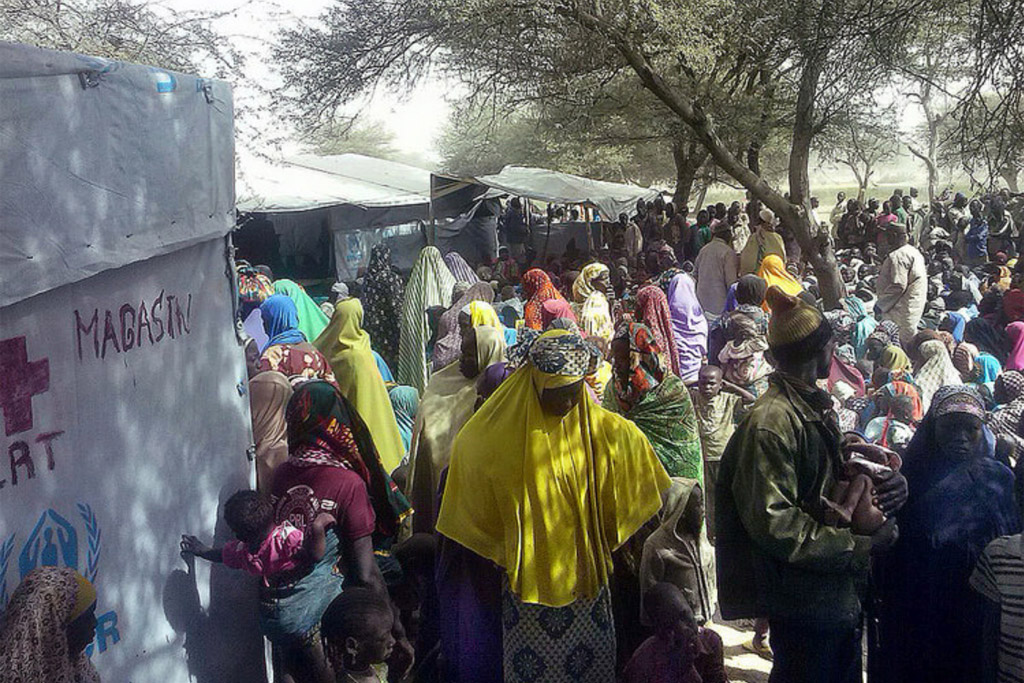
Nigerian refugees fleeing attacks by insurgents on Baga town and surrounding villages, wait to be registered by UNHCR in Ngouboua, western Chad. Photo: Chadian Red Cross/Hachim Abdoulaye | Source: UN News Centre
WFP and its partners had also conducted a food security and vulnerability assessment in Niger in November 2014, which showed that a total of 52.7 per cent of displaced households and their host families were severely – 14 per cent – or moderately – 38.7 per cent – food insecure, and in need of food assistance.
Byrs said WFP plans to distribute food for everyone in camps, with an additional mixture of conditional and unconditional support, based on vulnerability, for out-of-camp host and displaced populations in sites where new arrivals were most highly concentrated.
She added that WFP sought to reach 238,000 people in Cameroon, Chad and Niger with food assistance, including in the form of transfers and vouchers, over the next year. In that time, the agency’s regional emergency operation in the area needs $50.1 million and it currently has a funding shortfall of $41.4 million. (*Source: UN).
Read also:
Boko Haram Facing Mounting Regional Military Pressure
UN Human Rights Agency Deeply Deplores Boko Haram’s “Vicious, Ruthless Attacks against Civilians”
UN Condemns Boko Haram’s ‘Depraved Act’ as Child Suicide Bombers Attack Northern Nigeria Market
New Boko Haram Attacks in Nigeria Drive Thousands of Refugees into Chad
‘We Saw What You Did’ – Satellites and Human Rights
2015 Human Wrongs Watch
Discover more from HUMAN WRONGS WATCH
Subscribe to get the latest posts sent to your email.
 Baher Kamal
 HUMAN WRONGS WATCH
Leave a comment