New York – The United Nations disarmament chief on 6 April 2015 urged Member States to work actively and seek common ground on disarmament issues related to nuclear weapons and conventional arms amid a period of increasing global tensions and violence.
UN Photo/Martine Perret
Addressing the opening of the 2015 substantive session of the Organization’s Disarmament Commission (UNDC) in New York, UN High Representative for Disarmament Affairs Angela Kane warned gathered delegates that efforts to reduce the global circulation of weaponry had stalled and that the prospects of nuclear disarmament were particularly “dim.”
“I have never seen a wider divide between nuclear haves and nuclear have-nots,” declared Kane.
She added that the “schism” continued to act as a “significant” obstacle to non-proliferation and underscored the need “to bridge the fissure” between Member States while noting that the world’s brewing conflicts had fed the increasing proliferation of conventional weapons.
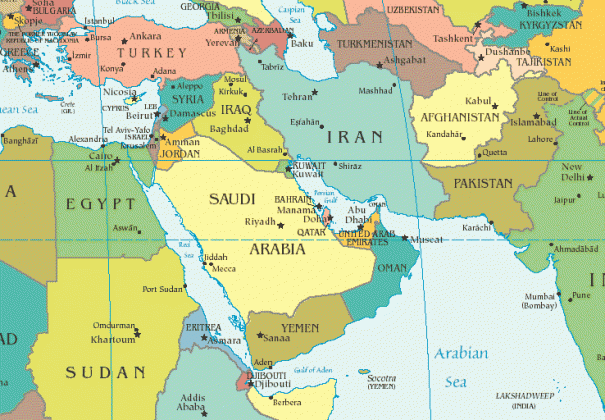
6 April 2015 — The framework nuclear agreement struck last Thursday by the US and its negotiating partners with Iran, while still facing obstacles, marks a significant strategic shift in American foreign policy.
.
**Middle East map. By: W123 | Wikimedia Commons
.
For the entire period since the 1979 Iranian revolution overthrew the US-backed Shah—that is, for 36 years—Washington has maintained a stance of unremitting hostility to the Iranian regime.
This has been a constant in US policy in the region and internationally. Now the US has reached a deal that holds out the possibility of a broader rapprochement between Washington and Tehran.
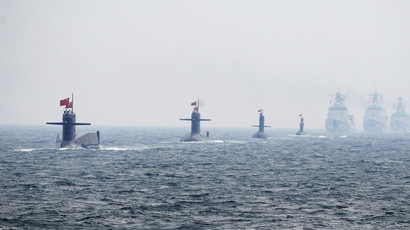
6 April 2015 (RT)* — Chinese shipbuilders have completed three advanced nuclear-propelled submarines that can fire the latest vertically launched anti-ship missiles, local media reported.
Satellite pictures broadcast last week by China Central Television showed three submarines anchored at an unidentified port, China Daily reported. The vessels were reported to be Type-093G submarines just completed by a shipyard and ready to be delivered to the Navy of the People’s Liberation Army.
Type-093G is an advanced version of Type-093, China’s second-generation nuclear-powered attack submarines.
Compared to the relatively short 110-m regular variant, the Type-093G has a longer hull to make room for a vertical launch system, the report said.
5 April 2015 – Kisumu, Kenya (Pressenza) — No one is left without a sensation of horror at last week’s awful attack on Garissa University College, Kenya in which it seems that the dead number more than 150 young students who had their whole lives ahead of them. It is also noticeable that world leaders have not flocked to Kenya in order to march in solidarity with President Kenyatta and the people of Kenya as they did with President Hollande and the people of France after the Charlie Hebdo attack. Such hypocrisy requires a separate article though.
The roots of this terrorism in Kenya are surely not simple but certainly have to do with the colonial history of both Kenya and Somalia. With Somali territory divided between the French, the British and the Italians, after the second world Somalia was reconstituted into Somalia and Djibouti but with parts of Somali territory handed over to Ethiopia and other parts forcibly incorporated into what would become the Republic of Kenya in 1963.
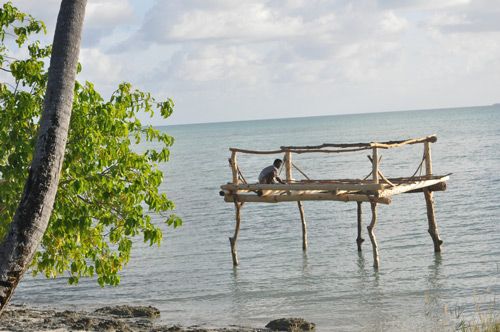
A few things you may not know about small island developing States. There are currently 39 small island developing States in three geographic regions: the Caribbean; the Pacific; and Africa, Indian Ocean and South China Sea.*
.
Young man on top of a stick structure coming out of the water | Source: UN
.
These small islands have a combined population of 63.2 million people and a combined gross domestic product (GDP) of $575.3 billion.
Small islands face a unique set of challenges due to their small size and remote location. They are also highly vulnerable to climate change and natural disasters.
While they have many things in common, the standards of living among small islands differ widely, with GDP per capita ranging from $51,000 in Singapore to $830 in Comoros.
The head of the United Nations office dealing with disaster risk mitigation has on 4 April 2015 underlined her concerns about the future development of Small Island Developing States (SIDS) in the face of extreme weather events.
.
Crop damage caused by Super Cyclone Pam on the Pacific Island of Vanuatu. Photo: UNICEF/Gaelle Sevenier
.
“Climate change combined with poverty and exposed infrastructure and housing, will lead to a significant increase in economic losses due to increased wind damage and sea level rise,” said Margareta Wahlström, the Special Representative of the Secretary-General on Disaster Risk Reduction and head of the UN’s Office for Disaster Risk Reduction (UNISDR).*
3 April 2015 (RT)* – The war in Yemen is developing into a disaster for the US and Saudis as al-Qaeda is becoming stronger and might make Yemen, once a model example for the US ‘war on terror’, its headquarters, Abdel Bari Atwan, former editor-in-chief of Al Quds, told RT.
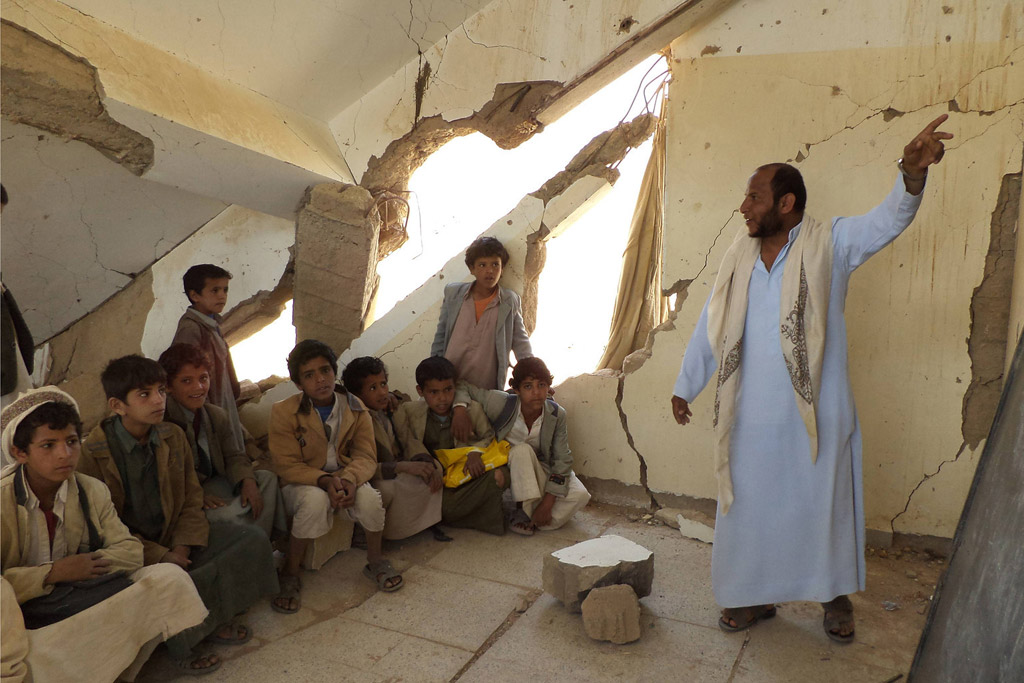
Children attend classes in Yemen, where over 600 schools have been damaged as a result of conflict. Photo: UNICEF
RT:You’ve written a series of books about al-Qaeda. What can you tell us about its position in Yemen? They are taking advantage of the current situation, don’t they?
Abdel Bari Atwan: Oh, yes, definitely. It is a golden opportunity for al-Qaeda to take advantage of the anarchy which is spreading in the whole country now. I believe that al-Qaeda will be the greatest beneficiary from this kind of anarchy. We know that al-Qaeda in Yemen is very strong and [it] is getting stronger, and stronger.
DUBAI, 3 April 2015 (IRIN*) – A week ago, a coalition of 10 countries led by Saudi Arabia began to bomb Yemen. The unrest involves several different actors and constantly changing allegiances. Here is IRIN’s guide to the major players in the conflict and a reading list to help unravel the complex reasons behind it:
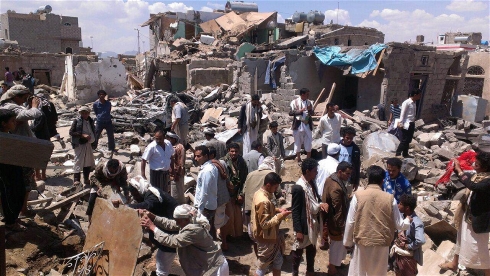
**Photo: Almigdad Mojalli/IRIN | Yemenis search through the rubble after an airstrike in the capital Sana’a
Ali Abdullah Salehruled Yemen as president for 33 years until 2011, when he agreed to leave office after 10 months of violence following Arab Spring-inspired protests. The terms of his resignation – brokered by theGulf Co-operation Council (GCC) of which Saudi Arabia is a leading member – gave Saleh full immunity against prosecution and he has continued to manoeuvre behind the scenes.
During the 2000s, his government fought a five-year war with the Houthis, who opposed Saleh’s close ties with Saudi Arabia and his support for US-led counter-terrorism operations. However, in recent months, the former president, who still commands loyalty within the Yemeni military, has switched sides and now backs the Houthis against the Saudi-led assault.
4 April 2015 — Early Wednesday morning [1 April] the Pemex oil platform, Abkatun Alpha blew up off the West coast of the Yucatan peninsula. The explosion killed four people and sent 16 to the hospital. 300 people managed to escape the blazing wreckage. Three people are still missing.
The rig might as well have imploded, though, given the swift clamp-down on facts and sudden empty space devoid of independent information. What we know about the blaze is only what Pemex and the Mexican government would tell the world.
Oil companies are reckless, stumbling, unwieldy behemoths and Pemex is no different. However, the speed at which they managed to start bottle-necking information about the burning rig could be commendable, if it weren’t so deceitful.
I MUST start with a shocking confession: I am not afraid of the Iranian nuclear bomb.
I know that this makes me an abnormal person, almost a freak.
But what can I do? I am unable to work up fear, like a real Israeli. Try as I may, the Iranian bomb does not make me hysterical.
MY FATHER once taught me how to withstand blackmail: imagine that the awful threat of the blackmailer has already come about. Then you can tell him: Go to hell.
I have tried many times to follow this advice and found it sound. So now I apply it to the Iranian bomb: I imagine that the worst has already happened: the awful ayatollahs have got the bombs that can eradicate little Israel in a minute.
So what?
According to foreign experts, Israel has several hundred nuclear bombs (assessments vary between 80-400. If Iran sends its bombs and obliterates most of Israel (myself included), Israeli submarines will obliterate Iran.
Whatever I might think about Binyamin Netanyahu, I rely on him and our security chiefs to keep our “second strike” capability intact. Just last week we were informed that Germany had delivered another state-of-the-art submarine to our navy for this purpose.




 HUMAN WRONGS WATCH