BEIRUT, 9 April 2015 (IRIN)– Warnings about the scale of the humanitarian disaster unfolding in Yemen are becoming graver with each passing day.
**Photo: Almigdad Mojalli/IRIN | The aftermath of a bombing by the Saudi-led coalition in Yemen
On Wednesday [8 April 2015], United Nations Special Rapporteur Chaloka Beyani predicted “massive displacement and humanitarian crisis,” and said: “The international community must prepare for a worst-case scenario.”
The following day, UN Secretary-General Ban Ki-moon warned that countless civilians were being “willfully abandoned to misery.” Here are four reasons why the plight of civilians in Yemen is so severe:
8 April 2015, TRANSCEND Media Service– Johan Galtung** is often asked to define peace journalism. In the most concise way, he says, it is to ask two questions (in addition to the usual questions like how many bombs were dropped, how many buildings destroyed, who is winning, etc.): “What is the conflict about, and what could be the solutions?”
.
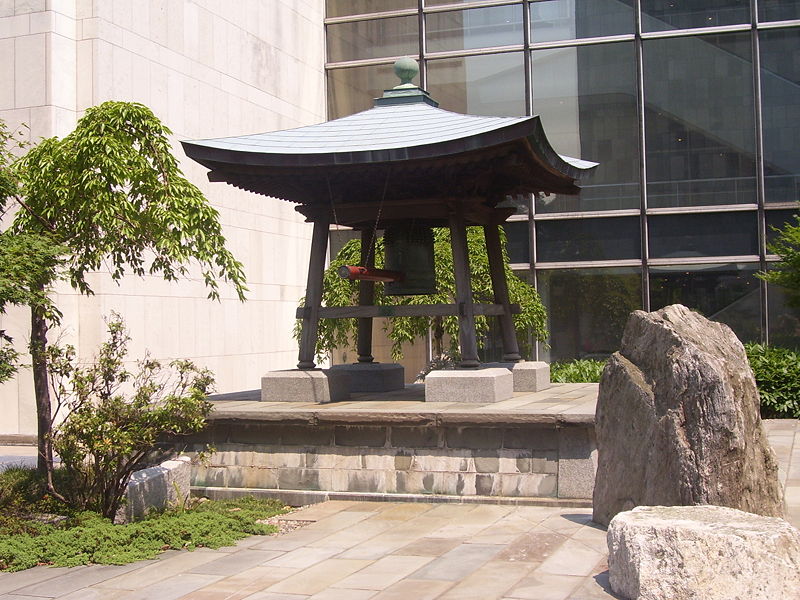
***The Japanese Peace Bell and its en:pagoda at United Nations Headquarters, New York City.| Photograph credit: Dragonbite.| The original uploader was Rodsan18 at English Wikipedia | Wikimedia Commons
If George W. Bush were asked, “What is the conflict with Iraq about?”, he would probably reply, “It is a struggle between good and evil.” “Would you like to expand on that?” “No.” “What is the solution?” “To crush evil!” “Would you like to expand on that?” “No.” If he were asked this twenty times, and quoted each time, he could not get away with it forever. Bush is being under-quoted.
Rome — Geothermal energy, the flow of heat energy radiating from the earth’s core, provides unique opportunities for cost efficient, sustainable food production and processing in developing countries, says a new report published by FAO on 7 April 2015.
For developing countries rich in geothermal activity, using the earth’s heat offers new possibilities for agriculture | FAO
In some developing economies, as much as half of all food produced is lost post-harvest – that’s due in part to a lack of affordable energy for food processing, according to “Uses of Geothermal Energy in Food and Agriculture”.
This makes the use of heat energy for drying foods, pasteurizing milk and sterilizing produce especially interesting for developing countries, where increased food processing can give a boost to food security.
Food drying can prolong the shelf life of nutritious foods like fish and vegetables and make them available year-round, including in times of drought.
7 April 2015 — Regarding the feminine as an object. Women’s bodies, who do they belong to?
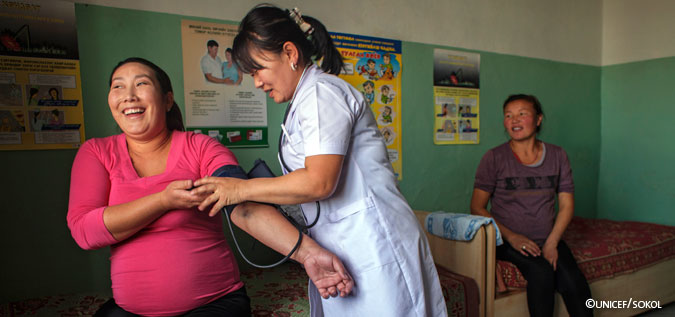
Credit: UNICEF/SOKOL | Source: UN Women
According to Silvia Federici, feminist historian and activist, in the Europe of the middle ages women still exercised undisputed control over their bodies and giving birth.
It was with the advent of capitalism that new ways were introduced to supervise pregnancy and maternity and the crime of infanticide was established (when a baby was still born or died during birth, blame was attributed to the mother).
It’s from then on that women lost control of their bodies and reproduction. Employment became the main source of wealth, and in this light, control over the bodies of women acquired new meaning when they were seen as production machines for manpower.
Today these machines continue to be crucial for the accumulation of capital. The production of manpower continues to be controlled, with decisions made about how many workers are being produced and in what conditions.
Rome, April 2015 – The last International Council (IC) of the World Social Forum (29 and 30 March 2015) in Tunis was characterized by the usual sequence of three-minute statements, without any conclusions. This time, the presence of several people who intervened vehemently, without being members of the IC or representing anyone, added more confusion.
Source: International Forum of National NGO Platforms IFP
ICs are usually held without any control of participants, often in inadequate space, with problems of sound and translation.
And with the passing of the years, the numbers of those who question the present format of the WSF are increasing, with a consensus to postpone the issue until a serious debate on a future occasion.
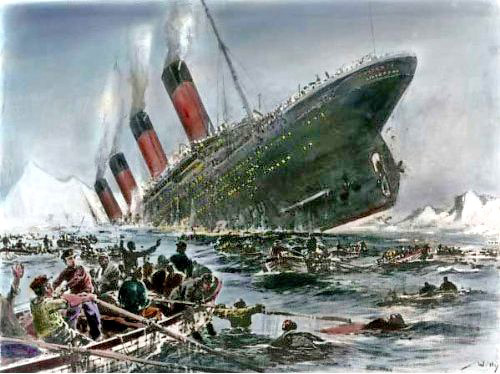
On 15 April 1912, the ‘Titanic’, the largest ship afloat at the time it entered service, sank in the North Atlantic Ocean after hitting an iceberg on its maiden voyage. The large and unnecessary death toll – more than 1,500 passengers and crew – was the result of many factors.
Understanding the psychology that underpins these factors teaches us why so many people died in the ‘Titanic’ disaster. This, in turn, gives us insight into how we might be able to improve our chances of averting the sinking of the Good Ship ‘Earth’ and losing most of its passengers in the years now immediately ahead.
Two key factors in the sinking of the ‘Titanic’ were the ship’s design, including the limited number of watertight compartments in the hull, and the ship’s speed at the time of the incident despite the risk of hitting an iceberg (which could only be detected visually, rather than technologically, in 1912).
The world must make use of the International Day of Reflection on the Genocide in Rwanda to look back on the past – and to squarely confront the challenges of the present, renewing collective resolve and summoning the courage to prevent such atrocities from happening again, United Nations Secretary-General Ban Ki-moon on 7 April 2015 said.
The UN family in Rwanda commemorates the 21st anniversary of the genocide. Photo: UNDP Rwanda
“Our annual sombre observance is all the more meaningful this year as we mark the 70th anniversary of the founding of the United Nations, said Ban in his message on the Day,” which honors the memory of the more than 800,000 people – overwhelmingly Tutsi, and also moderate Hutu, Twa and others – systematically killed across Rwanda in less than three months just over two decades ago.
It is also an occasion to recognize the pain and the courage of those who survived.
With the United Nations health agency highlighting food safety on World Health Day, the Secretary-General on 7 April 2015 called for unified efforts to ensure that production, distribution, and preparation of food is done safely.
At an open market in Haute-Savoie, France, a vendor offers a variety of vegetables, all produced meeting standards recommended by WHO. Photo: WHO/V. Martin
“The health, agriculture, trade, and environment sectors need to work together,” said Ban Ki-moon. “We all have a role to play in keeping food safe – from farm to plate.”*
Ban pointed to the more than 200 diseases that can come from contaminated food and to the constantly evolving threat from new production, distribution and consumption methods, as well as the emergence of resistant bacteria.
“With the food supply chain stretching around the world, the need to strengthen food safety systems within and among countries is becoming more critical,” he said.
6 Apr 2015 – TRANSCEND Media Service – Let us start by summarizing. We are looking at six major leaders of forces and movements shaping centuries–Churchill- Hitler-Stalin-Mao-Gandhi-Mandela–comparing, two at a time.
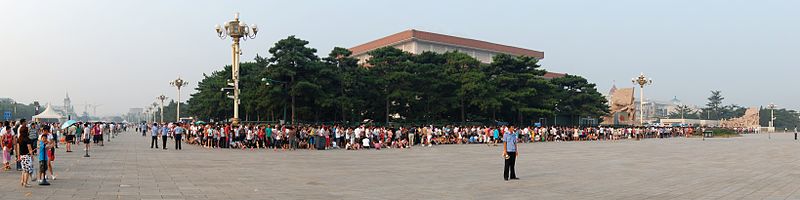
**Images: A line to enter Mao Zedong Mausoleum | Author: Marcin Białek | Wikimedia Commons
We are looking for similarities and dissimilarities. Some of them are out in the open, in their spoken ideologies. But most of them–maybe the most interesting–are hidden to the untrained eye.
There are the similarities when they are from the same civilization and the dissimilarities when different– however much they profess to be on the same or very different lines. The six were themselves hardly aware of this factor.
As Churchill, Hitler and Stalin share the Christian-secular civilization; we would expect anti-Semitism, racism, and little hesitation when killing–by war, starvation (the Lord also did it), by revolution, millions–even with enthusiasm.
Deeper down there are deductive reasonings from axioms about race and class and a final state: the British Empire, the Aryan Reich, for one thousand years, and socialism on the way to the final stage, communism forever; run from London, Berlin, Moscow. So we got the triangular Second World War with Moscow entering two alliances of convenience.
Kisumu, Kenya, 6 April 2015 (Pressenza) — On the 26th of March this year, President Kenyatta shocked those watching and listening as he gave his “State of the Nation” address in parliament.
Elephants at Amboseli national park against Mount Kilimanjaro (Image by user Amoghavarsha on wikimedia commons) | Source: Pressenza
Instead of a regular condemnation of corruption in government as normally happens by Kenyan politicians, Kenyatta went much further by lodging with Parliament a report (not yet made public) containing a list of 175 names of people suspected of being involved in corruption by the Ethics and Anti-Corruption Commission (EACC); a body set up in accordance with the new constitution of 2010.




 HUMAN WRONGS WATCH