Human Wrongs Watch
December 2015 (OXFAM)* – Za’atari refugee camp hosts around 80,000 Syrians who have been forced to flee the war in Syria. More than half of these refugees are children. The size of the camp, now Jordan’s fourth biggest city, is presenting huge challenges for infrastructure.

**A close-up view of the Za’atri camp in Jordan for Syrian refugees as seen on July 18, 2013, from a helicopter carrying U.S. Secretary of State John Kerry and Jordanian Foreign Minister Nasser Judeh. [State Department photo/ Public Domain] | Wikimedia Commons: “This file has been identified as being free of known restrictions under copyright law, including all related and neighboring rights.”
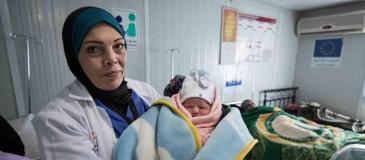
A doctor holds a baby in the maternity center in Za’atari refugee camp, Jordan. | OXFAM
Oxfam currently works in 3 of Za’atari’s 12 districts, supervising, water and sanitation, refuse management and the cleaning and maintenance of wash blocks. We also co-ordinate hygiene promotion activities which are crucial in preventing the spread of disease.
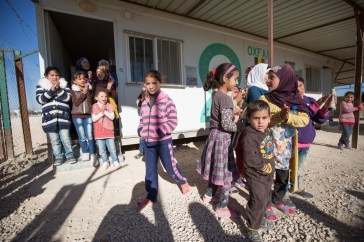
Children outside an Oxfam facility in the Za’atari camp, where we are campaigning for a permanent water and sewage systems. | OXFAM
Oxfam is working with UNICEF and other international actors, to install a water network in the camp which will ensure refugees have safe access to water. When our water network has been completed it will be the largest ever to be constructed in a refugee camp.
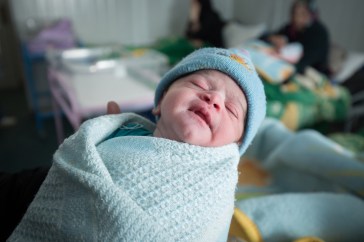
Baby Sham is just a few hours old, and the youngest resident of Za’atari camp when this photo was taken. | OXFAM
In some ways life carries on as normal in the camp, babies are born and some children are able go to school.

Syria, ten, and Hassan, four, walked for almost 12 hours to cross the border from Syria to Jordan. They now live in Za’atari refugee camp with their mother. | OXFAM
As the camp transitions into a semi-permanent city refugees are struggling to find work and create a livelihood for themselves and their families. Many refugees are surviving on meager humanitarian aid or working illegally.

A view of Za’atari camp stretching towards the horizon. | OXFAM
As a host country Jordan is estimated to spend $870 million a year supporting Syrian refugees; if it were treated as a traditional donor, Jordan would have contributed 5,622% of its fair share.

Jamal Ashamed with one of his birds. | OXFAM
Jamal and his seven children fled Syria three years ago. He left everything behind but has managed to reclaim part of his identity, his passion for training pigeons.
Jamal spent some time volunteering with Oxfam, before he was offered the opportunity to work with us as a water distributor.
We are calling for urgent and immediate action by the international community to deal with this deepening crisis: to fully fund the aid response, to offer refuge to those who have fled the country including through resettlement of a fair share of the refugee population, to halt the transfer of arms and ammunition and to revive concerted efforts towards a resolution of the crisis.
Photos: Tom White/ Oxfam
 *Source: OXFAM, an international confederation of 17 organizations working in approximately 94 countries worldwide to find solutions to poverty and what it considers injustice around the world. Go to Original.
—
Additional photo:
**A close-up view of the Za’atri camp in Jordan for Syrian refugees as seen on July 18, 2013, from a helicopter carrying U.S. Secretary of State John Kerry and Jordanian Foreign Minister Nasser Judeh. [State Department photo/ Public Domain] | Wikimedia Commons: “This file has been identified as being free of known restrictions under copyright law, including all related and neighboring rights.“
2015 Human Wrongs Watch
Discover more from HUMAN WRONGS WATCH
Subscribe to get the latest posts sent to your email.
 Baher Kamal
 HUMAN WRONGS WATCH
Leave a comment