Human Wrongs Watch
– After nine years in office, UN Secretary-General Ban Ki-moon will step down in December perhaps without achieving one of his more ambitious and elusive political goals: ensuring the entry into force of the Comprehensive Nuclear-Test-Ban Treaty (CTBT).
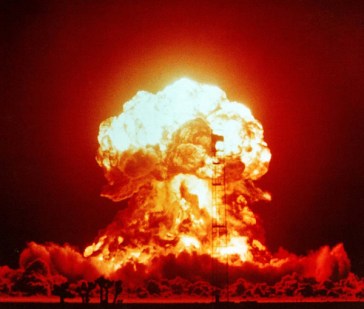
(Image by The Official CTBTO Photostream – flickr.com) | Source: Pressenza
“This year marks 20 years since it has been open for signature,” he said last week, pointing out that the recent nuclear test by the Democratic People’s Republic of Korea (DPRK) – the fourth since 2006 — was “deeply destabilizing for regional security and seriously undermines international non-proliferation efforts.”
Now is the time, he argued, to make the final push to secure the CTBT’s entry into force, as well as to achieve its universality.
In the interim, states should consider how to strengthen the current defacto moratorium on nuclear tests, he advised, “so that no state can use the current status of the CTBT as an excuse to conduct a nuclear test.”
But how close – or how further away– are we from the CTBT coming into force?
Jayantha Dhanapala, a member of the Group of Eminent Persons appointed by the Executive Secretary of the Provisional Technical Secretariat of the Comprehensive Nuclear-Test-Ban Treaty Organisation (CTBTO), told IPS:
“The CTBT was widely acclaimed as the litmus test of the sincerity of nuclear weapon states in their commitment to nuclear disarmament. The concrete promise of its conclusion was among the causes that led to the permanent extension of the Nuclear Non-Proliferation Treaty (NPT) in 1995 under my Presidency.”
He said the fact that this important brake on the research and development of the most destructive weapon invented is not in force is ominous as relations between the major nuclear weapon states – the US and the Russian Federation who hold 93% of the weapons between them – deteriorate with no dialogue across the divide.
Huge sums of money are being spent on modernisation of the weapons and extremist groups practising barbaric terrorism may acquire them adding to the existential threat that the weapons pose, said Dhanapala, a former UN Under-Secretary-General for Disarmament Affairs.
John Hallam, Nuclear Disarmament Campaigner with People for Nuclear Disarmament and the Human Survival Project, told IPS he has, over the years, suggested a number of possibilities for entry into force of the CTBT, including a ‘group of friends’ (governments) declaring that, for them, the CTBT has already entered into force.
Once such group of governments could constitute a comfortable General Assembly (GA) majority in a resolution cementing this in some sense, he added. Possibly at a later stage, he said, one could put up a GA resolution simply declaring that it is now in force. Period.
“I understand fully that such approaches are likely to encounter resistance from non-ratifiers. However the pressure would then be on them to ratify. And a majority should not be bound by the tiny minority of holdouts however influential,” said Hallam.
“And it is an idea I have been gently suggesting in a number of quarters for a number of years,” he pointed out.
The CTBT, which was adopted by the U.N. General Assembly back in 1996, has still not come into force for one primary reason: eight key countries have either refused to sign or have held back their ratifications.
The three who have not signed – India, North Korea and Pakistan – and the five who have not ratified — the United States, China, Egypt, Iran and Israel – remain non-committal 20 years following the adoption of the treaty.
Currently, there is a voluntary moratoria on testing imposed by many nuclear-armed States. “But moratoria are no substitute for a CTBT in force. The four nuclear tests conducted by the DPRK are proof of this, Ban said.
In September 2013, a group of about 20 “eminent persons” was tasked with an unenviable job: convince eight recalcitrant countries to join the CTBT.
Under the provisions of the CTBT, the treaty cannot enter into force without the participation of the last of the eight key countries.
Addressing the UN’s Committee on Disarmament and International Security last October, Lassina Zerbo, Executive Secretary of the CTBTO, said it was necessary to reignite the spirit of the 1990s and go beyond the “business-as-usual” approach of recent years.
“It was necessary to further disarmament, because they would lead the process and see it through. Operationalizing the CTBT would greatly increase the capacity of the international community to address proliferation and advance prospects for those weapons’ eventual elimination”.
In the current millennium, he pointed out, there had only been one county (DPRK) that had violated the moratorium on nuclear testing. “Action was still needed to secure the future of the Treaty as a firm legal barrier against nuclear testing and the nuclear arms race,” he said.
He said nuclear weapons and nuclear testing had a dangerous and destabilizing impact on global security, as well as a negative impact on the environment. More than $1 billion had so far been invested in the most sophisticated and far-reaching verification regime ever conceived.
Significant national security decisions were made in good faith, with the expectation that the Treaty would become legally binding, in line with international law. Countries should finish the job done by experts, he added.
“The challenges of disarmament and non-proliferation required bold ideas and global solutions, as well as the active engagement of stakeholders from all corners of the world. Equally important was building capacity among the next generation of experts, who would carry the endeavours forward,” Zerbo declared.
Hallam told IPS whatever multilateral initiative is adopted, something has got to be done that does an end run around entry-into-force conditions in the text of the treaty, that are, almost impossible ever to satisfy. They have to be in some way short-circuited.
He said that other alternatives must be sought, and that” we should be creative in doing so.”
“I think the CTBTO is already doing a splendid job (and specifically that Lassina Zerbo is doing a great job in promoting it), and this fact already stands it in good stead.”
It would be important to ensure that raw data from the CTBTO sensor network is readily and quickly available to the research community – not just the nonproliferation community but others who might be interested such as geophysicists and climate researchers, not to mention tsunami warning centres, he added.
*Thalif Deen’s article was published in IPS. Go to Original.
Related articles in Human Wrongs Watch
Nuclear Weapons and Nuclearism: Abolish or Be Abolished
The Urgent Need for Complete Abolition of Nuclear Weapons
Doomsday Clock: Nuclear Arsenals More Dangerous Now than During the Cold War
Governments to Start Talks on New Law on Nuclear Weapons in 2016
Pro-nuclear Politicians Never Studied What It Means to Have Nuclear Weapons
Don’t Get Excited: Nuclear Disarmament Is Not on the Horizon
‘Persisting Risk of Nuclear Weapons; Dangerous Return to Cold War Mentalities’
Nuclear Weapons Abolition – “NATO” Is Not an Excuse
Nuclear Weapons Abolition – ‘US Attempts to Bully Allies into Inaction’
Tell Your Bank Not to Invest in Nuclear Weapons!
Initiative on Humanitarian Impact of Nuclear Weapons Takes Centre Stage at UN General Assembly
‘The Damage Caused by Past Nuclear Testing Cannot Be Reversed’
Nuclear — Despite Price Dip, Uranium Demand, Production Continue to Rise
UN Officials Call for Renewed Global Commitment to Ending Nuclear Tests
Do You Have the Courage to Ban Nuclear Weapons?
Why Is the Total Elimination of Nuclear Weapons So Urgent?
Hiroshima: The Myth of “Military Necessity”
Inhumane, Illegal, Immoral and Cruel: a Survivor Account of the Hiroshima Bombing
Banks, Pension Funds, Insurance Companies in 30 Countries ‘Invest’ Your Money in Nuclear Arms
‘Humanity Could Not Survive a Nuclear War Using Even a Fraction of Existing Arsenals’
Another Lost Chance to Save Middle East from Mass Destruction
Watch The Sky–It May Rain Atomic Bombs
Nuclear Terrorism – Killing 100,000 People Not Very Difficult
Humanitarian Consequences of Nuclear Weapons — Are You Ready to Hit the Gas?
Ecocide, a Catastrophic Consequence of Nuclear Weapons
“Breaking the Nuclear Chain” Campaign
Pressure to Push the Nuclear Genie Back in the Bottle
Germany Resolved to Pave the Way to Nuclear Disarmament
India, Pakistan Engaged in World’s Most Active Nuclear Arms Race
World Nuclear Forces: ‘Fewer But Newer’ Weapons
Desert “Star Wars”, Respect Dignity of Life
Nuclear Dangers, The World Is “One Minute Closer to Midnight” U.S. Spending on Atomic Bombs Doubles UN Budget
Of Dr. Strangelove and the Risk of Using Atomic Bombs World Campain Against False ‘Nuclear Deterrence Doctrine’
The Story of Child Yami and the Atomic Bomb
Obama and How to Save a Quarter of a Trillion Dollars
You Choose: $105 Billion a Year for Health Care or Nuclear Weapons?
Read on nuclear Middle East:
Non-Proliferation Treaty: Nuclear Weapons and Tension Areas
No Way to Free Middle East from Nuclear Weapons – UN Warns of ‘Dangerous Return to Cold War’
Arabs Set to Create Their Own NATO, Urge a Nuclear-free Middle East
The Middle East Oil/Nuclear Puzzle
Anti-Nukes Move from Norway to Bahrain
The NPT’s “Unacceptable and Continuous Failure”: Egypt Walks Out
Fed Up With Empty Promises, The Arab May Abandon Nuclear Non-Proliferation Treaty
Middle East Nuclear Free Bid Moves to Finland – Yet Another Lost Chance?
Nuclear Free Middle East “High Priority” Nuclear Free Middle East — Necessary Yet Impossible
Middle East — France’s Fuzzy Face on Nuclear Abolition
‘Strong UN Commitment’ to Nuclear-free Middle East Conference
Another Lost Chance to Save Middle East from Mass Destruction
Tactical Nuclear Weapons in Europe – The Dangers Are Very Great Today
Will Israel Attack Iran … Really?
Top US Military Commander: ‘I Don’t Want to Be Complicit’ if Israel Attacks Iran
US Defense Secretary Warns of ‘Pearl Harbor’ Cyber Attack by Iran
2016 Human Wrongs Watch
Discover more from HUMAN WRONGS WATCH
Subscribe to get the latest posts sent to your email.
 Baher Kamal
 HUMAN WRONGS WATCH
Leave a comment