The Gaza Strip is a war-ravaged, poverty-stricken area, locked into 365 square kilometers and living under a tight illegal blockade on land, air a sea, which entered its tenth year in June 2016.
The blockade, in addition to recurrent armed violence and conflict, today remains the principle causes of the socio-economic and psychosocial crisis in Gaza.
The restrictions on movement of people and goods continue to collectively punish the civilian population, affecting every aspect of life in Gaza, undermining the local economy and threatening the enjoyment of most human rights, in clear violation of Israel’s legal obligations under international law.
20 June 2016 – TRANSCEND Media Service– The 12 June 2016 exchange of artillery fire along the heavily militarized frontier between Ethiopia and Eritrea could be just one of the periodic skirmishes between the two States. However, it could be the first signs of a flare up of violence. There have been calls from the United Nations and African Union officials for “restraint” but as yet no steps for real conflict resolution.
**This image is a map derived from a United Nations map. | User: Jeroen (talk | contribs) | Public Domain | Wikimedia Commons.
The Imburi are spirits that are said to inhabit the forests of Gabon in Equatorial Africa and who cry out for those who can hear them at times of impending violence or danger.
21 June 2016 – Vast swathes of war-torn Yemen – 19 out of 22 governorates – are facing severe food insecurity, and the situation within affected areas is likely to deteriorate if conflict persists, according to a new assessment by the United Nations and partners.
At least 7 million people across Yemen are living under emergency levels of food insecurity. A further 7.1 million people are in a state of crisis, according to the latest assessment. Photo: WFP/Asmaa Waguih
The latest Integrated Food Security Phase Classification (IPC) analysis confirms that over half the country’s population is living in ‘emergency’ or ‘crisis’ levels of food insecurity, with some governorates seeing as much as 70 per cent of their population struggling to feed themselves.
ROME, 19 June 2016 (IPS) – Will the rapid–though silent escalation of political tensions between the European Union and Turkey, which has been taking a dangerous turn over the last few weeks, push Ankara to drop a “human bomb” on Europe by opening its borders for refugees to enter Greece and other EU countries?
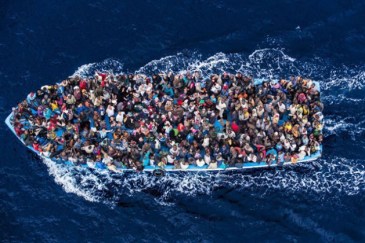
Hundreds of refugees and migrants aboard a fishing boat moments before being rescued by the Italian Navy as part of their Mare Nostrum operation in June 2014. Photo: The Italian Coastguard/Massimo Sestini | Source: UN News Centre
17 June 2016 (UN News Centre)* – Renowned photographer Giles Duley, who barely survived a 2011 explosion in Afghanistan in which he lost both legs and part of his left arm, now reports for the United Nations refugee agency, and feels that his lasting wounds have allowed him to better connect with people and capture their stories.
With fear etched on their faces, clearly still suffering from the trauma of a rough by boat across the Aegean, an Afghan family arrives in Lesvos, Greece (2015). Photo: UNHCR/Giles Duley
Most recently, Mr. Duley’s focus has been on the refugee situation in Europe; in October 2015, he began a project documenting their flight from conflict in the Middle East, starting from Lesvos, Greece, where an unprecedented number of people have arrived via tumultuous, and often deadly rides across the Mediterranean Sea.
NATO is supposed to be a defensive alliance, whose purpose is to “protect Europe from aggression”; but today it is aggressive tool of the United States. Today NATO is threatening to drive Europe into an all-destroying thermonuclear war with Russia.
**[NATO members intervention in Libya]: Part of a group of six (italian built) Palmaria heavy howitzers of the Gaddafi forces, destroyed by French Rafale airplanes at the west-southern outskirts of Benghazi, Libya, in Opération Harmattan on March 19, 2011. In the background other destroyed vehicles along the street that leads from Benghazi to Ajdabija. | Author: Bernd.Brincken | Creative Commons Attribution-Share Alike 3.0 Unported license. | Wikimedia Commons
13 June 2016 (UNICEF)*– Alone on the move to Europe, their friendship started when seven Gambian boys met while waiting to travel by boat from Libya to Italy. Referencing their journey, the boys named their crew “Do it or die”.
World Economic Forum* – In 2015, when more than a million refugees and migrants arrived on European shores, the reaction in many countries quickly turned to tightening border controls and erecting fences. Public opinion became increasingly alarmed, with some irresponsible politicians stoking fears and adding to growing tensions.
Nearly 800 million people are chronically undernourished as a direct consequence of land degradation, declining soil, fertility, unsustainable water use, drought and biodiversity loss, requiring long-term solutions to help communities increase resilience to climate change, United Nations Secretary-General Ban Ki-moon on 17 June 2016 declared.
.
Baobab tree in a degraded, arid landscape in Kenya’s Eastern province. Photo: World Bank/Flore de Preneuf | Source: UN News Centre
“The livelihoods and well-being of hundreds of millions of people are at stake,” the Secretary-General said in his message to mark the World Day to Combat Desertification, whose theme this year is ‘Protect Earth. Restore land. Engage people.’
ROME, 17 June 2016 (IPS) – Allow me a rare personal anecdote. In 1965 I met Lord [Alexander Frederick Douglas-] Home, who had just left the post of Prime Minister and we had a mutual sympathy. Lord Home invited me for lunch at the Chamber of Lords. Over an extremely delicious rump of Scottish lamb, I asked if I was allowed to ask a complex question.
Roberto Savio
I explained that I had started my professional career as a Kremlinologist, which had served me well in following British foreign policy.
One day London was looking to Europe as its compass, and another day, to Washington.
All this on the basis of small signals, difficult to detect.
Could his Lordship explain to me how to address this dualism?
Lord Home’s answer was that only a British citizen could understand the dualism, and therefore, I should try to be British for five minutes.





 HUMAN WRONGS WATCH