11/12/2016
9 December 2016 – A new report by INTERPOL and the United Nations Environment Programme (UNEP) links environmental crimes with other serious illegal activity, including corruption, counterfeiting, drug trafficking, cybercrime, and financial crimes as well as with terrorist organizations and non-State armed groups.

Illegal trade in wildlife and timber products finances criminal and militia groups, threatening security and sustainable development. Photo: World Bank/Curt Carnemark ” Source: UN News Centre
“Environmental crime is transnational in scope and insidious in nature. It robs governments of much-needed revenues, people of their livelihoods, and communities of peace and security,” announced Jürgen Stock, Secretary General of INTERPOL, the world’s largest international police organization.
read more »
Posted in Africa, Asia, Latin America & Caribbean, Market Lords, Middle East, Mother Earth, Others-USA-Europe-etc., The Peoples, War Lords |
Leave a Comment »
11/12/2016
Upholding human rights is in the interest of all and are at the heart of the work and identify of the United Nations, Secretary-General Ban Ki-moon on 9 December stressed ahead of Human Rights Day, calling on the international community to “stand up for someone’s rights today, tomorrow and every day.”

A voter displays proof of having exercised her voice at the ballot box in Timore-Leste’s parliamentary elections. UN Photo/Martine Perret
In his message on the Day, Ban recalled that over the decade of his tenure as UN chief, he has repeatedly stressed the interdependence of the three pillars of the Organization – peace, sustainable development and human rights.
“Together, they form the basis of resilient and cohesive societies rooted in inclusion, justice and the rule of law,” he said, noting that human rights are also at the heart of the work of the UN.
read more »
Posted in Africa, Asia, Latin America & Caribbean, Market Lords, Middle East, Mother Earth, Others-USA-Europe-etc., The Peoples, War Lords |
Leave a Comment »
08/12/2016
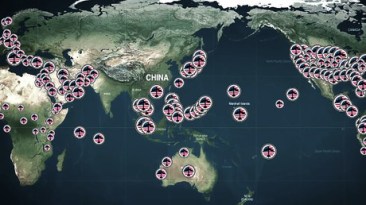
A major US military build-up – including nuclear weapons – is under way in Asia and the Pacific with the purpose of confronting China. John Pilger raises the alarm on an under-reported and dangerous provocation.
.

4 Dec 2016 – When I first went to Hiroshima in 1967, the shadow on the steps was still there. It was an almost perfect impression of a human being at ease: legs splayed, back bent, one hand by her side as she sat waiting for a bank to open.
At a quarter past eight on the morning of 6 August, 1945, she and her silhouette were burned into the granite. I stared at the shadow for an hour or more, unforgettably. When I returned many years later, it was gone: taken away, “disappeared”, a political embarrassment.
read more »
Posted in Africa, Asia, Latin America & Caribbean, Market Lords, Middle East, Mother Earth, Others-USA-Europe-etc., The Peoples, War Lords |
Leave a Comment »
08/12/2016
8 Dec, 2016 — Nuclear war is no longer unthinkable as it may be provoked by a US military build-up in the Pacific, clearly aimed at confronting Beijing, John Pilger says in his new documentary ‘The Coming War on China’, set to be aired on rt.com and the RTD channel.
.
According to the BAFTA-winning journalist and filmmaker, mainstream media reports of Beijing’s ambitious expansion and reclaiming of land in the South China Sea is in fact a response to US military activity around its borders.
US President Barack Obama’s pivot to Asia in 2011 has resulted in the construction of 400 American bases, including in Guam, elsewhere in the South China Sea, South Korea and Japan – thereby encircling China.
read more »
Posted in Africa, Asia, Latin America & Caribbean, Market Lords, Middle East, Mother Earth, Others-USA-Europe-etc., The Peoples, War Lords |
1 Comment »
08/12/2016
The United Nations and its partner non-governmental organizations on 7 December 2016 launched an appeal for $2.66 billion to provide emergency assistance across eight countries in the Sahel region, where “millions of people still live in conditions of deplorable human suffering.”

Two young boys at Maina Kaderi camp for internally displaced persons in the Diffa region, Niger. Photo: OCHA/Federica Gabellini
“The Sahel faces considerable challenges and will remain the site of one of the world’s major humanitarian operations in 2017,” stated UN Regional Humanitarian Coordinator Toby Lanzer, in a news release on the appeal, which aims to cover the needs of 15 million people across Africa’s Sahel region, which includes Chad, Mali, Niger, Cameroon, Nigeria, Burkina Faso, Mauritania and Senegal.
read more »
Posted in Africa, Asia, Latin America & Caribbean, Market Lords, Middle East, Mother Earth, Others-USA-Europe-etc., The Peoples |
Leave a Comment »
08/12/2016
ROME, Dec 6 2016 (IPS) – Is the demise of Matteo Renzi really a local affair? There is no doubt that a referendum on a constitutional change can be a matter of confidence in him, having personalized the issue to a point that it became basically a vote on the Italian young Prime Minister.

Roberto Savio
But if you look at the sociology of the vote, you find that the No vote was again coming from the poorest parts of Italy.
A case study is Milan. Voters living in the centre voted Yes, and those in the periphery voted No.
Is this not similar to what has happened in Brexit and in the US elections?
Renzi fell into the same trap like Cameron, calling for a referendum on a very complex issue and putting at stake his own credibility and prestige, to be swept away by an unexpected tide of resentment. Lamented Renzi: “I had no idea I was so hated”.
This is important. It shows how politicians, even those as brilliant as Renzi, do not realize that there is a tsunami of resentment that has been out there for some years, has been ignored by the establishment, by the media and by politics.
read more »
Posted in Africa, Asia, Latin America & Caribbean, Market Lords, Middle East, Mother Earth, Others-USA-Europe-etc., The Peoples, War Lords |
Leave a Comment »
07/12/2016
Human Wrongs Watch
Robert J. Burrowes*
DAYLESFORD, Australia, 6 December, 2016 — On the day that you read this article, 200 species of life on Earth (plants, birds, animals, fish, amphibians, insects, reptiles) will cease to exist. Tomorrow, another 200 species will vanish forever.

Robert J. Burrowes
The human onslaught to destroy life on Earth is unprecedented in Earth’s history.
Planet Earth is now experiencing its sixth mass extinction event and Homo sapiens sapiens is the cause.
Moreover, this mass extinction event is accelerating and is so comprehensive in its impact that the piecemeal measures being taken by the United Nations, international agencies and governments constitute a tokenism that is breathtaking in the extreme.
And it is no longer the case that mainly ‘invisible’ species are vanishing: those insects, amphibians and small animals about which you had never even heard, assuming they have been identified and given a name by humans.
read more »
Posted in Africa, Asia, Latin America & Caribbean, Market Lords, Middle East, Mother Earth, Others-USA-Europe-etc., The Peoples, War Lords |
Leave a Comment »
07/12/2016
6 December 2016 – Nearly 75 per cent of domestic workers 15 and older are estimated to work in informal employment situations, according to a new study by the United Nations International Labour Organization (ILO), which calls for a combination of incentives and compliance to reduce high levels of informality in domestic work.

A domestic worker washes clothes by hand in New Delhi, India. Photo: ILO/B. Patel
The report, Formalizing Domestic Work, confirms that because domestic work takes place in the private sphere, many households do not make use of formal arrangements, whether due to cost concerns, lack of information, or a belief that domestic labour is not real work.
read more »
Posted in Africa, Asia, Latin America & Caribbean, Market Lords, Middle East, Others-USA-Europe-etc., The Peoples |
Leave a Comment »
07/12/2016

Credit: Amantha Perera/IPS
Trump has recently emphasised that he will take the US out of the Trans Pacific Partnership Agreement (TPPA) on his first day of office, and renegotiate the North American Free Trade Agreement (NAFTA).
read more »
Posted in Africa, Asia, Español, Market Lords, Middle East, Mother Earth, Others-USA-Europe-etc., The Peoples, War Lords |
Leave a Comment »
06/12/2016
Marine debris is negatively affecting more than 800 animal species and causing serious losses to many countries’ economies, according to a United Nations report launched on 5 December 2016.

Marine waste, mainly fishing gear, being collected on the beaches of Northwest Spitsbergen, Norway. Photo: UNEP GRID Arendal/Peter Prokosch
The report, Marine Debris: Understanding, Preventing and Mitigating the Significant Adverse Impacts on Marine and Coastal Biodiversity found that the number of species affected by marine debris has increased from 663 to 817 since 2012.
It also warned that this type of waste, which is mostly made of plastic, is an increasing threat to human health and well-being, and is costing countries billions of dollars each year.
read more »
Posted in Africa, Asia, Latin America & Caribbean, Market Lords, Middle East, Mother Earth, Others-USA-Europe-etc., The Peoples |
Leave a Comment »




 HUMAN WRONGS WATCH