15/04/2017
The trend continued last week when the Green Climate Fund (GCF), a new multilateral financing body set up to fund climate change related projects in developing countries, rejected a proposal to help farmers in Ethiopia cope with increasingly frequent droughts.
Only two of the other eight projects worth 755 million USD approved at the meeting were in least developed countries:
read more »
Posted in Africa, Asia, Latin America & Caribbean, Market Lords, Middle East, Mother Earth, Others-USA-Europe-etc., The Peoples |
Leave a Comment »
15/04/2017
By Amb. Sergio Duarte*
10 Apr 2017 – TRANSCEND Media Service – The nine possessors of nuclear weapons and most of their allies chose to ignore the negotiations on a legally binding instrument to prohibit nuclear weapons, leading towards their total elimination.

Image by The Official Comprehensive Nuclear-Test-Ban Treaty Organization (CTBTO) Photostream – flickr.com
This unprecedented initiative resulted from a proposal by South Africa, Austria, Brazil, Ireland, Mexico and Nigeria and was adopted by the United Nations General Assembly in December 2016 by an overwhelming majority.
read more »
Posted in Africa, Asia, Latin America & Caribbean, Market Lords, Middle East, Mother Earth, Others-USA-Europe-etc., The Peoples, War Lords |
Leave a Comment »
13/04/2017
ROME, Apr 13 2017 (IPS) – Perhaps you are not aware enough of the fact the oceans have it all! What is “all”? Well, oceans have from microscopic life to the largest animal that has ever lived on Earth, from the colourless to the shimmering, from the frozen to the boiling and from the sunlit to the mysterious dark of the deepest parts of the planet. Who says that?

Healthy oceans have a central role to play in solving one of the biggest problems of the 21st century – how to feed 9 billion people by 2050. Credit: FAO
It is the United Nations, which by the way reminds that oceans are an essential component of the Earth’s ecosystem –a source of biodiversity, food, and life. Just think that over 40 per cent of the world’s population lives within 100 kilometres of the coast.
read more »
Posted in Africa, Asia, Latin America & Caribbean, Market Lords, Middle East, Mother Earth, Others-USA-Europe-etc., The Peoples |
Leave a Comment »
13/04/2017
12 April 2017 – The use of children, particularly girls, by the Boko Haram terrorist group in violent attacks in the Lake Chad region has seen an “alarming” surge in 2017, the United Nations Children’s Fund (UNICEF) has reported.
.
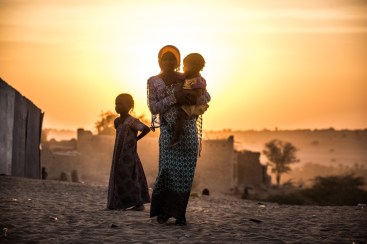
A girl carries her sister as another stands by her in the village of Mao in Chad. Photo: UNICEF/Tremeau
According to the UNICEF report, Silent Shame: Bringing out the voices of children caught in the Lake Chad crisis, 27 children have been used to carry out bomb attacks in public places across Nigeria, Chad, Niger and Cameroon in the first quarter of this year. During the same period last year, the number was nine.
read more »
Posted in Africa, Middle East, Others-USA-Europe-etc., The Peoples, War Lords |
Leave a Comment »
13/04/2017
12 April 2017 – The United Nations envoy for Africa’s Great Lakes region encouraged today the countries of the region, and the UN Security Council, to help strengthen the fight against illegal armed groups in the Democratic Republic of the Congo (DRC) and its neighbours, particularly as elements of the former M23 rebel group have resurfaced.
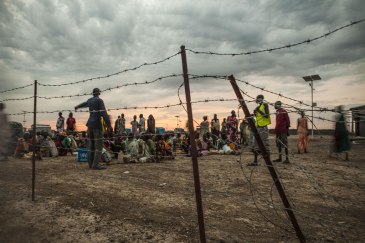
Internally displaced persons (IDPs) line up early in the morning for a general food distribution at the UN Protection of Civilians Site, Malakal, South Sudan. Photo: IOM/Bannon
“The persistent activities of illegal armed groups remain one of the main threats to the security of the population and the stability of the DRC and the region,” said Said Djinnit, the Special Envoy for the Great Lakes Region told the Security Council.
read more »
Posted in Africa, Market Lords, Middle East, Others-USA-Europe-etc., The Peoples, War Lords |
Leave a Comment »
13/04/2017
ROME, Apr 12 2017 (IPS) – Nearly 50 per cent of all emergency multilateral food assistance to Africa is due to natural disasters, with advancing droughts significantly threatening both livelihoods and economic growth, warns the African Union through its ground-breaking extreme weather insurance mechanism designed to help the continent’s countries resist and recover from the ravages of drought.
The mechanism, known as the African Risk Capacity (ARC) provides participating African states with quick-disbursing funds in the event of drought, and assists countries in developing drought response contingency plans to implement timely and effective responses.
read more »
Posted in Africa, Market Lords, Middle East, Mother Earth, Others-USA-Europe-etc., The Peoples, War Lords |
Leave a Comment »
13/04/2017
11 April 2017 – Warning of increasing risk of mass deaths from starvation in many countries in Africa and in Yemen due to worsening drought and conflict, the United Nations refugee agency has called for international support to prevent the repeat of the 2011 tragedy in the Horn of Africa that claimed more than 260,000 lives.
.
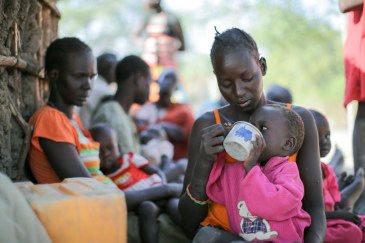
A two-year old child is fed an infusion of neem tree leaves in Rumbek, South Sudan. Photo: UNHCR/Rocco Nuri
Posted in Africa, Asia, Market Lords, Middle East, Others-USA-Europe-etc., The Peoples, War Lords |
Leave a Comment »
13/04/2017
The United Nations World Food Programme (WFP) is scaling up its emergency operations in war-torn Yemen to provide urgently needed food assistance to some nine million people, the agency on 12 April 2017 said.
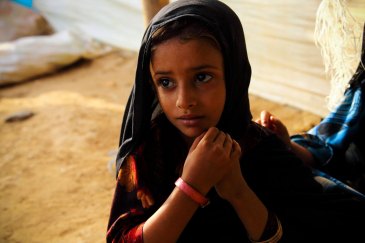
In Mazrak, Yemen, a five year-old girl, diagnosed as malnourished, is given a pink wristband to wear to show she has not been getting enough to eat. Photo: UNHCR/Hugh Macleod
“We are in a race against time to save lives and prevent a full-scale famine unfolding in the country, but we urgently need resources to do this,” said the WFP Representative and Country Director in Yemen, Stephen Anderson.
The new emergency operation will require up to $1.2 billion over a one-year period and should allow WFP to gradually scale up assistance to feed all severely food insecure people in Yemen every month.
read more »
Posted in Africa, Asia, Market Lords, Middle East, Mother Earth, Others-USA-Europe-etc., The Peoples, War Lords |
Leave a Comment »
11/04/2017

A Warsaw protest in solidarity with Ameer Alkhawlany. The banner reads ‘Free Ameer’. Credit: TV Kryzys
Pawel Koteja, his professor at the institute, told Polish media that Alkhawlany was “very committed to his scientific research, to which he dedicated a lot of time and effort, and was determined to pursue an academic career.”
read more »
Posted in Africa, Asia, Latin America & Caribbean, Market Lords, Middle East, Others-USA-Europe-etc., The Peoples, War Lords |
Leave a Comment »
11/04/2017
By Johan Galtung*
10 April 2017 – TRANSCEND Media Service – For some insights in science at its best see Peter Atkins, Galileo’s Finger-The Ten Great Ideas of Science: evolution, DNA, energy, entropy, atoms, symmetry, quanta, cosmology, spacetime, arithmetics (Oxford University Press, 2003).
Johan Galtung
All Western in space, and most of them fairly recent in time. There could be some spatial and temporal myopia at work here. But the book is highly recommended.
Galileo’s finger points to two pillars for science: scientific knowledge must be based on empirical facts observed or by experiments; and the language to express scientific knowledge is mathematics.
First objection: only the past can produce empirical facts; that limits what might or ought to be to what already have been facts. But humans are capable of transcending the past, and create new facts.
read more »
Posted in Africa, Asia, Latin America & Caribbean, Market Lords, Middle East, Mother Earth, Others-USA-Europe-etc., The Peoples |
Leave a Comment »


 HUMAN WRONGS WATCH
