Human Wrongs Watch
By Baher Kamal*
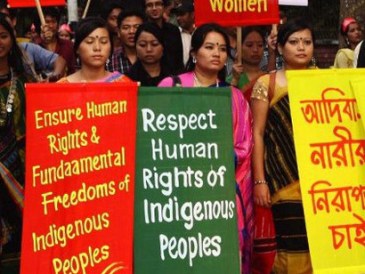
Kapaeeng Foundation – Photo Hiran Mitra Chakma
While totalling over 370 million self-recognised indigenous peoples, and in spite of the very fact that their lands guard 80 per cent of the world’s biodiversity, the original inhabitants of planet Earth, in particular women and girls, have been systematically falling victims of natural resources and land grabbers.
See what a major international organisation supporting indigenous peoples’ struggle for human rights and self-determination says: indigenous peoples “have long stood at the frontline of resistance against land grabbing caused by, for example, deforestation; mineral, oil, and gas extraction; and the expansion of plantations, national parks, agribusiness, dams and infrastructure.”
In fact, the International Working Group for Indigenous Affairs (IWGIA) reports that global race for economic growth and the increasing material consumption and trade have consequences for indigenous peoples globally.
“Their lands and territories have been appropriated, grabbed, sold, leased or simply plundered and polluted by governments, private companies and powerful individuals.”
And many indigenous peoples have been uprooted from their land “through discriminatory government policies or armed conflict,” a trend that goes beyond Bangladesh.

Land Grabbing
Land grabbing causes forced evictions and other forms of gross human rights abuses, which happen on a large scale in Africa and Asia, the Copenhagen-based organisation further reports, adding that this is driven by very strong forces and is exacerbated by the fact that many indigenous peoples suffer from a weak legal protection of their lands.
Therefore –it adds – indigenous peoples’ lands are often seen as fertile ground for natural resource exploitation since there is no ‘visible’ use or occupation of the land – or simply because the use of the land is not seen as profitable/adequate.
Brutal Sexual Violence
In some states like Bangladesh indigenous women and girls have been reportedly increasingly raped and abused in land-related conflicts, especially in militarised areas.
The case has been revealed by IWGIA, which has warned just ahead of the International Women Day on 8 March that “the latest example of brutal sexual violence against indigenous women and girls in Bangladesh sparked international attention last month, when two young indigenous Marma sisters were allegedly raped and assaulted by security forces in Rangamati Hill District.”
According to the organisation, 20 years after the government of Bangladesh signed a peace accord to solve long standing territorial and natural resources conflicts, “violence against indigenous women and girls is intensifying as a tool in the midst of the unresolved land conflict.”
Indigenous Women Raped for Land Grabbing
Unspoken Struggle
For its part, the Human Rights organisation for Indigenous Peoples of Bangladesh, the Kapaeeng Foundation has reported that the incidents of violence against indigenous women have been increasing every year.
“In this densely populated country, the struggle over land and resources is extremely present in the everyday life of the communities. Rape continues to be the type of assault that indigenous women are most often victims of.”
Kapaeeng Foundation’s latest research –to be published soon– indicates that only in 2017 an estimated 56 indigenous women were sexually or physically assaulted by 75 alleged perpetrators, most of them non-indigenous.
“What is more, most of the rape victims were children and girls below 18 years old. All of this without contemplating the many cases that go unreported because the victims fear both retaliation by the offenders and social ostracism.”
On this, Pallab Chakma, Director of the Kapaeeng Foundation, stressed, “What is important to understand is that this violence is driven by unresolved land disputes. The perpetrators are part of an organised strategy to grab their lands, using terror and rape as its main weapon to suppress indigenous peoples’ claims.”
According to the International Working Group for Indigenous Affairs indigenous women and girls are left alone in a fragile state of unprotectedness. “They face challenges while accessing medical treatment and legal justice, particularly in remote areas, where they navigate a justice system that does not recognise their indigenous languages and cultural traditions.”
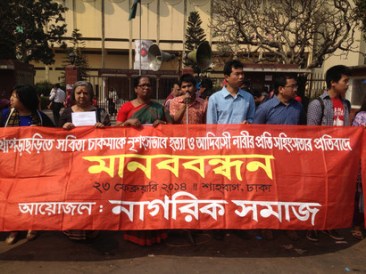
Bangladesh indigenous women – Kapaeeng Foundation
Hostages
This is the case of a continuous struggle driven by land grabbing. About it, IWGIA explains that the Chittagong Hill Tracts (CHT) – situated in the South-Eastern part of Bangladesh – is home to 11 different indigenous peoples, with a population estimated at 700,000 by the last census in 2011.
Land grabbing in the name of ‘development’ interventions, militarisation, corporate greed, energy and forestry projects on their ancestral lands have pushed the survival of indigenous peoples in Bangladesh to an alarming state, warns IWGIA.
The Kapaeeng Foundation reported that “evidence also shows that many victims were unable to properly file a complaint with relevant authorities due to language barriers, cultural barriers, lack of awareness of the laws, and lack of resources to access judicial support.”
The Foundation’s research has also found that doctors at hospitals delay health check-ups abetting the evidence to disappear.
“Even though military presence is argued for promoting conflict resolution, many claim that it has instead worsened the conflicts. Military personnel are often the alleged perpetrators and had largely enjoyed impunity. A study report commissioned by the CHT Commission reveals that not a single conviction had taken place out of 215 cases occurred in the CHT documented by them.”
Signe Leth, senior advisor on Land Rights in Asia at IWGIA, explains that the root of the escalating violence comes down to discrimination at its core. And that for indigenous peoples discrimination most often means being deprived of the right to their land – this is the case all over Bangladesh.
“It is unspoken that this is one of the most heavily militarised areas in the world with 1 military person per 6 indigenous peoples,” she adds.
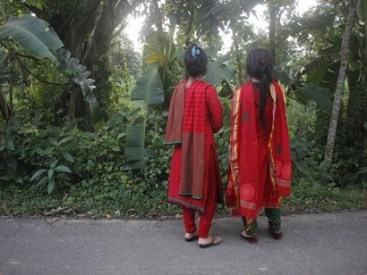
Bangladesh indigenous women – IWGIA
Access to Justice
Meanwhile, “some of the areas where the violence takes place are so remote that you can only reach them by walking”, explains lawyer Projjal Chakma at Kapaeeng Foundation. For him, besides the obstacles of geographical location, the challenge is that there is very little expertise and resource allocation within the justice system to deal with cases against indigenous women.
According to Projjal Chakma, at the end of 2016 the CHT district had a total of 5,000 cases waiting to be solved, of which an average of 15 are filled on the ground of violence against indigenous women and girls.
“Given the fact that there is only one district court with one judge handling all cases, that meant that maybe 5 of the cases could be processed a day. As a result of this, the system in itself encourages the victims to settle their disputes outside of the courtroom.”
Here, Amnesty International in its report Hidden Bangladesh: Violence and Brutality in the Chittagong Hill Tracts says the following:
.
“When you think of Bangladesh you may think of a vibrant nation of teeming people in the Ganges delta. The Chittagong Hill Tracts are altogether different: impossibly green, forested mountains rise above lakes in a verdant, uncrowded land – a side of Bangladesh most people never see. This is hardly surprising: since March 2015, access to outsiders is tightly controlled and the indigenous people are forbidden to speak to foreigners without supervision.”
“The Chittagong Hill Tracts in Bangladesh have been affected by what has been described as “genocide” or “ethnic cleansing” for many year.”
“In the 1960s and 1970s, thousands were forced off their lands to make way for reservoirs and hydroelectric schemes, a displacement made worse by massacres against the Jumma people (the collective name for all indigenous peoples in the region), and nearly twenty years of conflict against a military dictatorship and also with the democratic government of Bangladesh.”
“This only ended in 1997 when a peace accord recognised the rights of the Jumma people over their lands. This accord remains largely unimplemented and the Jumma people are not even acknowledged in the Bangladesh constitution.”
“The Bangladesh government has settled hundreds of thousands of Bengali people in the Chittagong Hills, and they now make up the majority of the population in the region. Settlement has not been peaceful. In a number of violent clashes, tobacco, rubber and tea planters have seized Jumma lands at will, usually with military support.”
“By 2012 the situation had become so bad that one indigenous woman told Amnesty International: “We are now left with no land to farm and grow crops, or forest to go to for collecting fuel, wood, and fruit. Life has become very hard as we have [the] army at very close proximity and I feel very insecure even walking short distances.”
Last but not least: the website of the Ministry of Chittagong Hill Tracts Affairs of Government of the People’s Republic of Bangladesh does not provide detailed, specific information about the issue.
Read also:

Baher Kamal is member of the TRANSCEND Network for Peace Development Environment, of Other News, and former Senior Advisor to the Director general of the international news agency IPS (Inter Press Service).
He is an Egyptian-born, Spanish-national, secular journalist, with over 45 years of professional experience. Since the 70s, he specialised in all development related issues, as well as international politics.
Baher Kamal‘s article was published in Wall Street International. Go to Original.
Recent articles by Baher Kamal in Human Wrongs Watch:
Ghost Fishing? 640.000 Tonnes of Fishing Gear Dumped in Oceans Every Year
The Polar Boom: Corporations Flock to Melting Arctic for Oil and Trade Routes
Switzerland, US ‘The Most Corrupt’
Are the Miserable of the Earth Aware of Davos? Part II: Heinous Inequalities
Are the Miserable of the Earth Aware of Davos? Part I: The Nation of Millions of Jobless Youth
One Billion Mountain People Marching on Cities?
Once Upon a Time a Planet (II): Voracious Consumption, Unlimited Greed
To Be a Latin-American Migrant in Madrid
No Health Protection for Migrant-Women Healthcare Givers
Libya: Up to One Million Enslaved Migrants, Victims of ‘Europe’s Complicity’
Trump-Mideast: Much More than a ‘Kiss of Death’ to Palestinians
Resistance to Antibiotics: The Good, the Bad and the Ugly
South-South Cooperation Key to a New Multilateralism
One Third of Food Lost, Wasted – Enough to Feed All Hungry People
Desperate Need to Halt ‘World’s Largest Killer’ — Pollution
Good to Know (Perhaps) That Food Is Being ‘Nuclearised’
The Harsh Plight of 152 Million Child Labourers
Nations without Nationality – An ‘Unseen’ Stark Reality
Climate Change Summit a Step Further, Yes… But Where To?
The Roots of Exodus: Why Are People Compelled to Leave their Homes?
Pollution or How the ‘Take-Make-Dispose’ Economic Model Does Kill
What Do You Really Eat When You Order a Steak, Fish or Chicken Filet?
Not True that Hunger Doesn’t Discriminate — It Does
How to Eradicate Rural Poverty, End Urban Malnutrition – A New Approach
The World Is Running Out of Much Needed New Antibiotics
To Be an Egyptian Migrant in Rome (and by the Way Make Great Pizza)
Poor Orphan Crops… So Valuable, So Neglected
Conflicts, Climate Shocks Causing New Famines, Severe Food Crisis
Alert: Nature, on the Verge of Bankruptcy
Floods, Hurricanes, Droughts… When Climate Sets the Agenda
Europe, New Border of Africa’s ‘Great Desert’ – The Sahara
Climate-Smart Agriculture Urgently Needed in Africa
To Be a Nigerian Migrant in Italy
Forced Evictions, Rights Abuses of Maasai People in Tanzania Reported
Climate Migrants Might Reach One Billion by 2050
Yemen: African Migrants Beaten, Starved, Sexually Violated by Criminal Groups
Can the Gender Gap Be Measured in Dollars Only?
Millions of Women and Children for Sale for Sex, Slavery, Organs…
Migrants – The Increasingly Expensive Deadly Voyages
Not Just Numbers: Migrants Tell Their Stories
Climate Change-Poverty-Migration: The New, Inhuman ‘Bermuda Triangle’
Drought Pushes 1 in 3 Somalis to a Hunger Knife-Edge
Mideast: Drought to Turn People into Eternal Migrants, Prey to Extremism?
More Plastic than Fish or How Politicians Help Ocean Destruction
The Relentless March of Drought – That ‘Horseman of the Apocalypse
Re-Connect with Nature Now… Before It Is Too Late!
The ‘Water-Employment-Migration’ Explosive Nexus
Asia: 260 Million Indigenous Peoples Marginalised, Discriminated
Mideast: Growing Urbanisation Worsens Water Scarcity, Food Imports
A Grisly Tale of Children Falling Easy Prey to Ruthless Smugglers
Agony of Mother Earth (I) The Unstoppable Destruction of Forests
Agony of Mother Earth (II) World’s Forests Depleted for Fuel
Who Are the Best ‘Eaters’ and How to Use Eggplants as a Toothbrush
African Migrants Bought and Sold Openly in ‘Slave Markets’ in Libya
The Very Survival of Africa’s Indigenous Peoples ‘Seriously Threatened’
20 Million People Could ‘Starve to Death’ in Next Six Months
Indigenous Peoples – Best Allies or Worst Enemies?
Middle East, Engulfed by a ‘Perfect Storm’
Yemen, World’s Largest Humanitarian Crisis
ACP: One Billion People to Speak To Europe with One Voice
Did You Know that the Oceans Have It All?
The Unbearable Cost of Drought in Africa
‘Humanity and Social Justice, a Must for the Future of Work’
Work, What Future? Seven Big Questions Needing Urgent Response
Plastic No More… Also in Kenya
Climate Breaks All Records: Hottest Year, Lowest Ice, Highest Sea Level
New Evidence Confirms Risk That Mideast May Become Uninhabitable
The Indigenous ‘People of Wildlife’ Know How to Protect Nature
These Women Cannot Celebrate Their Day
Antarctic Ice Lowest Ever – Asia at High Risk – Africa Drying Up
UN Declares War on Ocean Plastic
Of Arabs and Muslims and the Big Ban
Every Year 700 Million People Fall Ill from Contaminated Food
A Dire Vacuum in a World in Crisis
Indigenous Peoples Lands Guard 80 Per Cent of World’s Biodiversity
World’s 40,000 MP’s Must Enjoy Their Rights – But Are They?
Want to Prevent Stroke, Diabetes, Cancer? Get Moving… Now!
Trump to Pull Out of the UN, Expel It from the US?
Inequality (III): Less Employment… and More ‘Junk’ Jobs
Inequality (II): “It Will Take 170 Years for Women to Be Paid as Men Are”
Inequality (I): Half of World’s Wealth, in the Pockets of Just Eight Men
Discover more from HUMAN WRONGS WATCH
Subscribe to get the latest posts sent to your email.
 Baher Kamal
 HUMAN WRONGS WATCH
Leave a comment