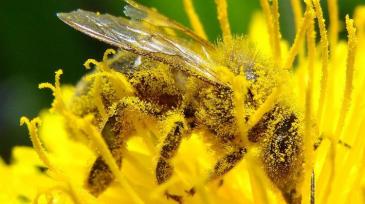
Chemicals giants Bayer and Syngenta had gone to the European Court of Justice hoping to get the restrictions on neonicotinoids overturned.
The ban relates to the outdoor use of three neonicotinoids – clothianidin, imidacloprid and thiamethoxam – and is expected to come into force by the end of the year. It will prohibit outdoor use of the chemicals (they may still be used inside greenhouses).
Policy makers in other jurisdictions will doubtless be paying close attention.
Neonicotinoids (often called neonics) were introduced in the late 1980s as a safer alternative to older insecticides that are more toxic. Yet a growing body of research has pointed to environmental problems with their use.
Scientific studies have found that the chemicals can disorientate bees, harming their ability to pollinate and return to hives.
Some other factors – notably mites and fungus – have also been blamed for the widespread bee decline.
“Bees play a crucial role in increasing crop yields and promoting food security and nutrition,“ saysCarla Mucavi, Director of the Food and Agriculture Organization of the United Nations (FAO) Liaison Office in New York.
“Without them, we could lose a variety of food such as potatoes, pepper, coffee, pumpkins, carrots, apples, almonds, tomatoes, just to name a few. In short, without bees, FAO cannot achieve a world without hunger. World Bee Day recognizes the importance of these tiny helpers and will increase awareness of the need to protect them.”
Bees, along with many other animals, carry pollen from one flower to another and are vital for global food security.
“Pollination has a positive impact on the environment in general, helping to maintain biodiversity and the vibrant ecosystems upon which agriculture depends,” says UN Environment ecosystems expert Marieta Sakalian.
Meanwhile, a new studysuggests bees and other insects may be more sensitive to climate change than plants and vertebrates.
The report titled One and a half degrees on biodiversitysays “for vertebrates and plants, the number of species losing more than half their geographic range by 2100 is halved when warming is limited to 1.5°C, compared with projected losses at 2°C. But for insects, the number is reduced by two-thirds.”
SOURCE: UN Environment. Go to ORIGINAL.
Read also:
Junk Planet: Is Earth the Largest Garbage Dump in the Universe?
Bees Must Be Protected for the Future of Our Food — First World Bee Day
Can You Imagine a World Without Bees?
‘Bees Can Help Boost Food Security of Two Billion Small Farmers at No Cost’
2018 Human Wrongs Watch
Discover more from HUMAN WRONGS WATCH
Subscribe to get the latest posts sent to your email.
 Baher Kamal
 HUMAN WRONGS WATCH
Leave a comment