Human Wrongs Watch
By Jorge Valero| EURACTIV.com*
29 May 2018 — A former governor of the Bank of Spain told EURACTIV that Luis de Guindos has the right CV to become vice-president of the ECB, a post he will take up later this week. But the ex-minister’s “brutally wrong” decisions led the country to the “disaster” of the bailout, he added.
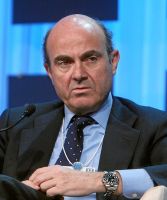
**Photo: Span’s former Minister of Economy Luis de Guindos | World Economic Forum | Creative Commons Attribution-Share Alike 2.0 Generic license.
Miguel Ángel Fernández Ordóñez, a socialist politician who headed the Bank of Spain between 2006 and 2012, is keen to remind that the construction bubble was already fuelling when he took over as governor, a post he left before the end of his mandate because of disputes with de Guindos, who hails from the rival centre-right party, the Partido Popular (PP).
“He was brutally wrong the first six months, he led us to disaster,” he told EURACTIV in an interview. “The markets were closed to us. That never happened in the history of Spain, since 1959,” he remarked.
Ordóñez also poured scorn on the ECB vice-president designate “for his nonsense of saying ‘I will not put money’ in the banks; or proclaiming that ‘the Bank of Spain is a horror’,” he further told EURACTIV.
But that is water under the bridge and now the worst period of the fourth largest eurozone economy is “happily forgotten,” Ordóñez said.

De Guindos will take over from Vítor Constâncio as ECB vice-president on 1 June. His nomination was questioned given his lack of experience in monetary affairs and MEPs were not happy either about sending a politician to the Executive Board, the ECB’s managing body.
But MAFO, as Fernández Ordóñez is known in Spain, believes that De Guindos does at least have the right CV for the post. “He is well prepared”, he acknowledged.

He doubts De Guindos would make any mistakes, because of peer pressure exerted by some of the brightest minds in financial and economic matters in Europe.
Fernández Ordóñez represented Spain on the ECB’s Governing Council when he was governor of Spain’s central bank.
“If you screw up at some point, or do something silly, there are five guys who look at you and you do not screw up again,” he said.
But the former governor still blames the PP minister for losing the seat on the Executive Board in 2012.
Back then, the Spanish government put forward as a candidate the head of the ECB legal services, Antonio Sáinz de Vicuña. He was seen as a lightweight nomination for the post, and the eurozone members decided to pick the governor of the Central Bank of Luxembourg, Yves Mersch instead.
That was despite a gentlemen’s agreement that should have seen a seat reserved for each of the four largest economies; namely, Germany, France, Italy and Spain.
“He wanted to nominate a friend and they said no,” Fernández Ordóñez explained. He argued that the position would have gone to Spain if Mariano Rajoy’s government had picked José Manuel Campa or David Vegara, some of former PM José Luis Rodríguez Zapatero’s closest aides.
“It is much better to always have a Spaniard on the Executive Board, than getting the vice presidency after having lost the chair on the Council,” he insisted.
“We have spent six years without the post and it has been a disaster,” he added.

Central bank for all
But besides a small digression to look back down memory lane, Fernández Ordóñez is not interested in discussing “current issues”. His heart and soul are dedicated to a “revolutionary idea” that he defends with the passion of a converted man.
He preaches the idea of letting citizens and small companies deposit their money in the safe hands of central banks as well.
A simple but powerful move that would bring to an end the “monstrous” banking crisis, he claims. As someone who managed a financial crisis, he knows all too well what he is talking about.
“We have to separate money from risk,” he insisted.
For Fernández Ordóñez, the decision to create accounts in central banks not only for commercial banks but for everybody is comparable to Montesquieu’s separation of powers, the liberalization of airspace in Europe, or even the #MeToo movement against sexual abuse.
“Sexual abuse has been part of our lives because I am very old. In the civil service, I have not seen much, but in the business world I have seen it. It has existed. Suddenly, someone said it’s over, and this is over,” he said.
He said that eventually, citizens will start demanding similar treatment when it comes to banks.
Although he admitted that the debate is still in a very early stage, the idea is gaining visibility because the Swiss will vote on 10 June whether they support it in a national referendum.

In his view, the proposal will see the light of day sooner or later.
“Citizens will ask one day why commercial banks can have their deposits with central banks, with their security and safety, and they cannot. I am convinced that it is a devastating question,” he said.
He noted that the arguments in favour (especially liberalization of the banking system and the end of banking crises) clearly outweigh the reasons against it.
Only a messy switch to the new system could bring some turbulence but this risk would disappear with a well-designed transition.
“The question will be if this will happen in an orderly fashion in two decades or in a chaotic manner in three decades,” he warned.
*SOURCE: EURACTIV.com. Go to ORIGINAL.
**Photo: Spain’s former Minister of Economy Luis de Guindos | Author: World Economic Forum | Flickr: Luis de Guindos Jurado – World Economic Forum Annual Meeting 2012| Creative CommonsAttribution-Share Alike 2.0 Generic license.
2018 Human Wrongs Watch
Discover more from HUMAN WRONGS WATCH
Subscribe to get the latest posts sent to your email.
 Baher Kamal
 HUMAN WRONGS WATCH
Leave a comment