The electoral authority announced the results at 7:00 p.m. local time after the closing of the last polling stations.
Supporters of Fernando Haddad, presidential candidate of Brazil’s leftist Workers Party (PT), react during a runoff election in Rio de Janeiro, Brazil. | Photo: Reuters | Photo from teleSUR.
28 October 2018 (teleSUR)* — Far-right politician Jair Bolsonaro has won the Brazilian presidential elections with over 55 percent of the vote beating leftist Fernando Haddad who scored 44.3 percent in the country’s most polarized elections in decades.
17 October 2018 (UN Environment)* — Ali Omar remembers a time when the practically bare patch of desert in northern Djibouti he calls home was a bustling seaside resort and the waters around it were teeming with fish. “Lots of people lived here and they had shops all along the seaside,” says 75-year-old Omar, recalling his hometown Khor Angar’s 1970s heyday, before it was hot year-round and the village had dwindled to just a few huts in the desert.
UN Environment / Hannah McNeish
“You used to need a jacket around here,” he says, squinting in the morning sun next to a sparkling shoreline, now empty apart from crabs scuttling to and from the froth. There used to be enough fresh water for all and so much seafood that planes would come from the capital to fill up with lobster, crab, fish and langoustine.
Only sixteen countries out of the 197 that have signed the Paris Agreement have defined national climate action plan ambitious enough to meet their pledges, according to a policy brief released on Monday (29 October), ahead of the crucial UN climate conference COP24 in Katowice (Poland) in December.
Three years ago, the EU was leading the pack in the run up to the Paris Climate Change talks. [WeMeanBusiness / Flickr]
The 16 countries are: Algeria, Canada, Costa Rica, Ethiopia, Guatemala, Indonesia, Japan, FYR Macedonia, Malaysia, Montenegro, Norway, Papua New Guinea, Peru, Samoa, Singapore and Tonga.
27 October 2018 (FAO)* — There is more than enough food produced today to feed everyone, yet about 821 million people are chronically undernourished. Achieving food security for everyone requires an integrated approach from all stakeholders, including from governments. Bringing the hunger number down to zero by 2030 will require appropriate legislation backed by the necessary budgets and proper monitoring, allowing for just and long-lasting legal frameworks.
26 October 2018 — Old, grainy film and video footage from years gone by, not only stirs powerful memories – it’s also a vital resource for future generations, the United Nations cultural agency has highlighted, urging everyone to safeguard audio-visual heritage and make archives more accessible.
.
UN Photo | Over 37,000 discs with audio recordings of meetings at the United Nations are part of the organization’s rich audio heritage.
25 October 2018 (Wall Street International)*— The ominous sense of fear and anxiety that spread through the United States during the 1930s appears to be reoccurring today. Understandably during the years of the Great Depression, financial and social insecurity were the norm. Unemployment and breadlines reflected the sense of self-preservation especially among whites who considered themselves to be pure Anglo-Saxons.
The Black Legion (1937) – A Warning Against Fascism And Bigotry | Photo from Wall Street International.
Once again, there is uncertainty about where the nation is heading.
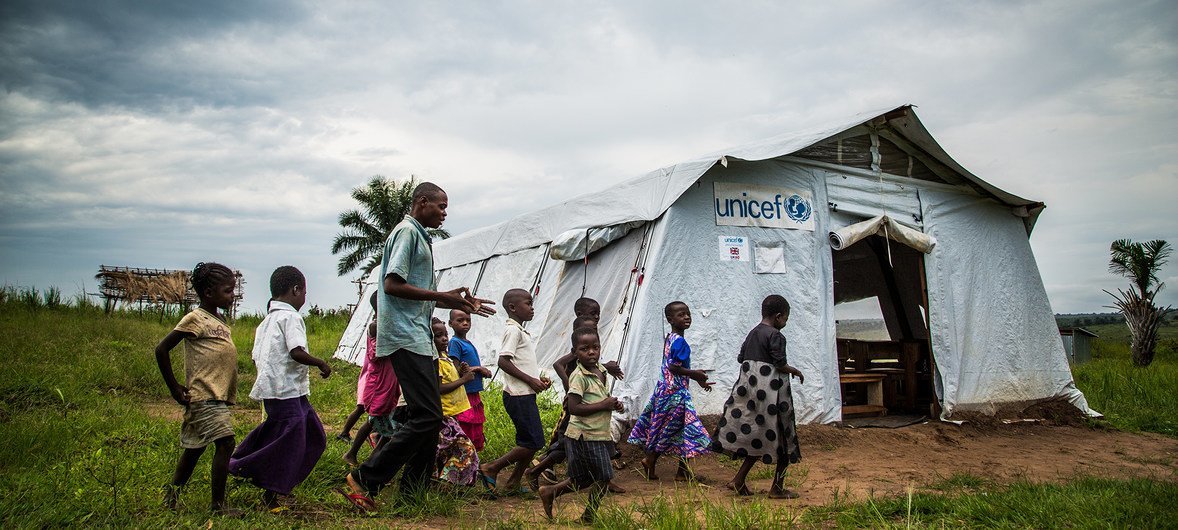
The United Nations human rights chief, Michelle Bachelet, on 26 October 2018warned that the forcible mass expulsion of Congolese migrants from Angola has resulted in “serious human rights violations by security forces on both sides of the border” and left at least 330,000 returnees in an “extremely precarious situation”.
UNICEF/UN0162335/Tremeau | Children attend class in a temporary tent school in Mulombela village, Kasaï region, Democratic Republic of the Congo
This month, some 330,000 people have reportedly crossed from Angola into the Kasai, Kasai Central and Kwango provinces of the Democratic Republic of Congo (DRC), following an expulsion order by the Government of Angola targeting irregular migrants.
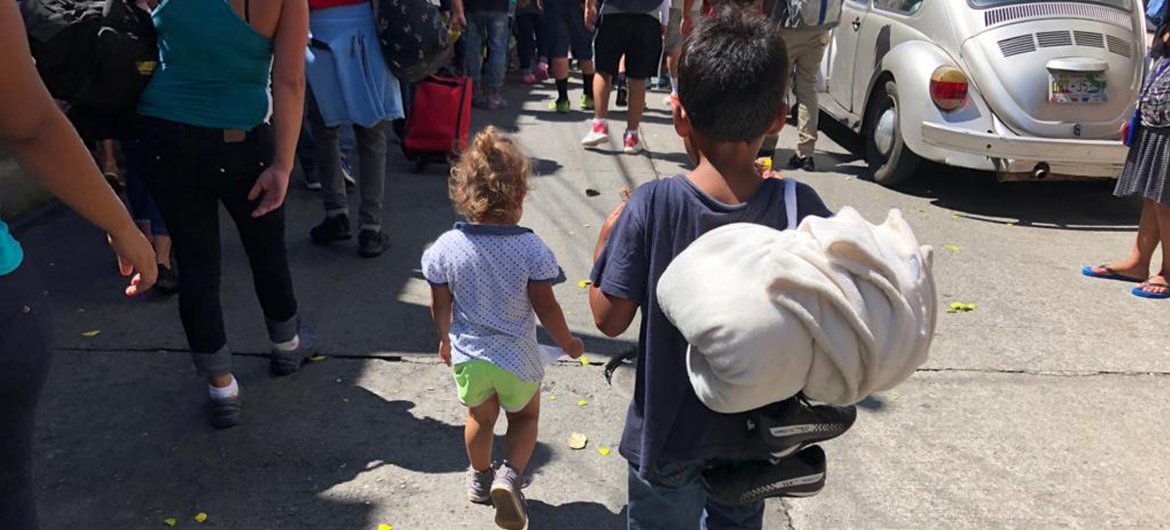
As some 7,000 mostly-Honduran migrants continue their journey northwards toward the United States, governments must prioritize the needs of migrant children when it comes to applying immigration laws and procedures, said the UN Children’s Fund (UNICEF) on 26 October 2018.
UNICEF México | Children are among the migrants from Central America who are walking north towards the United States. Here they are pictured on the streets of Tapachula, Chiapas, Mexico. 21 October 2018.
Highlighting the vulnerability of children on the move, the agency advised all transit and destination countries, to consider alternatives to immigration detention.
24 October 2018 (UN Environment)*– As Miremba enters her classroom in the morning, little does she know that the walls of the one place that should help her secure a better future are, in fact, poisoning it. As she playfully chips the hallway paint before going into class, she exposes herself, and her fellow schoolmates, to the irreversible toxic effects of lead.
Photo by bill wegener on Unsplash
Years after lead in paint and petrol was banned in many parts of world, this toxic, heavy metal continues to pose a threat to people’s health as well as the environment – particularly in developing countries, where the major source of lead exposure to children is from paint.
TAPACHULA, Mexico, 24 October 2018 (UNHCR)* – When street gang members torched his family home in Honduras, 16-year-old Eduardo* felt he had no option but to run for his life. “When I saw our house burning I knew our number had been called, our luck had run out, it was time to flee,” he says.






 HUMAN WRONGS WATCH