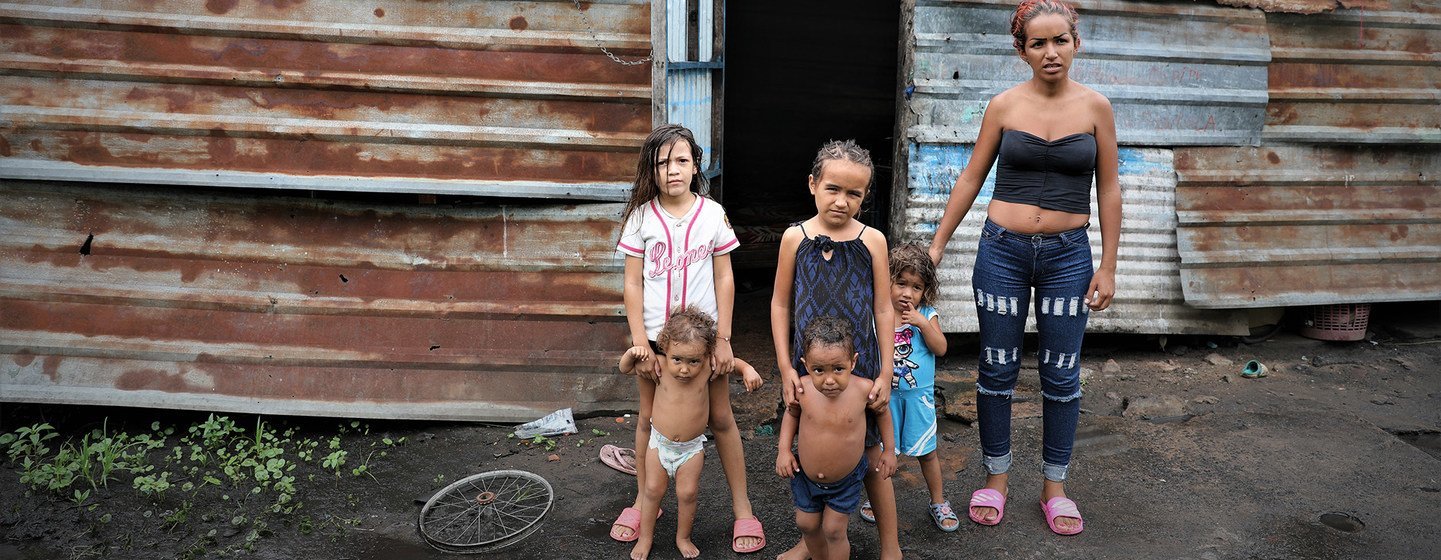
OCHA/Gemma Cortes | Dioximar Guevara lives with her five children in San Felix, a slum of Puerto Ordaz, the main city in Bolívar, Venezuela, where poverty runs deep.
'Unseen' News and Views

OCHA/Gemma Cortes | Dioximar Guevara lives with her five children in San Felix, a slum of Puerto Ordaz, the main city in Bolívar, Venezuela, where poverty runs deep.
11 July 2020 (UN Women)* — Across the globe, many migrants have been waiting to reunite with their families in the wake of the COVID-19 pandemic and travel restrictions to prevent its spread.
Mithu Tamang waits in a queue to get her temperature checked by staff at WHR’s women-managed quarantine facility. Photo: UN Women/Ashma Shrestha
Mithu Tamang, 30, was among more than 300 fellow Nepali migrants stuck in Kuwait for over two months before a chartered flight was arranged to bring them home on 11 June. It was the first flight to land since the national lockdown on 24 March 2020.

Respondents to a survey of TVET institutions, jointly collected by UNESCO, the International Labour Organization (ILO) and the World Bank, reported that distance training has become the most common way of imparting skills, with considerable difficulties regarding, among others, curricula adaptation, trainee and trainer preparedness, connectivity, or assessment and certification processes.

For example, some people are advocating a consumer boycott of Starbucks over an internal memo that prohibits employees from wearing gear that refers to the movement. And advocates are urging supporters to target other companies under the Twitter tag #boycott4blacklives.
1.5oC is the point where global warming linked consequences become increasingly severe and more difficult and expensive to adapt to, protect ourselves from, and control further temperature increases.
Scientifically documented consequences of breaching 1.5oC include 70% loss of corals and loss of half the habitat of insects, including food pollinators, by the end of the century, bringing global food security issues, on top of accelerating frequency and intensity of extreme weather events.
10 July 2020 (WMO)* — Unusually heavy monsoon rainfall and flooding is affecting India and neighbouring South Asian countries, as well as China and Japan. This has caused major disruption, displacement and loss of life, and once again highlighted the importance of national meteorological and hydrological services in protecting public safety.

.
The situation is expected to be aggravated by further rain. More than 200mm of rainfall could fall in 24 hours in some mountainous regions of Bhutan/Bangladesh, Northeast India, Myanmar and Nepal according to the South East Asia Flash Flood Forecast System.
Additional similar amounts could be possible for the next 4-5 days. Authorities in China are also warning of more rains.