“The time for manufacturing of weapons of war has passed as a viable industry for our nation, despite the way some of our political leadership clings to economies of the past.” — Lisa Savage, U.S. Senate candidate in Maine
Fincantieri Marine Group
On 25 June 2020 President Trump’s re-election efforts took him to the “battleground” state of Wisconsin, where he toured the Fincantieri MarinetteMarine shipyard. He railed against the Democrats as a scarier enemy than Russia or China.
He also celebrated Wisconsin’s win over domestic enemies like the state of Maine in securing a key shipbuilding project.
CAIRO, Egypt (UNFPA)* – “Every morning we meet with the intention of packing as many kits as we can, to be delivered to the health workers who are working hard to protect us,” 22-year-old Ammar told UNFPA.
Ammar is a volunteer with Y-PEER, UNFPA’s youth leadership network, which mobilized dozens of young people to assemble hygiene and dignity kits for distribution to health workers working on the front lines of the COVID-19 response.
3 July 2020 (WMO)* — Climate change impacts are affecting water availability and are exacerbating the damages floods and drought cause worldwide. Climate related water action is a key for bringing us back on track to deliver Sustainable Development Goal 6, to ensure access to water and sanitation for all and to sustain a healthy environment.
WMO hosted a virtual diplomatic briefing on 2 July on plans for a Water and Climate Coalition aimed at building momentum on water and climate action through implementing concrete activities at the national, regional and global levels.
Afghanistan’s shortage of decent and affordable housing is one of the biggest challenges facing millions of displaced and returning refugees. A new project is offering some a solution. |Français | عربي
3 July 2020 (UNHCR)* — Mohammad Daud and his family fled fighting and insecurity in their home area and came to Kandahar province in southern Afghanistan more than eight years ago. But until recently, they still lacked a secure roof over their heads.
As of Friday [3 July 2020] morning, Brazil had reported 1,508,991 COVID-19 cases and 62,304 deaths.
Crosses installed in tribute to the victims of COVID-19, Brasilia, Brazil, June 28. | Photo: EFE
(teleSUR)* — Brazil’s President Jair Bolsonaro Friday [3 July 2020] passed a bill on the mandatory use of masks against COVID-19 but vetoed some provisions that required their use in places where people gather such as shops, religious temples, and schools.
The far-right politician, who has always downplayed the importance of physical isolation, argued that wearing masks in such cases “incurs a possible violation of residence” contrary to the Constitution.
“We don’t want to be used as government’s propaganda,” Indigenous leader Parana Yanomami said.
Members of the Yanomami community arrive at a military brigade, Surucucu, Brazil, 2020. | Photo: EFE
3 July 2020 (teleSUR)* — Indigenous leaders from the isolated Brazilian Yanomami community complained that a military mission sent to protect them from the coronavirus brought instead a risk of infection to their people through contact with journalists among other outsiders.
Federal prosecutors said they were investigating the visit for ignoring the wishes of Yanomami communities to remain isolated from society, violating rules of social distancing, and distributing chloroquine to Indigenous people.
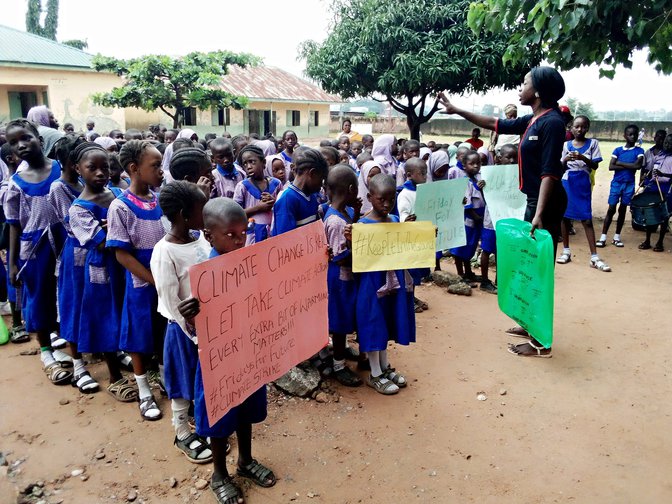
If climate change directly affected white Westerners, action would have come quicker.
Climate activist Oladosu Adenike organising with schoolchildren in Abuja, Nigeria, 2019 | Oladosu Adenike (All rights reserved)
1 July 2020 (openDemocracy)* — We have known about climate change for decades. As early as 1992 the threat was sufficiently obvious, and the science sufficiently clear, to justify a UN treaty on the topic. Yet we’ve only even begun to get our act together in the last five or so years. Why?
By Walid Saleh and Warda Al-Jawahiry in Tripoli, Lebanon | UNHCR*
In Lebanon, the capacity of local community and Syrian refugees to provide mutual support is being stretched to breaking point by economic turmoil and the COVID-19 crisis. |Español | Français| عربي
Behind the counter of her small convenience store in a rundown neighbourhood of Tripoli, northern Lebanon, 35-year-old Kawkab Mustafa keeps a list of debts owed to her by customers she has allowed to buy goods on credit. In recent months, the list has grown so long she needs four separate notebooks to record all the entries.
On May 14, the Central Bank of Venezuela sued the Bank of England to obtain its gold bars.
The High Court in London, Britain, July 2, 2020. | Photo: EFE
(teleSUR)* — The United Kingdom’s High Court Thursday [2 July 2020] decided that opposition lawmaker Juan Guaido can access 31 tons of Venezuelan gold held in the Bank of England, which prevents President Nicolas Maduro’s administration from using those resources to fight the pandemic.
The ruling about this monetary reserve valued at over US $ 1 billion occurs after months of disputes between Venezuela and the Bank of England, which denied the constitutionally constituted government access to its own resources
3 July 2020 (United Nations)* — No country is immune from it. Greenhouse gas emissions are more than 50 percent higher than it was in 1990, and global warming is causing long-lasting changes to our climate system which threatens irreversible consequences if we do not act. Cooperatives for Climate Action was chosen as this year’s theme to address this, and to support Sustainable Development Goal (SDG) 13 on Climate Action.
Climate change severely impacts people’s livelihoods around the world, especially the most disadvantaged groups such as small-scale farmers, women, youth, indigenous peoples and ethnic minorities, who have to cope with extreme natural disasters and degradation of natural resources.




 HUMAN WRONGS WATCH