The prime minister is a political parasite, feeding on distrust in dying institutions. He must be stopped before it’s too late
Boris Johnson’s government is planning to slash the UK’s aid to war-torn countries | Hannah Mckay/Reuters/Alamy
17 March 2021 (openDemocrcay)* — There are lots of reasons why the prime minister, Boris Johnson, should not cut development aid.
Maybe the thought of the 16 million Yemenis who will go hungry this year, while living in fear of British-made bombs, might cause him to turn over at night?
Perhaps he might allow a tear for children in Syria. Those under the age of ten have known nothing but war, but Johnson’s senior civil servants have discussed cutting aid to them by two-thirds.
“The basic problem is that the 193-member General Assembly has deferred too many times, for too long, and on too many issues to the UN Security Council and the five permanent members (P-5) of the UN Security Council (UNSC)”.
UNITED NATIONS, Mar 15 2021 (IPS)* – The United Nations has continued to pursue a notoriously longstanding tradition of doling out some of the highest-ranking jobs either to the five big powers, who are permanent members of the Security Council—namely the US, UK, China, France and Russia – or to Western industrialized nations such as Spain, Italy, Canada, Sweden, Germany, plus Japan.
.
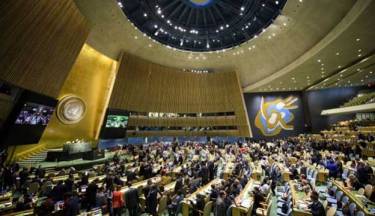
The UN General Assembly in session. Credit: UN Photo/Manuel Elias
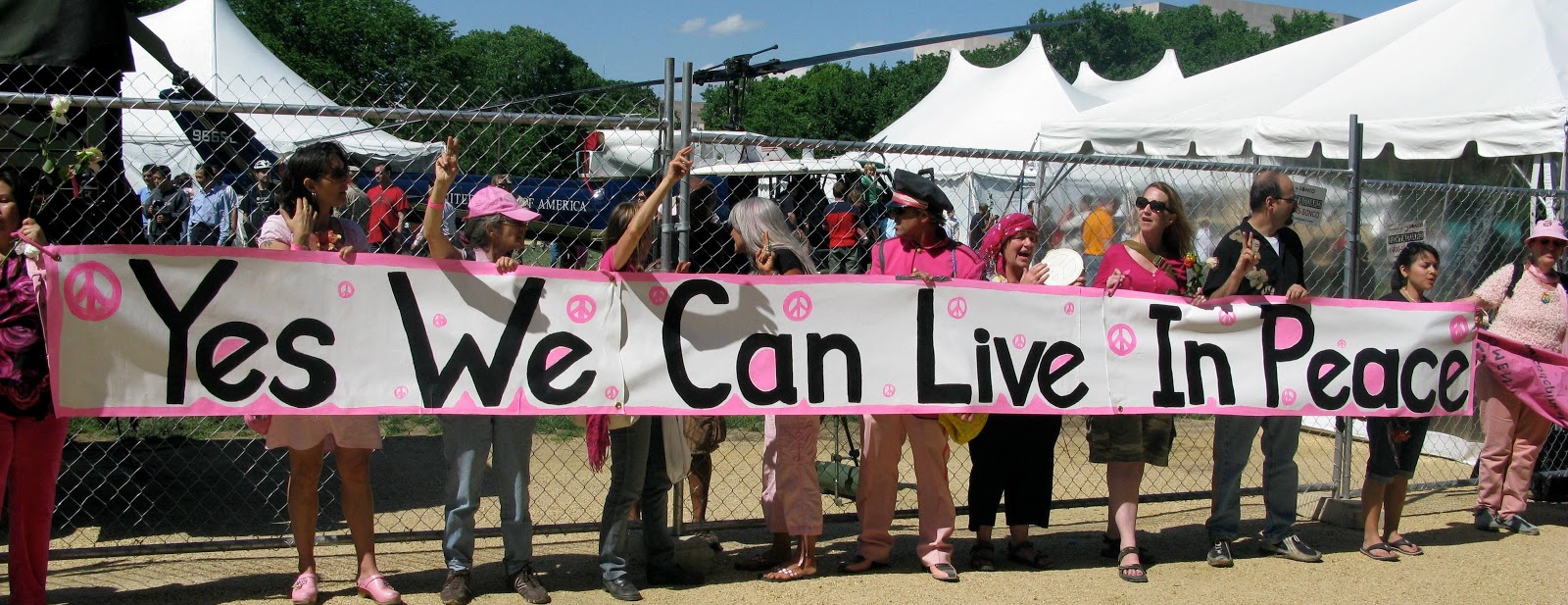
The Biden presidency is still in its early days, but it’s not too early to point to areas in the foreign policy realm where we, as progressives, have been disappointed–or even infuriated.
.
There are one or two positive developments, such as the renewal of Obama’s New START Treaty with Russia and Secretary of State Blinken’s initiative for a UN-led peace process in Afghanistan, where the United States is finally turning to peace as a last resort, after 20 years lost in the graveyard of empires.
By and large though, Biden’s foreign policy already seems stuck in the militarist quagmire of the past twenty years, a far cry from his campaign promise to reinvigorate diplomacy as the primary tool of U.S. foreign policy.
By Hilde F. Johnson, Norway’s Former Minister of International Development*
Achieving peace is not possible without engaging regional powers
Band-e Amir National Park located in the Bamyan Province of central Afghanistan | Image fromWall Street International.
15 March 2021 (Wall Street International)* — After 20 years of international allied engagement in Afghanistan, the country is in a worse state than ever. Despite the peace talks in Doha between the Government of Afghanistan and Taliban, the security situation has deteriorated significantly.
In addition, in the last few months, targeted killings of journalists, human rights activists, judges, and teachers have reached an unprecedented level. And many of them have been women.
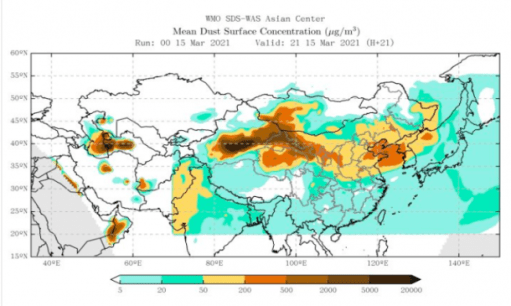
16 March 2021 (WMO)* — One of the worst sand and dust storms in a decade has hit Mongolia, northern China and other parts of Asia, with big environmental and economic impacts and harming air quality for millions of people.
.
The skies above the Chinese capital Beijing and other populous cities were choked with thick dust, triggering concerns about widespread health impacts, including respiratory problems because of high levels of particulate matter (PM).
A number of casualties were reported in Mongolia. Minimum visibility in many places decreased to less than 500 meters.
KUALA LUMPUR, Malaysia, Mar 16 2021 (IPS)* – Globalisation’s beginnings are symbolised by Ferdinand Magellan’s near circumnavigation of the world half a millennium ago. But its history is not simply of connection and trade, but also of intolerance, exploitation, slavery, violence, aggression and genocide.
Worldwide, international organizations such as the World Health Organization (WHO), governments and the corporate media, acting as agents of the global elite, continue their efforts to preoccupy the human population with measures supposedly being taken to address the non-existent virus labeled SARS-CoV-2.
Unfortunately, this lie is succeeding in distracting the vast bulk of the human population from the ongoing elite coup to take complete control – politically, economically, socially, spiritually and even physically – of the human population under the guise of the World Economic Forum’s ‘Great Reset’. See ‘The Great Reset’ and ‘Now is the time for a “great reset”’.
15 March 2021 (UNEP)* — The UN Decade on Ecosystem Restoration – set to launch during World Environment Day on 5 June – aims to rally citizens, governments and corporations around one common goal: preventing, halting and reversing the destruction of natural spaces.
The drive comes as experts warn that ecosystems around the world are facing collapse. The planet is losing 4.7 million hectares of forests every year – an area larger than Denmark – and over the past century, half of the globe’s wetlands have been drained.
14 March 2021 (FAO)* — From a media bed unit start-up in Bangkok to a fully developed 120 households deep water culture (DWC) unit in Ethiopia, aquaponics is showcasing its true potential to produce sustainable food anytime, anywhere.
UNITED NATIONS, Mar 12 2021 (IPS)* – The United Nations says the highest levels of political power remain the furthest from achieving gender parity in an increasingly male-dominated power structure worldwide.
.
María Fernanda Espinosa Garcés was only the fourth woman in the 76-year history of the United Nations to be elected President of the General Assembly, the UN’s main deliberative and policy-making body. She was the Foreign Minister of Ecuador. She is being congratulated by the outgoing President Miroslav Lajčák, (centre) and the UN Secretary-General, Antonio Guterres. September 2018. Credit: UN / Loey Felipe






 HUMAN WRONGS WATCH