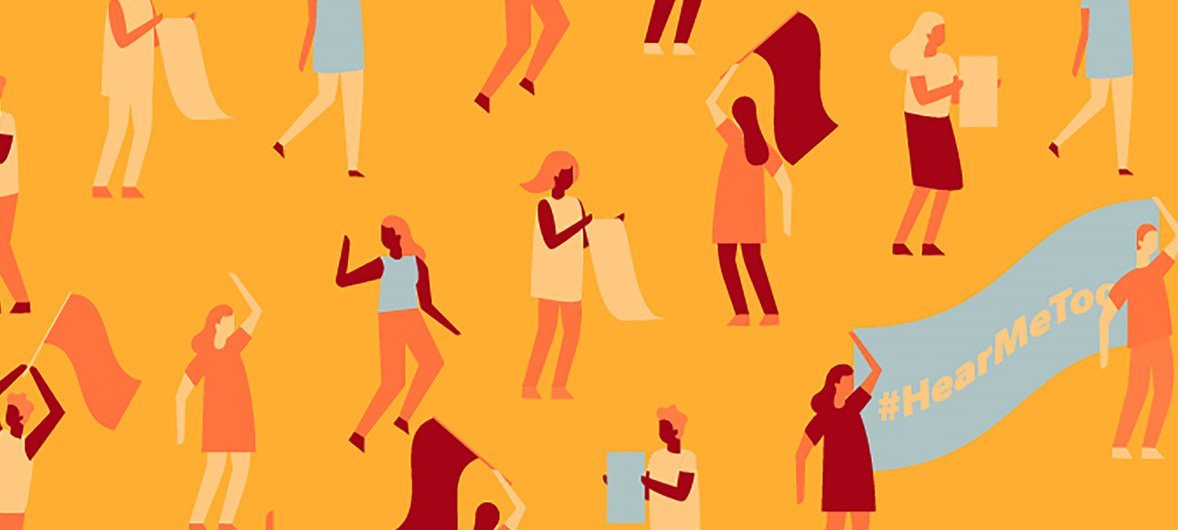
Until women and girls can live free of fear, violence and insecurity, the world cannot pride itself on being fair and equal, United Nations Secretary-General António Guterres said on 19 November 2018, commemorating the International Day for the Elimination of Violence Against Women, marked annually on 25 November.
UN Women | Graphic illustrating the #HearMeToo campaign
“At its core, violence against women and girls in all its forms is the manifestation of a profound lack of respect – a failure by men to recognize the inherent equality and dignity of women,” Guterres said at a special event at UN Headquarters observing the Day, which highlights that violence against women is as serious cause of death and incapacity as cancer, among women of reproductive age.
5 November 2018 — One year since the Saudi-led Coalition imposed a blockade on sea, land and air routes in Yemen, millions more are edging closer to famine and fatal disease.
A girl stands inside the Al Habbari informal settlement for displaced people in Sana’a. The settlement is on private land and receives a very small amount of support from its owner. Families living here lack basic services such as showers and latrines. Photo: Becky Bakr Abdulla/NRC, 30 August 2018
“The past 12 months have been a never-ending nightmare for Yemeni civilians. The parties to the conflict have consistently disavowed the laws of war and employed tactics that exacerbate suffering for civilian populations,” said Jan Egeland, Secretary General of the Norwegian Refugee Council (NRC).
18 November 2018 (Wall Street International)* – In January 1984, Dr. Seuss, one of the most popular authors of children’s books ever, who sold hundreds of millions of copies of his books, published The Butter Battle Book. It was a totally unexpected book from a children’s author―an overt political satire and protest against the nuclear arms race. Dr. Seuss considered it his best book, but one that ends pessimistically unlike most of his others.
The Butter Battle bookis full of references to the US-Soviet Cold War, from the building of the Berlin Wall to the deployment of more and more kinds of “advanced” weaponry.
The main characters are members of the Yooks, who appear to represent the US and NATO countries, while the antagonists, the Zooks, appear to represent the Soviet Union and Warsaw Pact countries.
18 November 2018 (Norwegian Refugee Council)* — Did you know that more people have a mobile phone than a toilet? Marking world toilet day, we give you five reasons why you should care about toilets.
.
In crowded camps it is essential that people have proper sanitation facilities and good hygiene practices in order to prevent diseases. In order to address the needs, NRC is conducting the following activities in Mtendeli refugee camp in Tanzania: • Constructing family latrines • Providing basic hygiene items, such as soap • Conducting hygiene promotions on good hygiene practices • Providing drinking taps and latrines in schools Photo: Ingrid Prestetun/NRC
Almost 30 percent of the world do not have access to latrines. The lack of access deprives people of a good health, safety and dignity.
A handful of Central American migrants take Mexican goverment job opportunities to escape U.S. hostility, their very presence receives rejection and xenophia.
18 November 2018 (teleSUR)* – Amongst the hundred of Central American Migrants denied passage to the United States, and currently stranded at the border border in Mexico, some are taking offers for work by their host government.
“If we had work, we would stay. This has been very tiring,” Orbelina Orellana told Reuters.
— While trying to save the 2015 Joint Comprehensive Plan of Action (JCPOA), or the Iran nuclear deal, some European leaders have stepped up pressure on Iran’s ballistic missile programme, simultaneously demanding talks and threatening sanctions. Iran—which sees ballistic missiles as crucial to the country’s defence—has responded by saying that its missile programme is non-negotiable.
.
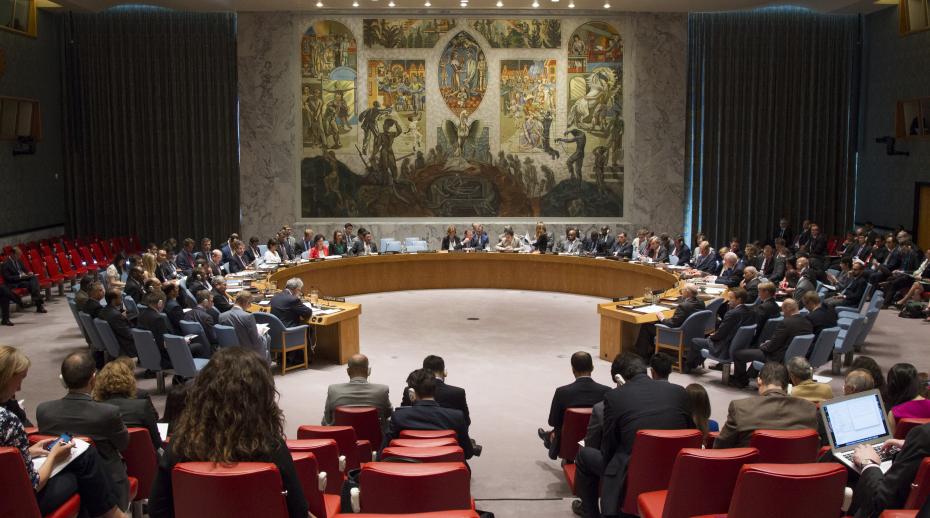
The UN Security Council Adopts Resolution on Iran Nuclear Deal (Resolution 2231), taken on 20 July 2015. Photo: Flickr/UN Photo/Loey Felipe.
The women of South Sudan are leading calls for political and militia leaders to honour the recent revitalized peace agreement, and end what they regard as a “futile man’s war”, the head of the UN gender equality agency, UN Women, told the Security Council on 16 November 2018.
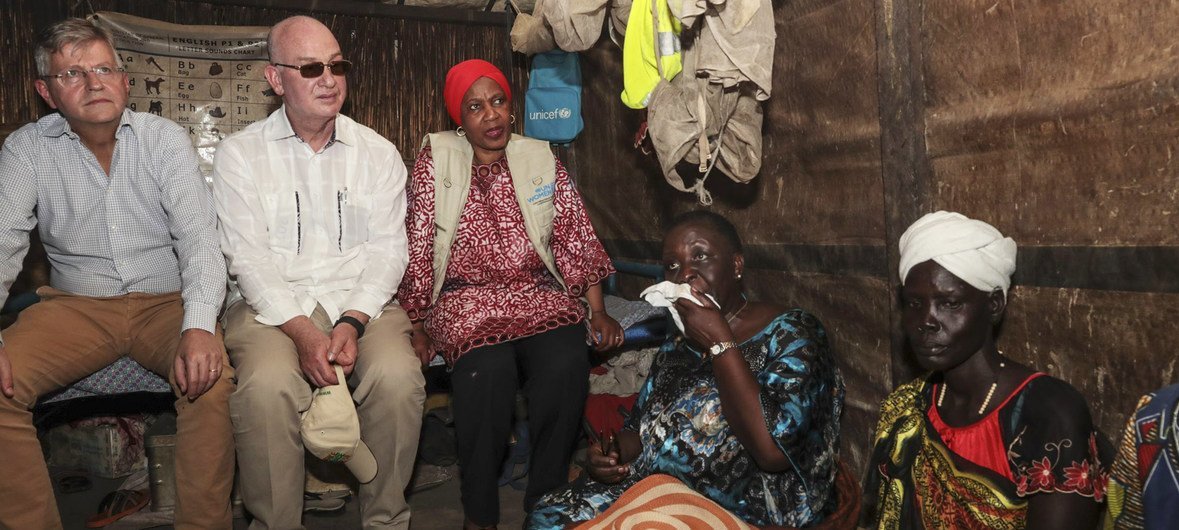
UNMISS/Isaac Billy | A high-level delegation from the United Nations and African Union meets Nyamile Malual Jiech (far right) who walked with her children through violent clashes to reach the safety of the United Nations protection site in Bentiu in the north of South Sudan.
Executive Director, Phumzile Mlambo-Ngcuka, told the 15-member Council that following September’s agreement between President Salva Kiir and his rival Riek Machar, who is due to be reinstated as Vice President, fighting was continuing.
16 November 2018 – Digital solutions are transforming lives: Think of robots that help the elderly, a mobile phone app that identifies crop pests, or surgical robots in hospitals. These advances are all due to Artificial Intelligence and an extraordinary new era of machine learning.
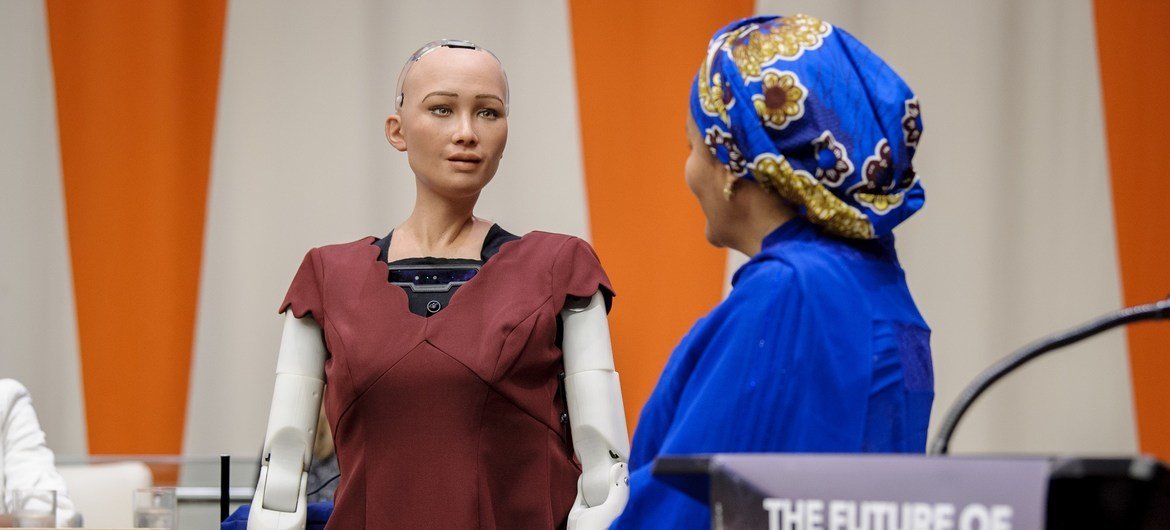
UN Photo/Manuel Elias | Sophia the Robot speaking to UN Deputy Secretary-General Amina Mohammed at UN Headquarters in 2017.
While these bring tremendous benefits, AI also raises concerns, ranging from security, to human rights abuses. Speaking in Paris last weekend, Secretary-General Antonio Guterres praised AI but cautioned that “technology should empower not overpower us” and that the world needs to set policies that contain unintended consequences or malicious use of frontier technologies.
Amidst an ongoing active conflict that seems to have fallen off the international community’s radar, temperatures in eastern Ukraine dropping well below zero and leaving millions are in need of urgent humanitarian assistance, said the United Nations, calling for support.
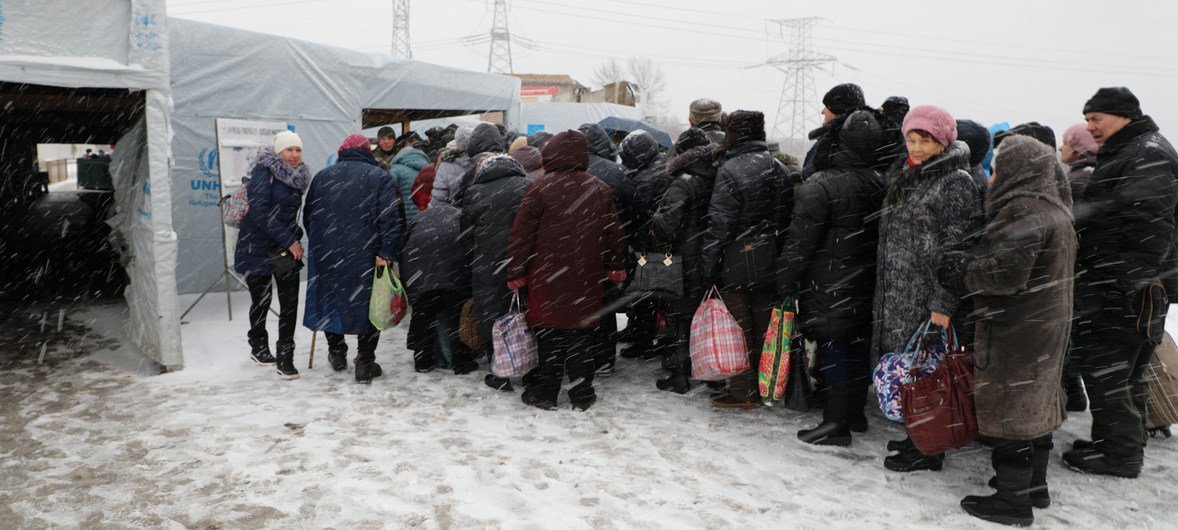
OCHA Ukraine/O.Gaskevych | People wait in line at Maiorske Entry/Exit Checkpoint in eastern Ukraine
In Geneva on Thursday [15 November 2018], Osnat Lubrani, the UN Humanitarian Coordinator in Ukraine, briefed UN Member States on the human cost and consequences of the severe humanitarian crisis and called on international donors to urgently increase funding to help vulnerable families through the long harsh winter.
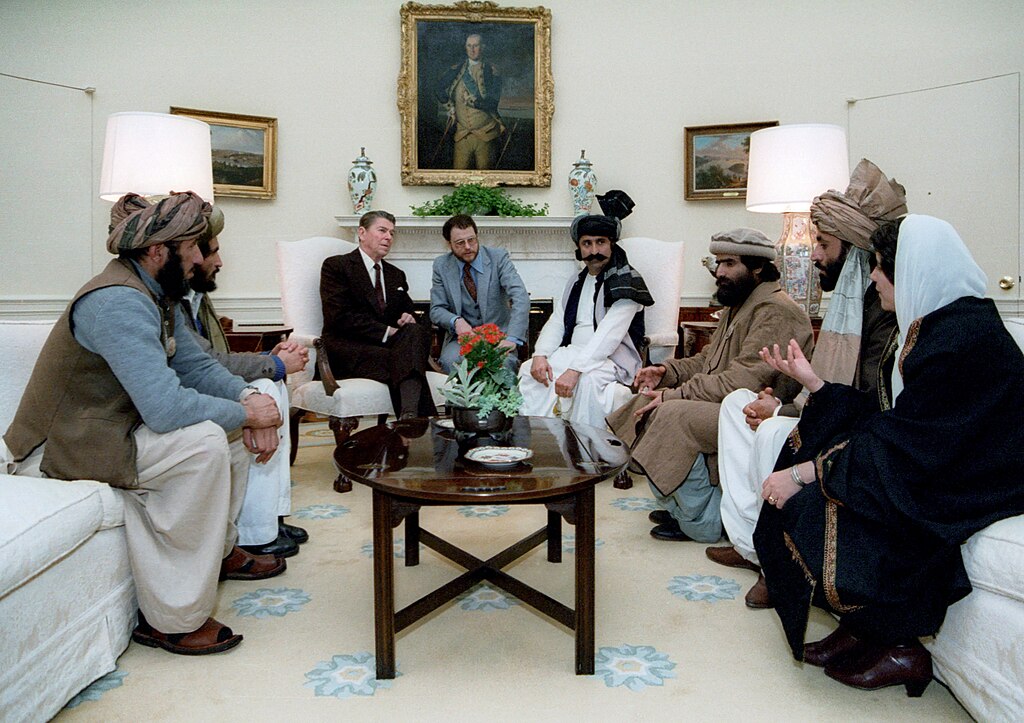
15 November 2018 (openDemocracy)* — The current war in Afghanistan has just entered its nineteenth year. Almost two decades after the United States-led invasion overthrew the Taliban regime in Kabul and dispersed Osama bin Laden’s al-Qaida network from mountainous Tora Bora in the country’s south-east, a reconfigured Taliban is once more driving the conflict.


 HUMAN WRONGS WATCH