Human Wrongs Watch
The global humanitarian system has reached its limits in dealing with the upward trend in forced displacement due to mounting pressures from conflicts and persecution around the world, the head of the United Nations refugee agency on 5 November 2014 warned, calling on the humanitarian community to “think out of the box” when it comes to funding emergency response.

South Sudanese seek a chance to get on with life without fear | Source: UNHCR
In a briefing to the UN General Assembly’s main social, humanitarian and cultural body (Third Committee), António Guterres, UN High Commissioner for Refugees, said that at the end of 2013, more than 51 million people were in displacement due to multiplying conflicts, climate change, population growth, urbanization, food insecurity and water scarcity, and events indicate that this number will be even higher by December of this year.
“The humanitarian community is scrambling to respond, but every new crisis clearly shows that the system has reached its limits,” he stressed.
“To those who trigger and prolong conflicts, leaving humanitarians to clean up the mess, it is time to stay that this must stop. We can no longer pick up the pieces,” he added.
Presenting his agency’s report, Guterres said that one of the reasons for the system reaching its limits is that humanitarian funding is close to bankruptcy. While funding has increased, the needs have grown much faster, causing the gap to widen.
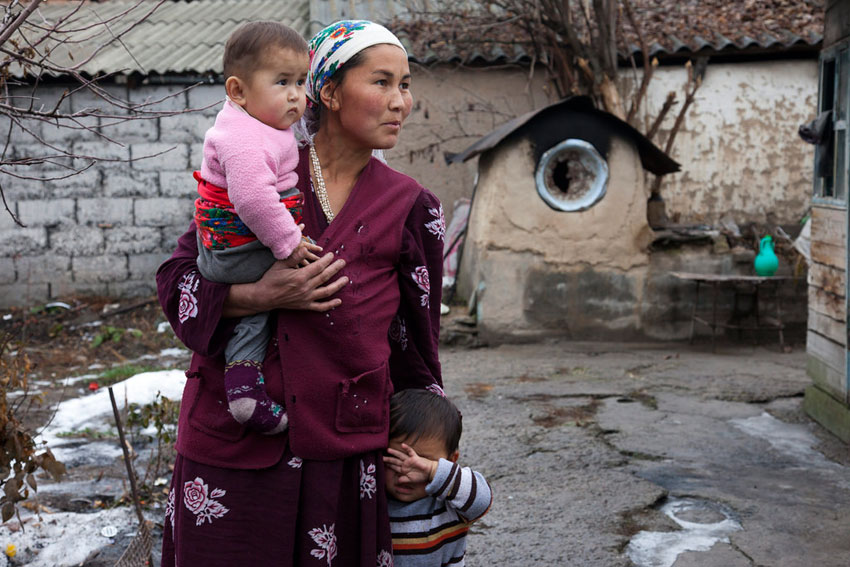
This stateless mother came to Kyrgyzstan from Tajikistan. Her children are also stateless as a result. Without papers proving her nationality, she cannot receive badly needed social assistance. Photo: UNHCR/Alimzhan Zhorobaev
To address the growing shortfall, measures must include continuing the strong investments already being made in building partnerships with emerging donors, as well as further expanding opportunities with the private sector and reviewing the relationship between humanitarian and development funding.
“It is also essential to think out of the box and be more creative when it comes to funding emergency response,” he said, noting that, in the future, humanitarian response should be able to rely partially on assessed contributions.
Such action could minimize the dramatically increasing gap between needs and available resources in humanitarian response, he said. Under the leadership of Valerie Amos, UN Under-Secretary-General for Humanitarian Affairs and Emergency Relief Coordinator, the UN Office for the Coordination of Humanitarian Affairs (OCHA) is now commissioning a study to explore how this might work.
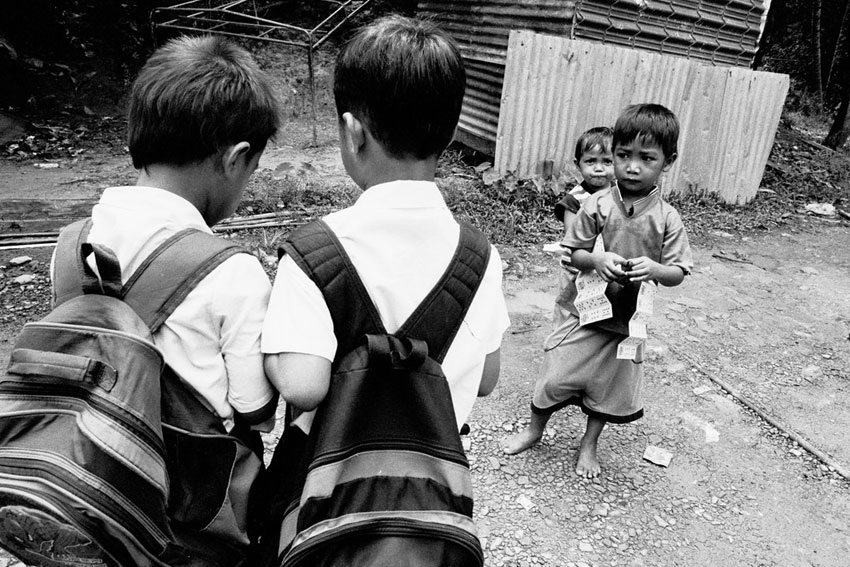
Children in Telipok, Sabah, Malaysia. Many children of migrants are unable to establish a nationality. Some are completely undocumented and do not have access to education. Photo: UNHCR/Greg Constantine
The total international humanitarian budget reaches just 10 per cent of what is available globally for development cooperation, Mr. Guterres continued. In the current global context, development funds are not accessible quickly enough in many situations where they are needed, forcing humanitarian actors to act as substitutes for the absence of structural assistance.
“Humanitarian assistance only gets a fragment of the resources, but it often has to cover things it really should not,” he said.
As such, development agencies, donors and international financial institutions should work together to increase flexibility and complementarity between short and longer-term interventions, as well as be present on the ground from the very beginning of a crisis.
“It is in our common interest, and our collective responsibility, to ensure that ‘bridging the gap’ is more than a slogan. But this requires strong political leadership to change the objectives, the priorities, and, above all, the organizational culture of development cooperation,” he stressed.
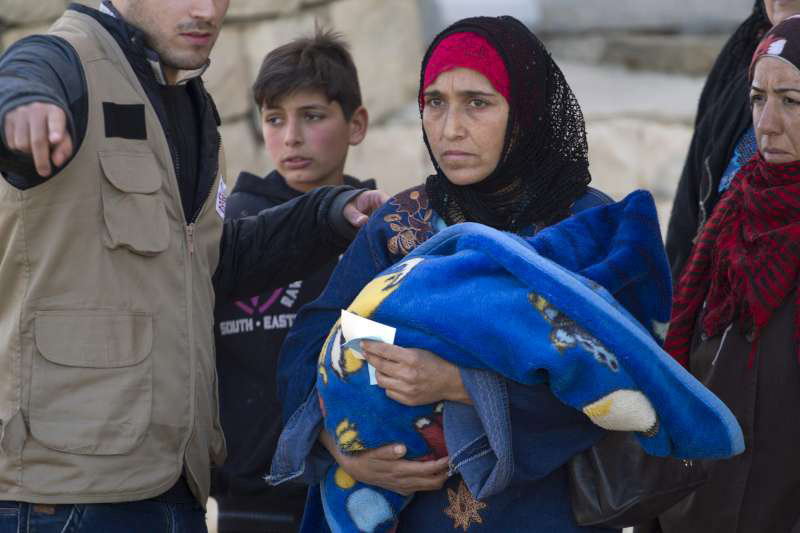
A Syrian refugee mother waits in line with her child to collect aid in Arsal, Lebanon. Photo: UNHCR/M. Hofer
Another factor is the need to building an effective universal partnership for humanitarian action, Guterres said, expressing hope that the upcoming World Humanitarian Summit in Istanbul can be used to work towards a universal approach to humanitarian values and principles.
“The present multilateral humanitarian system is essentially a Western creation,” he said.
“But today, what is needed is a truly universal partnership that can draw on the totality of efforts and resources to meet humanitarian needs,” he added.
There was some encouraging progress in Africa, Guterres noted, including the recently launched voluntary return operation of some 30,000 former Angolan refugees from the Democratic Republic of the Congo (DRC).
In the Americas, a comprehensive initiative for Colombian refugees is being implemented in Ecuador, combining improved livelihood opportunities, resettlement and facilitated labour mobility in the region.
Guterres concluded his address by emphasizing that the most important way in which the humanitarian system must change course to avoid a complete failure of humanitarian response in the future is conflict prevention.
Conflict prevention and conflict resolution should always be led by the countries affected, although countries require stronger international support, including in mediation and stabilization efforts, he said.
“This extends far beyond the realm of humanitarian action, and essentially comes down to a question of international political resolve to address the root causes of displacement,” he said. (*Source: UN Release).
Read also:
Refugees Perish at “Alarming” Rate on Dangerous Crossing to Europe – UN
Sinking of Mediterranean Migrant Boat Amounts to ‘Mass Murder’ – UN Rights Chief
Year’s Deadliest Week: More than 300 Die in Boat Tragedies on Mediterranean
Mediterranean, the Deadliest Sea for Refugees, Migrants
Tracing Dead Migrants in Europe
Cash Grants Transform Life in Congo Camp for Central African Republic Refugees, But…
Coffee and Patience: a Day in the Life of a Family Hosting Syrian Refugees
More War Refugees Today Than in World War II — 51 Million
‘Liberated’ Afghanistan: What to Do With Three Million Refugees, Half a Million Homeless
Becoming Refugees Once More: Palestinians from Syria Return to Gaza
Europeans, the Once Upon a Time Refugees!
Who Is Afraid of 300 Or 400 Or 500 Million Miserables?
2014 Human Wrongs Watch
Discover more from HUMAN WRONGS WATCH
Subscribe to get the latest posts sent to your email.
 Baher Kamal
 HUMAN WRONGS WATCH
Leave a comment