16/04/2016
By Helene Caux
The Far North Region of Cameroon, 14 April 2016 (UNHCR) – Paul and his younger brother Adam resisted with all their strength when several armed men from the Boko Haram sect burst into their house in their village, located in Nigeria’s Borno State, and dragged them outside.

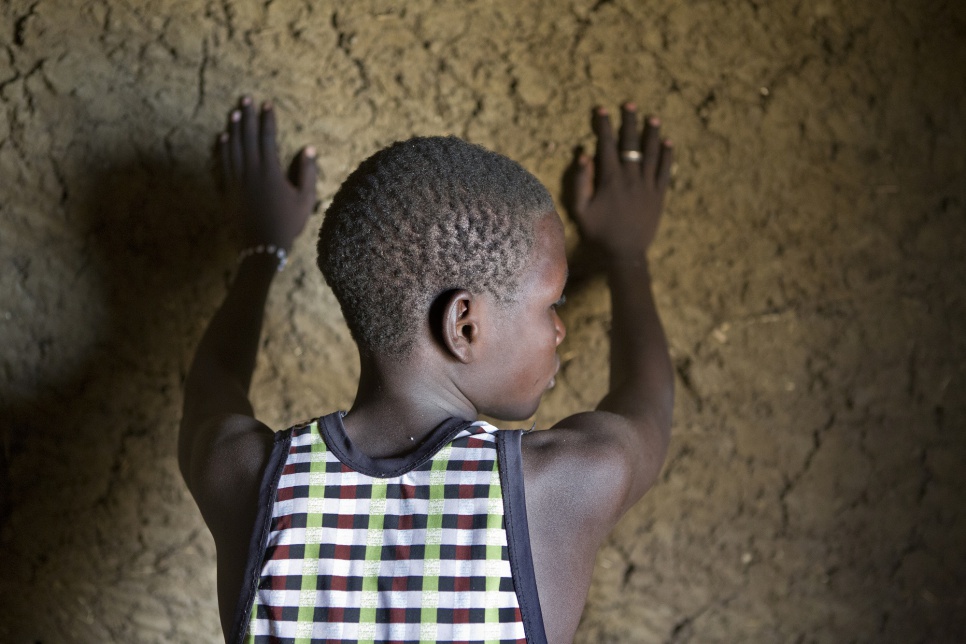
© UNHCR/H.Caux | Nigerian youngster Paul, who was abducted by Boko Haram militants at age 14, stands against a wall.
“They ended up lifting us up and threw us in a car. They handcuffed us, and we remained like that for a day,” remembers Paul from the Minawao camp, in Cameroon’s Far North region, where he is now a refugee with his brother and mother. “Our abduction happened almost three years ago but it feels as if it happened yesterday,” he added.
read more »
Posted in Africa, Market Lords, Others-USA-Europe-etc., The Peoples, War Lords |
Leave a Comment »
16/04/2016
Hope Amidst Violence — Conflict prompted by Boko Haram has led to widespread displacement of more than 2 million people across the Lake Chad region. A new UNICEF report details the impact on children. Hear their stories of being bound by violence, and freed by dreams.

Credit: UNICEF
12 April 2016 (UNICEF) – The number of children involved in ‘suicide’ attacks in Nigeria, Cameroon, Chad and Niger has risen sharply over the past year, from 4 in 2014 to 44 in 2015, according to a UNICEF report released today. More than 75 per cent of the children involved in the attacks are girls.
“Let us be clear: these children are victims, not perpetrators,” said Manuel Fontaine, UNICEF Regional Director for West and Central Africa.
read more »
Posted in Africa, Market Lords, Others-USA-Europe-etc., The Peoples, War Lords |
Leave a Comment »
16/04/2016
CAIRO, 13 April 2016 – Now that Yemenis begin to hope that their year-long armed conflict may come to an end as a result of the Gulf Cooperation Council and the UN sponsored round of talks between the parties in dispute, scheduled on 18 April in Kuwait, a new threat to their already desperate humanitarian crisis has just appeared in the form of a much feared massive desert locust invasion.

Juvenile desert locust hoppers. Photo: FAO/G.Tortoli
“The presence of recently discovered Desert Locust infestations in Yemen, where conflict is severely hampering control operations, poses a potential threat to crops in the region,” the Food and Agriculture Organization of the United Nations (FAO) has warned.
read more »
Posted in Africa, Middle East, Mother Earth, The Peoples |
Leave a Comment »
16/04/2016
“Who is doing this? Who is killing us? This great evil. How did it steal into the world?
We were a family. How did it break up and come apart?”
– Private Witt’s thoughts, The Thin Red Line, by Terrence Malick.

Credit: Greenpeace/Alan Hindle
Records from the first century portray Jewish peasants – men, women, and children marching on the governor in Caesarea, protesting atrocities of the Roman army, prostrating on the ground, and offering their lives en masse. Since the dawn of warfare, there have been peace movements.
read more »
Posted in Africa, Asia, Latin America & Caribbean, Market Lords, Middle East, Mother Earth, Others-USA-Europe-etc., The Peoples, War Lords |
Leave a Comment »
16/04/2016

This 15 year-old Nigerian refugee at the Minawao refugee camp in northern Cameroon, was abducted by Boko Haram and spent four months in captivity. Photo credit: UNICEF/Karel Prinsloo
“Humanitarian agencies are concerned that two years have passed, and still the fate of the Chibok girls and the many, many other abductees is unknown,” said Fatma Samoura, Humanitarian Coordinator for Nigeria.
read more »
Posted in Africa, Market Lords, Others-USA-Europe-etc., The Peoples, War Lords |
Leave a Comment »
12/04/2016
By Mairead Maguire, Nobel Peace Laureate*
11 April 2016 – TRANSCEND Media Service –
 When the President of Ireland, Michael D. Higgins, the Irish military, government members and many Irish people gathered in Dublin, on Easter Sunday (27 March 2016) to remember the Easter Rising of 1916, some of his challenging words were addressed to the young generation.
He encouraged them ‘to imagine and to dream,’ and he said that ‘we wish them well as they make music and continue to dream’. The leaders of 1916 had political hopes and dreams.
President Higgins said, ‘For the leaders of 1916, their political hopes and aspirations for what a free Irish Republic might be, were linked to a rich Irish culture which they cherished and promoted.
Within that vision, their ancient Irish language and culture, informed by our history and migration, was central to everything for which they hoped and fought.’
read more »
Posted in Market Lords, Mother Earth, Others-USA-Europe-etc., The Peoples |
Leave a Comment »
12/04/2016
By Roberto Savio*
Rome, April – The recent Brussels massacre has created a short term reaction, which ignores a long term projection. All the debate is now about security, police reinforcement, new military strategies, as if terrorism can be solved just as a matter of public order.

Roberto Savio
It is of critical importance to take a more global and comprehensive approach, and accept that we are facing a problem that needs to be approached from various angles.
Given the usual restrictions on length of articles in media outlets, a real analytical piece must wait for another occasion.
I therefore request readers to refer to the links to some of my previous, in order to have detailed information on points that I am not able to address adequately in this article.
read more »
Posted in Africa, Market Lords, Middle East, Others-USA-Europe-etc., The Peoples, War Lords |
Leave a Comment »
12/04/2016
9 April 2016 (RT) – Against all logic, and many would argue reason, Western powers have allowed for dangerous radical factions to hold a great many cards in the carving of Syria’s future, arguing pluralism and an imperious need for fair political representation.
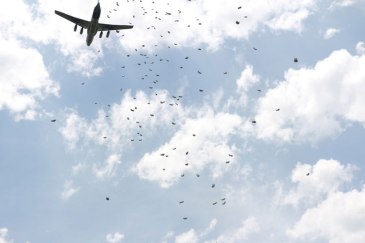
Photo: WFP (file) | In a boost to international humanitarian efforts in Syria, the UN World Food Programme (WFP) on | On 10 April 2016 delivered aid by air for hungry people trapped in the besieged eastern city of Deir Ezzor, an area controlled by Islamic State in Iraq and the Levant (ISIL/Da’esh).
But what happens when such parties, such democratic pawns, prove to be radicalism’s most rapacious tools – the very expression of the terror Western powers and their allies have so longingly claimed to have ambitions to destroy?
read more »
Posted in Market Lords, Middle East, Others-USA-Europe-etc., The Peoples, War Lords |
Leave a Comment »
12/04/2016
By John Scales Avery*
In a recent speech to the World Future Council, the distinguished writer, philanthropist, activist and former politician Jacob von Uexküll outlined the future dangers facing our world with an accuracy and eloquence that has seldom been equaled. Here is a link to his speech.

**World Future Council’s Founder Jakob von Uexküll
Jakob von Uexküll belongs to a brilliant family.
His grandfather was a famous Baltic-Genman physiologist who founded the discipline of Biosemiotics.
Besides being a former Member of the European Parliament and a leader of the German Green Party, von Uexküll himself founded both the Right Livlihood Award (sometimes called the Alternative Nobel Prize) and also the World Future Council.
read more »
Posted in Africa, Asia, Latin America & Caribbean, Middle East, Mother Earth, Others-USA-Europe-etc., The Peoples |
Leave a Comment »
12/04/2016
By Uri Avnery*
9 April 2016
IT SEEMS that everything possible has already been said, written, proclaimed, asserted and denied about the incident that is rocking Israel.
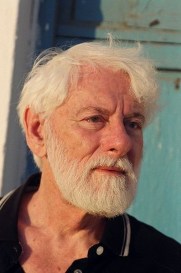
Uri Avnery
Everything except the main point.
THE INCIDENT revolves around “the Soldier of Hebron”. Military censorship does not allow him to be called by his name. He may be called “Soldier A”.
It happened in the Tel Rumaida neighborhood of the occupied South West Bank town of Hebron, where a group of super-extreme right-wing settlers live in the midst of some 160,000 Palestinians and are heavily protected by the Israeli army. Violent incidents abound.
read more »
Posted in Market Lords, Middle East, Others-USA-Europe-etc., The Peoples, War Lords |
Leave a Comment »
 HUMAN WRONGS WATCH