Human Wrongs Watch
ROME, Jan 25 2017 (IPS) – George W. Bush, the Republican bridge between Ronald Reagan and Donald Trump as U.S. president, declared that the United States was the only democracy in the world. The election of Trump now makes this traditional American rhetoric impossible. Trump received 3 million votes less than his opponent Hilary Clinton.
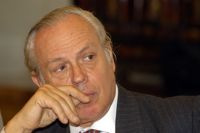
Roberto Savio
The American electoral system was born with the independence from Britain, more than 200 years ago.
These two centuries of union have formed a people united by myths, consumption and patriotism, but the constitution is untouchable, and based on the idea of protecting small states.
The result is a democratic aberration.
Each state is entitled to two senators – both Wyoming with 635,000 inhabitants and California with 39 million. The nine most populous states of the Union are home to just over 50 per cent of the total population.
The 25 least populated states house less than one-sixth. California has more inhabitants than 21 of the least populated states. But in the Senate, just 26 of the Union’s 50 states with slightly over 15 people of the American people have the majority vote.
The same happens with the election of the President. The vote of the citizens elects representatives not calibrated according to voters but to states, which elect the President.
Trump was basically elected with the votes of the inhabitants of rural areas and declining industrial areas, representing the country’s numerical minority.
According to all constitutionalists, a democracy is based on the balance among the legislative, executive and judicial branches.
This balance has ceased to exist since the time of Ronald Reagan. In a country where only 50 per cent of people vote, political polarisation has led to a structural conflict between the legislative and the executive branches of the system.
The Supreme Court, which is supposed to defend the rights of citizens, has become a political arm of the President who appoints the judges. With a Republican majority, it sanctioned the victory of George W. Bush – not Al Gore – in the presidential elections of 2000, bypassing the popular will.
And in 2010 it decided that companies have the same rights as citizens and can therefore finance election campaigns, just like citizens.
As a result, the Koch brothers, lords of fossil fuel, can vote individually as citizens but contribute 900 million dollars to conservative Republican candidates. A presidential election costs at least two billion dollars. And a senatorial election 40 million.
These are figures that marginalise the ordinary citizen. Do we not then have an oligarchy rather than a democracy?
Basically, democracy ceases to be real if citizens no longer believe in the political system. And this is not just the American way, but also that of Europe.
Since the fall of the Berlin Wall in 1989, with the end of ideologies, politics has lost vision and long-range strategy, to become a basically administrative fact, with a substantive increase in corruption.
Citizens, and especially young people, do not feel part of the system. From being participatory mechanisms, political parties have become self-referential.
And to political disaffection, we should add the discovery that the neo-liberal economic model of the free market has in no way led to the growth announced for all, but has instead increased to an unprecedented extent the gap between the rich (increasingly fewer) and the poor (increasingly more numerous).
Today, just eight people possess wealth equivalent to 2.3 billion of the poorest inhabitants of the planet … Since the crisis of 2008, at least four trillion dollars have been invested in the global financial system.
In Italy, the state is investing 20 billion euros in the rescue of the Monte dei Paschi di Siena bank, a sum that would solve the problems of the country’s education and health sectors.
Banks meanwhile have paid 220 billion in fines for illegal activities. Not a single banker has been sent to prison, neither in Europe nor in the United States. And salaries can easily exceed a million dollars.
This disastrous ethical, political and social framework is compounded by mass immigration that, it should be recalled, is the result in large part of US and European military interventions in Iraq, Libya, Syria and Yemen.
That’s why, as Pope Francis eloquently says, people are looking for a saviour.
The crisis of 2008, born in the United States from the fiasco of junk mortgages, and then transferred to Europe through speculation on state securities, gave rise to saviours in almost all European countries, a process which was crowned with Brexit. Now they’re on the attack.
Heartened by the victory of Trump, a meeting was held in Koblenz, Germany, on January 21 of right-wing xenophobic and populist candidates at the next Dutch, French and German elections, who have formed the Europe of Nations and Freedom Group in the European Parliament.
Present for Italy was Matteo Salvini who is calling for Italian elections in June, and who declares that the three founding countries of Europe – France, Italy and Germany – will soon shatter the chains of the European Union and refound the Europe of Nations.
It is interesting to note that all look to Vladimir Putin as a point of reference, the call for a conservative and traditional church, the defence of family values against recognition of the rights of homosexuals, and the call for national values. And the impact on politics is important.
In Italy, Trump’s predecessor Silvio Berlusconi says we must no longer speak of parties, which have become unpopular, but of movements. And Beppe Grillo of Italy’s 5-Star Movement, who today would win the Italian elections, has declared that Trump and Putin are a heritage for humanity.
As background to this Western context, we have a China, a Japan and an India ruled by nationalists. And a Philippines with a president elected on the promise to kill 60,000 people, victims of drugs.
And a Latin America undergoing a profound political crisis, evident in a different way from Brazil to Venezuela, from Colombia to Bolivia, from Ecuador to Central America.
And an Africa, with a population that will increase from a population of one billion to two billion in just three decades, which continues to have frequent democratic crises and inadequate responses to the economic and social needs of the continent.
But the real news is that the Anglophonic world has decided to abdicate its historic role in favour of democracy and multilateralism. It should be recognised that we have so far lived in a very Anglophonic world.
Until the First World War, the world lived under Pax Britannica, which had colonised 25 per cent of the planet. And after that, we had almost a century of Pax Americana.
The creation of the United Nations and international institutions, the concepts of gender equality, action against climate change, as well as neo-liberal globalisation, all came mainly from the Anglophonic world.
In just a few months, the Brexit vote has taken Britain back in time, and the United States under Trump is moving from a global policy to one with a purely national dimension.
All this is taking place in a multi-polar world, where China can now find unforeseen opportunities, like the other emerging countries so far framed in a world order governed by the United States and its European allies.
But now, suddenly, the United States is actively engaged in destabilising traditional allies. It should be noted that Trump’s strategist Stephen Bannon has said that part of his task at the White House is to strengthen European xenophobic parties and movements, and he cites Nigel Farage, the architect of Brexit, as the European model to work with.
Trump’s statements against the European Union, NATO, the United Nations and international agreements are known.
The Trump Revolution will not be easy, and will hopefully create a mobilisation in defence of the values through which we have had 70 years of international cooperation.
The development of greed – and replacement of the person as the centre of society by the market – has certainly emptied the world order of its idealistic content.
But what will this new world order be, based on nationalism, fear and greed?
What is certain is that a style of governing that belies the data of reality foments tension and hatred as political tools, fights against culture, intellectuals, the press, women, minorities, homosexuals and neighbours, and will have a profoundly negative impact on politics and society, ethics and democracy, in the world.
So, the real question is: will Trump have one term, or two?
If his electorate, which is basically localist, and thus ignorant of the world, does not understand that it has been used by Trump and so re-elects him, we will certainly enter an era of tension and fear, clashes and conflicts, in which it will not be pleasant to live.
We will see what happens in Europe and the rest of the world without international cooperation, which leads to peace and development.
—
*Author: Roberto Savio is the founder and former Director-General of international news agency Inter Press Service (IPS).
In recent years he has also founded Other News, a service providing ‘information that markets eliminate’.
*Roberto Savio’s Op-Ed was published in IPS. Go to Original. Some updates provided by the author have been incorporated.
Roberto Savio: utopie@ips.org. http://www.robertosavio.info.
In Spanish: http://www.other-news.info/noticias/
In English: http://www.other-net.info/
Don’t miss these articles by Roberto Savio in Human Wrongs Watch:
Please, Do Not Get Offended, But…
Some Uncomfortable Reflections on Trump Election
European Security, With or Without Russia?
How Did We Arrive to This Chaos?
‘Internationalism’ Is Out, ‘Nationalism’ Is Back
Is a Referendum a Valid Tool for Democracy?
Not Politically Correct Reflections on Brexit
Is It in Europe’s Interest to Push Russia into China’s Arms?
Greece, the Punching Ball of Germany
Islamophobia Is a Political Tool
The Hypocrisy of the West and Fiscal Paradise
Unnoticed, We Are Close to the Destruction of Our Planet
We Need Statesman and Values but We Get Selfish Politicians and Cynics
A Decalogue to Understand Terrorism and Its Consequences
Are We Entering Into a Long Term Stagnation?
Boutros Boutros Ghali, Turning Point in the History of United Nations
Europe Is Disintegrating While Its Citizens Watch Indifferent
The Lesson from Davos: No Connection to Reality
Christmas, the Weather, the Republicans and the Rest of Us
Of Democracy and Climate – Two Lessons from Paris
Military Security and Human Security
How Much is Left of Syrian in the Syrian War?
Paris, the Refugees and Europe
A Politically Incorrect Reflection on the Paris Massacre
Global Threat, Global Response
The West Vote for a Better Yesterday
From European Union to Just a Common Market
Misinformation Hides Real Dimension of Greek “Bailout”
The Kiss of Death for the Original European Dream
The Hidden Truth Behind the Greek Drama
Greece – A Sad Story of the European Establishment
Immigration, Myths and the Irresponsibility of Europe
Voracious Finance Growing Like a Cancer
The Crisis of the Left and the Decline of Europe and the United States
The West and Its Self-Assumed Right to Intervene
A Guide to the Religious Conflict in the Arab World
Blissful Ignorance Makes the West Slide into Mishaps
Pillar of Neoliberal Thinking Is Vacillating
It Should Be Clear What to Expect from the World Social Forum
Foreign Policy Is in the Hands of Sleepwalkers
What if Youth Now Fight for Social Change, But From the Right?
The Exceptional Destiny of U.S. Foreign Policy
Climate Change: Governments Say All the Right Things But Do Exactly the Opposite
Global Governance and Common Values: the Unavoidable Debate
Of Banks, Inequality and Citizens
The Paris Killings – A Fatal Trap for Europe
Ten Major Handicaps Facing 2015
The Steady Decline of Social Europe
The “Incestuous Relations” Between Governments and Energy Corporations
Four Key Reasons to Understand the Irresistible Attraction of Radical Islam
Europe Is Positioning Itself Outside World Arena
Planet Racing Towards Catastrophe and Politics Just Looking On
OP-ED: International Relations, the U.N. and Inter Press Service
Ever Wondered Why the World is a Mess?
Economic Growth Is Anything But “A Rising Tide Lifting All Boats”
Banks, Financial Institutions and Citizens — The Urgent Need to Update the Seven Deadly Sins
The Decline of the Middle Class
The Rich Complain That We Do Not Love Them
The Free Market Fundamentalists Are Now in Europe
The ‘European Dream’ Going the Way of the ‘American Dream’
Thatcher, Reagan and Their “Revolutions”
Cyprus: Do You Understand What Has Really Happened?
Hugo Chávez’s legacy to Latin America
“The Tide Is Growing, But The System Does Not Realise It”
The Palestine Drama, Public Theories and Hidden Realities
China Opening a Confrontation on the Sea
After Two Lost Decades, Japan Went to Sleep
Japan – Ethics, Democracy, Growth
China, Japan Brewing a Serious Conflict
A Personal Experience with the American Justice System
2017 Human Wrongs Watch
Discover more from HUMAN WRONGS WATCH
Subscribe to get the latest posts sent to your email.
 Baher Kamal
 HUMAN WRONGS WATCH
Leave a comment