Human Wrongs Watch
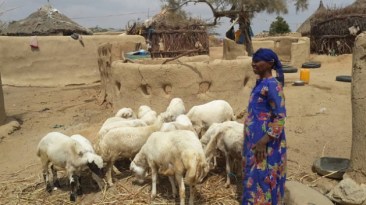
A livestock owner in Yemen tends her goats. Livestock production fell by more than 35 per cent in 2016 compared to the pre-crisis period. Credit: FAO
“Famine does not just kill people, it contributes to social instability and also perpetuates a cycle of poverty and aid dependency that endures for decades,” the UN Food and Agriculture Organization (FAO) the Director-General Jose Graziano da Silva added.
At a media briefing ahead of the conclusive session of the this UN specialised agency’s executive arm—the FAO Council, he launched a new appeal for voluntary contributions, that are “of vital importance to FAO, now more than ever.”
“I will be always committed to finding more savings and promoting more efficiency, as I have done over the last five years. But I have already cut to the bone. There is no more fat left.”
On this, Graziano da Silva emphasised the need to work with everyone on the basis of the 2030 agenda for sustainable development –“Leaving No One Behind”, in order to save all the affected people.
He also announced that agreement will be signed among FAO and the other two Rome-based UN agencies: the International Fund for Agriculture (IFAD) and the World Food Programme (WFP) on how to tackle the current famine in those 4 countries– Nigeria, Somalia, South Sudan and Yemen.
The FAO Council, which has met in FAO-headquarters in Rome on 24 – 28 April, convenes between sessions of the main Conference to provide advice and oversight related to programmatic and budgetary matters.
The Council’s 49 elected members have been briefed on the extent of the hunger crises, and the steps required to preventing catastrophe.
Making Funds Go Further
The organisation’s executive body has also approved FAO‘s Programme of Work and Budget 2018-2019, which prioritises areas where FAO can deliver the greatest impact to member countries to achieve the Sustainable Development Goals, including climate change mitigation and adaptation, sustainable agriculture production, water scarcity management, and building the resilience of poor family farmers.
Food and agriculture are central to the sustainable development agenda, and FAO’s work is projected to contribute to the achievement of 40 targets across 15 of the 17 goals.
Ahead of the FAO Council’s meeting, Graziano da Silva had on 25 April stated in Geneva that a combination of food assistance and food production assistance is the only way to avoid famine in conflict-ridden Yemen where two-thirds of the population –17 million people– are suffering from severe food insecurity.
“As the conflict continues, food security and nutrition will also continue to deteriorate,” he stressed in his address to a United Nations High-Level Pledging conference for Yemen organised in Geneva and co-hosted by the governments of Switzerland and Sweden.
“To put these figures into perspective, we are talking about the double of Switzerland’s population being unable to meet their basic daily food needs.”
He stressed how livelihoods support, especially for agriculture and fishing, must be an integral part of the international community’s response to the crisis in Yemen.

Famine has officially been declared by the South Sudanese government for some parts of the country. Credit: FAO
Over 17 Million Yemenis, Acutely Food Insecure
More than 17 million people around Yemen’s rugged landscape are acutely food insecure, and the figure is likely to increase as the on-going conflict continues to erode the ability to grow, import, distribute and pay for food, Graziano da Silva wrote on IPS.
“More than 7 million people are on the verge of famine, while the rest are marginally meeting the minimum day-to-day nutritional needs thanks to external humanitarian and livelihoods support. Large-scale famine is a real risk that will cast an awful shadow for generations to come.”
According to Graziano da Silva, only a political solution can end the suffering in Yemen, as there can be no food security without peace. And the longer the delay to draft an adequately funded recovery plan, the more expensive the burden will be in terms of resources and human livelihood.
In 2016, agriculture production in Yemen and the area under cultivation shrank by 38 per cent due to the lack of inputs and investments. Livestock production fell by 35 per cent.
“Agricultural assistance in a humanitarian crisis can no longer be an afterthought,” the FAO Director-General said. “We need to seize every opportunity to support communities in Yemen to continue producing food, even under difficult circumstances.”
In Geneva, Graziano da Silva met Yemen’s Prime Minister Ahmed Obaid Bin Daghr, for talks on FAO’s support to the country to deliver emergency livelihood assistance and kick-start food production, especially when resources pledged to tackle the crisis are concretely made available.
The Geneva pledging conference on April 25 mobilised half of the 2,1 billion dollars urgently required to rescue the starving Yemeni population.
Related:
- Yemen, World’s Largest Humanitarian Crisis
- Building resilient rural livelihoods is key to helping Yemen
 *Author: Baher Kamal, Egyptian-born, Spanish-national secular journalist. He is founder and publisher of Human Wrongs Watch.
 More articles by Baher Kamal in Human Wrongs Watch:
Indigenous Peoples – Best Allies or Worst Enemies?
Middle East, Engulfed by a ‘Perfect Storm’
Yemen, World’s Largest Humanitarian Crisis
ACP: One Billion People to Speak To Europe with One Voice
Did You Know that the Oceans Have It All?
The Unbearable Cost of Drought in Africa
‘Humanity and Social Justice, a Must for the Future of Work’
Work, What Future? Seven Big Questions Needing Urgent Response
Plastic No More… Also in Kenya
Climate Breaks All Records: Hottest Year, Lowest Ice, Highest Sea Level
New Evidence Confirms Risk That Mideast May Become Uninhabitable
The Indigenous ‘People of Wildlife’ Know How to Protect Nature
These Women Cannot Celebrate Their Day
Antarctic Ice Lowest Ever – Asia at High Risk – Africa Drying Up
UN Declares War on Ocean Plastic
Of Arabs and Muslims and the Big Ban
Every Year 700 Million People Fall Ill from Contaminated Food
A Dire Vacuum in a World in Crisis
Indigenous Peoples Lands Guard 80 Per Cent of World’s Biodiversity
World’s 40,000 MP’s Must Enjoy Their Rights – But Are They?
Want to Prevent Stroke, Diabetes, Cancer? Get Moving… Now!
Trump to Pull Out of the UN, Expel It from the US?
Inequality (III): Less Employment… and More ‘Junk’ Jobs
Inequality (II): “It Will Take 170 Years for Women to Be Paid as Men Are”
Inequality (I): Half of World’s Wealth, in the Pockets of Just Eight Men
Poor Darwin – Robots, Not Nature, Now Make the Selection
When Your Healers Become Your Killers
Is Cash Aid to the Poor Wasted on Tobacco and Alcohol?
Poor Darwin – Robots, Not Nature, Now Make the Selection
When Your Healers Become Your Killers
Is Cash Aid to the Poor Wasted on Tobacco and Alcohol?
“Bonn Has Become an Insider Tip on the International Stage”
Battle of the Desert (and III): The Silk Road
Battle of the Desert (II): A ‘Great Green Wall for Africa’
Battle of the Desert (I): To Fight or to Flee?
Children of the ‘Others’, Sons of Minor Gods
World to Cut Gas Emissions by 25 Percent More Than Paris Agreement
Toxic Air – The ‘Invisible Killer’ that Stifles 300 Million Children
Climate Doomsday – Another Step Closer
What Happens When a Small Farmer Migrates?
‘The Earth Is Not Flat; It Is Urban’
Take a Deep Breath?… But 9 in 10 People Live with Excessive Air Pollution!
Believe It or Not, Pulses Reduce Gas Emissions!
Ships Bring Your Coffee, Snack and TV Set, But Also Pests and Diseases
One Humanity? Millions of Children Tortured, Smuggled, Abused, Enslaved…
Arable Lands Lost at Unprecedented Rate: 33,000 Hectares… a Day!
War on Climate Terror (II): Fleeing Disasters, Escaping Drought, Migrating
War on Climate Terror (I): Deserts Bury Two Thirds of African Lands
African Farmers Can Feed the World, If Only…
Climate Victims – Every Second, One Person Is Displaced by Disaster
400 Million People Live with Hepatitis But They Do Not Know
Rights of Indigenous Peoples ‘Critical’ to Combat Climate Change
Forests: To Farm or Not to Farm? That’s the Question!
‘Monster’ El Niño Subsides, ‘Monster’ La Niña Hitting Soon
‘Modern World Is Chaotic, Confused; Human Security a Must’
Xenophobic Rhetoric, Now Socially and Politically ‘Acceptable’ ?
‘Hate Is Mainstreamed, Walls Are Back, Suspicion Kills’
What If Turkey Drops Its “Human Bomb” on Europe?
Humanitarian Aid – Business As Unusual?
World Oceans Day – A Death Sea Called Mediterranean
The Humanitarian Clock Is Ticking, The Powerful Feign Deafness
Humanitarian Summit, The Big Fiasco
Humanitarian Summit: Too Big to Fail?
Humanitarian Summit Aims to Mobilise Up to 30 Billion Dollars
Africa, Resolved to Address African Problems With African Solutions
‘We Cannot Keep Jumping from Crisis to Crisis’
‘Human Suffering Has Reached Staggering Levels’
Now 1 in 2 World’s Refugees Live in Urban Areas
Middle East – The Mother of All Humanitarian Crises
Mideast: 1 in 3 Pays Bribe to Access Basic Public Services
Climate: Africa’s Human Existence at Severe Risk
No Water in the Kingdom of the Two Seas – Nor Elsewhere
Will the Middle East Become ‘Uninhabitable’?
Can an Animal Heist Fable Help Solve the Middle East Crisis?
A “Colombian Triangle” for Daesh in Libya?
‘Take My Iraqis and Give Me Some Syrians’ – Europe to Turkey
New Nuclear Hysteria in the Middle East
Africa Launches Largest Trading Block with 620 Million Consumers
Big War Lords Playing Brinkmanship Game in Syria
Cameron at large: Want Not to Become a Terrorist? Speak Fluent English!
Women’s Rights First – African Summit
Africa, Only If It Bleeds It Leads?
Seven Top Challenges Facing African Women
Once Auctioned, What to Do with the ‘Stock’ of Syrian Refugees?
Silence, Please! A New Middle East Is in the Making
The Over-Written, Under-Reported Middle East (II): 99.5 Years of (Imposed) Solitude
The Over-Written, Under-Reported Middle East (I): Of Arabs and Muslims
Egypt in the Rear Mirror (I): The Irresistible Temptation to Analyse What One Ignores
Egypt in the Rear Mirror (II): Who Are the Not-So-Invisible Powers Behind the Troglodytes?
Fed Up With Empty Promises, The Arabs May Abandon Nuclear Non-Proliferation Treaty
Anti-Nukes Move from Norway to Bahrain
Middle East Nuclear Free Bid Moves to Finland – Yet Another Lost Chance?
Annual Spending on Nuclear Weapons, Equivalent To UN Budget For 45 Years
Watch The Sky–It May Rain Atomic Bombs
Save The Planet? Just Eat Cars, Drink Fuel!
Who Is Afraid of 300 Or 400 Or 500 Million Miserables?
Violence And Death For Millions Of Life-Givers
Whither Egypt (I) – Did You Say Dictatorship?
Whither Egypt (II) – Economic Bankruptcy
Politicians Promote Fossil Fuels with Half a Trillion Dollars a Year
Who Dares to Challenge a 32 Billion Dollars Business – Human Trafficking?
Palestine: Yet Another One Hundred Years of Solitude
Does Anyone Know Anything About A New Country Called South Sudan?
South Sudan: Yet Another Kitchen-Garden?
Somalia? Which Somalia? Some Facts About Everybody’s — Nobody’s Land
2017 Human Wrongs Watch
Discover more from HUMAN WRONGS WATCH
Subscribe to get the latest posts sent to your email.
 Baher Kamal
 HUMAN WRONGS WATCH
Leave a comment