
FAO massive famine-prevention campaign in Somalia–12 million animals treated so far against livestock diseases and illness. Credit: FAO
While an estimated 7.8 million people are food insecure in Ethiopia, where drought has dented crop and pasture output in southern regions, in the specific case of Somalia, the United Nations reports that 3.2 million people—that’s one third of its estimated 11 million inhabitants, are now on a ‘hunger knife-edge.’
Meanwhile, more than six million people are affected, of whom only about three million have been reached with food rations.
Key Numbers
· Animals provided with life-sustaining care so far: 12.3 million
· People supported by those animals: 1.8 million pastoralists
· Approximate cost of each FAO treatment per animal: $0.40
· Cost to a pastoralist to replace one dead animal: $40
· Cumulative value of prevented livestock losses so far: $492 million
SOURCE: FAO
.
“The humanitarian crisis has deteriorated more rapidly than was originally projected,” the Deputy Special Representative of the Secretary-General for Somalia, Raisedon Zenenga, few weeks ago told the Council in New York.
People Are Dying. Survivor, Forced to Migrate
“People are dying and need protection, particularly women and children, as drought conditions force them to migrate from rural areas to town, and as sexual violence increases in displacement camps.”
Worldwide, land degradation, severe droughts and advancing desertification are set to force populations to flee their homes and migrate.
Over the next few decades, worldwide, close to 135 million people are at risk of being permanently displaced by desertification and land degradation, says Monique Barbut, executive secretary of the United Nations Convention to Combat Desertification (UNCCD).
“If they don’t migrate, the young and unemployed are also at more risk of falling victim to extremist groups that exploit and recruit the disillusioned and vulnerable, “ added Barbut in her message on the occasion of this year’s World Day to Combat Desertification (WDCD) marked on June 17.
They are missing out on the opportunity to benefit from increasing global demand and wider sustained economic growth. In fact, the economic losses they suffer and growing inequalities they perceive means many people feel they are being left behind, Barbut said.
“They look for a route out. Migration is well-trodden path. People have always migrated, on a temporary basis, to survive when times are tough. The ambitious often chose to move for a better job and a brighter future.”
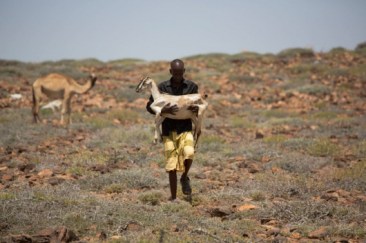
Famine-prevention: The livestock protection campaign is vital for vulnerable pastoralists who rely on their animals to survive. Credit: FAO
One in every five youth, aged 15-24 years, for example is willing to migrate to another country, she noted, adding that youth in poorer countries are even more willing to migrate for a chance to lift themselves out of poverty.
“It is becoming clear though that the element of hope and choice in migration is increasingly missing. Once, migration was temporary or ambitious. Now, it is often permanent and distressed.”
Saving Animals Saves Human Lives, Livelihoods
In parallel, concerned United Nations agencies have been strongly mobilised to help mitigate the new famine facing African countries. One of them, the Food and Agriculture Organization of the United Nations (FAO), has been pushing forward with a massive campaign that has so far treated more than 12 million animals in less than three months.
The objective is to protect the livelihoods of hundreds of thousands of families who rely on their livestock’s meat and milk for survival. By mid-July, the UN specialised body will have reached 22 million animals, benefiting over 3 million people.
“Saving animals saves human lives and livelihoods. When animals are weakened by drought, they stop producing milk or die which means people go hungry and families are pushed out of self-reliance,” said Richard Trenchard, FAO Representative in Somalia.

Worsening drought conditions have left hundreds of thousands of Somalis facing severe food and water shortages. Credit: OCHA Somalia
Around 3.2 million people in Somalia are on a hunger knife-edge, the agency reports, adding that the majority live in rural areas and livestock such as goats, camels, sheep and cattle are their main source of food and income.
“What we have heard again and again from displaced people in camps is that when they lost their animals, everything collapsed. It is a steep, long climb for them to get back on their feet again. We have stepped up our response to reach families before that happens,” added Trenchard. “Livelihoods are their best defence against famine”.
In Somalia, 6.7 million people face acute hunger as threat of famine persists, according to a FAO new assessment.
The UN agency is deploying 150 veterinary teams across Somalia to treat goats and sheep as well as cattle and camels – up to 270,000 animals each day. The teams are made up of local Somali veterinary professionals.
Simple, Cost-Effective Care
Livestock badly weakened by the lack of feed and water are highly susceptible to illnesses and parasites but are too weak to withstand vaccination, the specialised organisation reports.
As part of an integrated response program to improve the conditions of livestock, animals are treated with multivitamin boosters, medicines that kill off internal and external parasites, deworming, and other treatments to fight respiratory infections.
The simple and cost-effective care being provided by the FAO vet teams is reinforcing animals’ coping capacity and keeping them alive and productive. (See Key Numbers Box).
Meanwhile, through its Famine Prevention and Drought Response Plan, the UN specialised body is delivering large-scale, strategic combinations of assistance to prevent famine in Somalia.
In addition to livestock treatments, this includes giving rural families cash for food purchases, helping communities rehabilitate agricultural infrastructure, and providing farmers with vouchers for locally-sourced seeds along with tractor services that reduce their labour burden.
Any serious reaction from Africa’s former colonisers?
Related:
- Our Land. Our Home. Our Future.
- Mideast: Drought to Turn People into Eternal Migrants, Prey to Extremism?
- The Relentless March of Drought – That ‘Horseman of the Apocalypse
- New Evidence Confirms Risk That Mideast May Become Uninhabitable
- Mideast: ‘Climate Change Will Make a Difficult Situation Much Worse’
- Will the Middle East Become ‘Uninhabitable’?
- The Time is Ripe to Act against Drought
- Climate Victims – Every Second, One Person Is Displaced by Disaster
- The ‘Water-Employment-Migration’ Explosive Nexus
- 20 Million People Could ‘Starve to Death’ in Next Six Months
- Food Security in the Middle East Sharply Deteriorated
- Worldwide Displacement At Levels Never Seen Before
- Middle East – The Mother of All Humanitarian Crises
- Climate: Africa’s Human Existence Is at Severe Risk
 *Author: Baher Kamal, Egyptian-born, Spanish-national secular journalist. He is founder and publisher of Human Wrongs Watch.
 More articles by Baher Kamal in Human Wrongs Watch:
Mideast: Drought to Turn People into Eternal Migrants, Prey to Extremism?
More Plastic than Fish or How Politicians Help Ocean Destruction
The Relentless March of Drought – That ‘Horseman of the Apocalypse
Re-Connect with Nature Now… Before It Is Too Late!
The ‘Water-Employment-Migration’ Explosive Nexus
Asia: 260 Million Indigenous Peoples Marginalised, Discriminated
Mideast: Growing Urbanisation Worsens Water Scarcity, Food Imports
A Grisly Tale of Children Falling Easy Prey to Ruthless Smugglers
Agony of Mother Earth (I) The Unstoppable Destruction of Forests
Agony of Mother Earth (II) World’s Forests Depleted for Fuel
Who Are the Best ‘Eaters’ and How to Use Eggplants as a Toothbrush
African Migrants Bought and Sold Openly in ‘Slave Markets’ in Libya
The Very Survival of Africa’s Indigenous Peoples ‘Seriously Threatened’
20 Million People Could ‘Starve to Death’ in Next Six Months
Indigenous Peoples – Best Allies or Worst Enemies?
Middle East, Engulfed by a ‘Perfect Storm’
Yemen, World’s Largest Humanitarian Crisis
ACP: One Billion People to Speak To Europe with One Voice
Did You Know that the Oceans Have It All?
The Unbearable Cost of Drought in Africa
‘Humanity and Social Justice, a Must for the Future of Work’
Work, What Future? Seven Big Questions Needing Urgent Response
Plastic No More… Also in Kenya
Climate Breaks All Records: Hottest Year, Lowest Ice, Highest Sea Level
New Evidence Confirms Risk That Mideast May Become Uninhabitable
The Indigenous ‘People of Wildlife’ Know How to Protect Nature
These Women Cannot Celebrate Their Day
Antarctic Ice Lowest Ever – Asia at High Risk – Africa Drying Up
UN Declares War on Ocean Plastic
Of Arabs and Muslims and the Big Ban
Every Year 700 Million People Fall Ill from Contaminated Food
A Dire Vacuum in a World in Crisis
Indigenous Peoples Lands Guard 80 Per Cent of World’s Biodiversity
World’s 40,000 MP’s Must Enjoy Their Rights – But Are They?
Want to Prevent Stroke, Diabetes, Cancer? Get Moving… Now!
Trump to Pull Out of the UN, Expel It from the US?
Inequality (III): Less Employment… and More ‘Junk’ Jobs
Inequality (II): “It Will Take 170 Years for Women to Be Paid as Men Are”
Inequality (I): Half of World’s Wealth, in the Pockets of Just Eight Men
Poor Darwin – Robots, Not Nature, Now Make the Selection
When Your Healers Become Your Killers
Is Cash Aid to the Poor Wasted on Tobacco and Alcohol?
Poor Darwin – Robots, Not Nature, Now Make the Selection
When Your Healers Become Your Killers
Is Cash Aid to the Poor Wasted on Tobacco and Alcohol?
“Bonn Has Become an Insider Tip on the International Stage”
Battle of the Desert (and III): The Silk Road
Battle of the Desert (II): A ‘Great Green Wall for Africa’
Battle of the Desert (I): To Fight or to Flee?
Children of the ‘Others’, Sons of Minor Gods
World to Cut Gas Emissions by 25 Percent More Than Paris Agreement
Toxic Air – The ‘Invisible Killer’ that Stifles 300 Million Children
Climate Doomsday – Another Step Closer
What Happens When a Small Farmer Migrates?
‘The Earth Is Not Flat; It Is Urban’
Take a Deep Breath?… But 9 in 10 People Live with Excessive Air Pollution!
Believe It or Not, Pulses Reduce Gas Emissions!
Ships Bring Your Coffee, Snack and TV Set, But Also Pests and Diseases
One Humanity? Millions of Children Tortured, Smuggled, Abused, Enslaved…
Arable Lands Lost at Unprecedented Rate: 33,000 Hectares… a Day!
War on Climate Terror (II): Fleeing Disasters, Escaping Drought, Migrating
War on Climate Terror (I): Deserts Bury Two Thirds of African Lands
African Farmers Can Feed the World, If Only…
Climate Victims – Every Second, One Person Is Displaced by Disaster
400 Million People Live with Hepatitis But They Do Not Know
Rights of Indigenous Peoples ‘Critical’ to Combat Climate Change
Forests: To Farm or Not to Farm? That’s the Question!
‘Monster’ El Niño Subsides, ‘Monster’ La Niña Hitting Soon
‘Modern World Is Chaotic, Confused; Human Security a Must’
Xenophobic Rhetoric, Now Socially and Politically ‘Acceptable’ ?
‘Hate Is Mainstreamed, Walls Are Back, Suspicion Kills’
What If Turkey Drops Its “Human Bomb” on Europe?
Humanitarian Aid – Business As Unusual?
World Oceans Day – A Death Sea Called Mediterranean
The Humanitarian Clock Is Ticking, The Powerful Feign Deafness
Humanitarian Summit, The Big Fiasco
Humanitarian Summit: Too Big to Fail?
Humanitarian Summit Aims to Mobilise Up to 30 Billion Dollars
Africa, Resolved to Address African Problems With African Solutions
‘We Cannot Keep Jumping from Crisis to Crisis’
‘Human Suffering Has Reached Staggering Levels’
Now 1 in 2 World’s Refugees Live in Urban Areas
Middle East – The Mother of All Humanitarian Crises
Mideast: 1 in 3 Pays Bribe to Access Basic Public Services
Climate: Africa’s Human Existence at Severe Risk
No Water in the Kingdom of the Two Seas – Nor Elsewhere
Will the Middle East Become ‘Uninhabitable’?
Can an Animal Heist Fable Help Solve the Middle East Crisis?
A “Colombian Triangle” for Daesh in Libya?
‘Take My Iraqis and Give Me Some Syrians’ – Europe to Turkey
New Nuclear Hysteria in the Middle East
Africa Launches Largest Trading Block with 620 Million Consumers
Big War Lords Playing Brinkmanship Game in Syria
Cameron at large: Want Not to Become a Terrorist? Speak Fluent English!
Women’s Rights First – African Summit
Africa, Only If It Bleeds It Leads?
Seven Top Challenges Facing African Women
Once Auctioned, What to Do with the ‘Stock’ of Syrian Refugees?
Silence, Please! A New Middle East Is in the Making
The Over-Written, Under-Reported Middle East (II): 99.5 Years of (Imposed) Solitude
The Over-Written, Under-Reported Middle East (I): Of Arabs and Muslims
Egypt in the Rear Mirror (I): The Irresistible Temptation to Analyse What One Ignores
Egypt in the Rear Mirror (II): Who Are the Not-So-Invisible Powers Behind the Troglodytes?
Fed Up With Empty Promises, The Arabs May Abandon Nuclear Non-Proliferation Treaty
Anti-Nukes Move from Norway to Bahrain
Middle East Nuclear Free Bid Moves to Finland – Yet Another Lost Chance?
Annual Spending on Nuclear Weapons, Equivalent To UN Budget For 45 Years
Watch The Sky–It May Rain Atomic Bombs
Save The Planet? Just Eat Cars, Drink Fuel!
Who Is Afraid of 300 Or 400 Or 500 Million Miserables?
Violence And Death For Millions Of Life-Givers
Whither Egypt (I) – Did You Say Dictatorship?
Whither Egypt (II) – Economic Bankruptcy
Politicians Promote Fossil Fuels with Half a Trillion Dollars a Year
Who Dares to Challenge a 32 Billion Dollars Business – Human Trafficking?
Palestine: Yet Another One Hundred Years of Solitude
Does Anyone Know Anything About A New Country Called South Sudan?
South Sudan: Yet Another Kitchen-Garden?
Somalia? Which Somalia? Some Facts About Everybody’s — Nobody’s Land
2017 Human Wrongs Watch
Discover more from HUMAN WRONGS WATCH
Subscribe to get the latest posts sent to your email.
 Baher Kamal
 HUMAN WRONGS WATCH
Leave a comment