Human Wrongs Watch

Children of Peace – Stories and Dreams of Conflict-displaced Children, by Krizia Kaye Viray. Credit: Julie Christine Batula / IOM
There has been a surge in international migration in recent years, reaching a total of 244 million individuals in 2015.
Forced displacement has also reached a record high, with 65.3 million individuals displaced worldwide by the end of 2015 – including refugees, internally displaced persons and asylum seekers.
These figures have been repeated agin and again by the leading world specialised bodies and experts. Most importantly: they have also been explaining the major reasons behind such an unprecedented exodus.
Climate Change
Climate change migration is reaching crisis proportions, wrote Robert Glasser, the UN Secretary General’s Special Representative for Disaster Risk Reduction and the head of the UN Office for Disaster Risk Reduction, and William Lacy Swing, the Director General of the International Organization for Migration (IOM).
Over the last 18 months, some 20 countries have declared drought emergencies, forcing millions off their land, they added. “Often not for the first time and, for many, it may likely be the last time as they turn their backs on the countryside and try to make a life in urban slums and informal settlements.”
For at least the last two years, Glasser and Lacy Swing remind, we have seen more people forced from their homes by extreme weather events than by conflict — according to the Internal Displacement Monitoring Centre, over 40 million people have been internally displaced by floods, storms, and, in some cases, earthquakes, volcanic eruptions and landslides, in 2015 and 2016.
“And these numbers do not take into account the many people compelled to move every year as a result of slow-onset disasters, such as drought and environmental degradation. Nor do they factor in the millions affected by these disasters who are trapped and unable to flee their consequences.”
Migration flows can be heavily influenced by extreme weather, geophysical and hydrological events, they said.
“Part of ensuring that people move as a matter of choice rather than necessity is to strengthen synergies between disaster risk reduction and climate change adaption, ensuring that both agendas take into consideration migration dimensions, including displacement risks.”
Food Insecurity and Conflict
Meanwhile, two other United Nations specialised agencies – the Food and Agriculture Organization (FAO) and World Food Programme (WFP), have been focusing on other major causes why people are forced to abandon their homes and even countries.

Credit: UNICEF
It is recent 2017 report “At the root of exodus: Food security, conflict and international migration,” WFP says that though the initial driver of migration may differ across populations, countries and contexts, migrants tend to seek the same fundamental objective: to provide security and adequate living conditions for their families and themselves.
The study sought to answer some of the following questions: What is it that compels people to leave their homes? What role does food insecurity play in migration? Are these factors common across all international migrants, or do unique root causes spur specific migrant populations to move from their homes?
One major conclusion is that countries with the “highest level of food insecurity, coupled with armed conflict, have the highest outward migration of refugees.” Additionally, when coupled with poverty, food insecurity increases the likelihood and intensity of armed conflicts; something that has clear implications for refugee outflows.
Whenever the term migrant is used in the report, it refers to all migrants, including refugees.
“Food insecurity was also shown as a significant determinant of the incidence and intensity of armed conflict.” And it was also found to be “a critical ‘push’ factor driving international migration, along with income inequality, population growth and the existence of established networks for migration.”
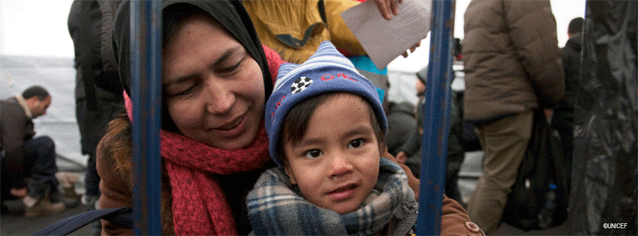
Credit: UNICEF
Further, the act of migration itself can cause food insecurity, given the lack of income opportunities and adverse travel conditions along the journey, in addition to the potentially crippling costs of transit, the report underlines.
“This has clear implications for policymakers who aim to stem the dangerous land and sea journeys many migrants are forced to make.”
The WFP study provides some examples. For instance, among migrants from Bangladesh and East and West Africa, food insecurity and resource constraints are key drivers for outward migration, whereas lack of safety and security were triggers for migration from Afghanistan and Syria, the study says.
Many Afghans and Syrians reported that sustained conflict had destroyed employment opportunities and access to markets, leading to a depletion of assets, adds the study. “Food insecurity is a consequential factor for migration from Afghanistan and Syria.”
For its part, the FAO states that migration should be a choice, not a necessity.
“International cooperation should address the structural drivers of large movements of people and create conditions that allow communities to live in peace and prosperity in their homelands.”
A world on the move: Refugees and Migrants. Credit: UN DESA
FAO underlines that agriculture and rural development can address the root causes of migration, including rural poverty, food insecurity, inequality, unemployment, lack of social protection as well as natural resource depletion due to environmental degradation and climate change.
Therefore, it stresses that investing in sustainable rural development, climate change adaptation and resilient rural livelihoods is an important part of the global response to the current migration challenge.
Working with governments, UN agencies, the private sector, civil society and local communities, FAO plays an important role in addressing the root causes of internal and international migration and displacement and in harnessing the developmental potential of migration, especially in terms of food security and poverty reduction.
Protracted Crises
The UN specialised agency also underlines that agricultural and rural development can contribute to address the root causes of migration and build the resilience of both displaced and host communities, laying the ground for long-term recovery.
For this, it works with relevant stakeholders to strengthen their capacities to provide viable livelihood opportunities in agriculture and rural areas in countries in protracted crises.
It also protects the right to food of all people on the move, while fostering their integration and strengthening the social and economic resilience of host communities.
In short: the causes of the growing massive displacement of human beings are well known. People are forced to leave their homes and families due to the flagrant lack of political wisdom and the capacity of decision-makers to address the roots instead of just complaining and alarming their societies. Do they really think that building walls and wire fences can stop climate change, food insecurity, poverty and conflicts?
Key Facts
• In 2015, there were 244 million international migrants, representing an increase of 40% since 2000. They included 150 million migrant workers.
• About one-third of all international migrants are aged 15–34. Women account for almost half of all international migrants.
• A large share of migrants originate from rural areas. Around 40% of international remittances are sent to rural areas, reflecting the rural origins of a large share of migrants.
• In many African countries, more than 50% of rural households report having at least one internal migrant.
SOURCE: FAO
Related
- How to Change the Future of Migration
- Climate-Smart Agriculture Urgently Needed in Africa
- World Hunger on the Rise Again
- Floods, Hurricanes, Droughts… When Climate Sets the Agenda
- Climate Migrants Might Reach One Billion by 2050
——-
 *Baher Kamal, Egyptian-born, Spanish-national secular journalist. He is founder and publisher of Human Wrongs Watch.
 Recent articles by Baher Kamal in Human Wrongs Watch:
Pollution or How the ‘Take-Make-Dispose’ Economic Model Does Kill
What Do You Really Eat When You Order a Steak, Fish or Chicken Filet?
Not True that Hunger Doesn’t Discriminate — It Does
How to Eradicate Rural Poverty, End Urban Malnutrition – A New Approach
The World Is Running Out of Much Needed New Antibiotics
To Be an Egyptian Migrant in Rome (and by the Way Make Great Pizza)
Poor Orphan Crops… So Valuable, So Neglected
Conflicts, Climate Shocks Causing New Famines, Severe Food Crisis
Alert: Nature, on the Verge of Bankruptcy
Floods, Hurricanes, Droughts… When Climate Sets the Agenda
Europe, New Border of Africa’s ‘Great Desert’ – The Sahara
Climate-Smart Agriculture Urgently Needed in Africa
To Be a Nigerian Migrant in Italy
Forced Evictions, Rights Abuses of Maasai People in Tanzania Reported
Climate Migrants Might Reach One Billion by 2050
Yemen: African Migrants Beaten, Starved, Sexually Violated by Criminal Groups
Can the Gender Gap Be Measured in Dollars Only?
Millions of Women and Children for Sale for Sex, Slavery, Organs…
Migrants – The Increasingly Expensive Deadly Voyages
Not Just Numbers: Migrants Tell Their Stories
Climate Change-Poverty-Migration: The New, Inhuman ‘Bermuda Triangle’
Drought Pushes 1 in 3 Somalis to a Hunger Knife-Edge
Mideast: Drought to Turn People into Eternal Migrants, Prey to Extremism?
More Plastic than Fish or How Politicians Help Ocean Destruction
The Relentless March of Drought – That ‘Horseman of the Apocalypse
Re-Connect with Nature Now… Before It Is Too Late!
The ‘Water-Employment-Migration’ Explosive Nexus
Asia: 260 Million Indigenous Peoples Marginalised, Discriminated
Mideast: Growing Urbanisation Worsens Water Scarcity, Food Imports
A Grisly Tale of Children Falling Easy Prey to Ruthless Smugglers
Agony of Mother Earth (I) The Unstoppable Destruction of Forests
Agony of Mother Earth (II) World’s Forests Depleted for Fuel
Who Are the Best ‘Eaters’ and How to Use Eggplants as a Toothbrush
African Migrants Bought and Sold Openly in ‘Slave Markets’ in Libya
The Very Survival of Africa’s Indigenous Peoples ‘Seriously Threatened’
20 Million People Could ‘Starve to Death’ in Next Six Months
Indigenous Peoples – Best Allies or Worst Enemies?
Middle East, Engulfed by a ‘Perfect Storm’
Yemen, World’s Largest Humanitarian Crisis
ACP: One Billion People to Speak To Europe with One Voice
Did You Know that the Oceans Have It All?
The Unbearable Cost of Drought in Africa
‘Humanity and Social Justice, a Must for the Future of Work’
Work, What Future? Seven Big Questions Needing Urgent Response
Plastic No More… Also in Kenya
Climate Breaks All Records: Hottest Year, Lowest Ice, Highest Sea Level
New Evidence Confirms Risk That Mideast May Become Uninhabitable
The Indigenous ‘People of Wildlife’ Know How to Protect Nature
These Women Cannot Celebrate Their Day
Antarctic Ice Lowest Ever – Asia at High Risk – Africa Drying Up
UN Declares War on Ocean Plastic
Of Arabs and Muslims and the Big Ban
Every Year 700 Million People Fall Ill from Contaminated Food
A Dire Vacuum in a World in Crisis
Indigenous Peoples Lands Guard 80 Per Cent of World’s Biodiversity
World’s 40,000 MP’s Must Enjoy Their Rights – But Are They?
Want to Prevent Stroke, Diabetes, Cancer? Get Moving… Now!
Trump to Pull Out of the UN, Expel It from the US?
Inequality (III): Less Employment… and More ‘Junk’ Jobs
Inequality (II): “It Will Take 170 Years for Women to Be Paid as Men Are”
Inequality (I): Half of World’s Wealth, in the Pockets of Just Eight Men
Poor Darwin – Robots, Not Nature, Now Make the Selection
2017 Human Wrongs Watch
Discover more from HUMAN WRONGS WATCH
Subscribe to get the latest posts sent to your email.
 Baher Kamal
 HUMAN WRONGS WATCH
Leave a comment