23 April, 2018 – TRANSCEND Media Service — There is an old saying: “You judge your Ego by your intentions and Others’ by facts.” In a conflict Ego vs Other, judgement is by the best intentions and the worst facts. “Islamophobia” sounds like that, as does Christiano-phobia. A supporting Saying, “By the Fruits you shall know the Tree”.
Johan Galtung
Christianity may be judged for Inquisition and witch-hunt processes. And Christians may respond, yes, this happened in Christian countries.
But there are deeper truths in Christianity, such as Jesus’ Samaritan work and solidarity with those who suffer and Mary’s intercession to save us from purgatory and damnation in hell, for salvation in heaven.
Much islamophobia is rooted in images of one or more of the 57 Muslim countries, judging them by (Western-individualist) Human Rights and sometimes by more universal People’s Rights–like the plight of the Kurds in Turkey and Syria-Iraq-Iran.
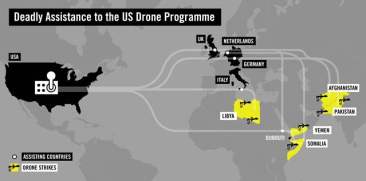
Since the start of the so-called “War on Terror” the USA has carried out hundreds of lethal drone strikes in at least seven countries (Afghanistan, Pakistan, Libya, Yemen, Somalia, Iraq and Syria).
According to the Bureau of Investigative Journalism, US drone strikes have killed up to 1,551 civilians since 2004 in Pakistan, Afghanistan, Yemen and Somalia. Amnesty International and others have exposed how some drone strikes have violated international law, and may amount to extrajudicial executions or war crimes.
In Italy, discourses around labour subcontracting in the agricultural sector serve an important purpose: obscuring the root causes of labour exploitation.
23 April 2018 (openDemocracy)* — Over the last few years, issues of labour subcontracting and forced labour in the Italian agricultural sector have gained significant traction, especially after the shocking deaths of agrarian workers were brought to light in 2015.
19 April, 2018 (UN Women)* — Purity Soinato Oiyie is a Maasai girl from Kenya who escaped Female Genital Mutilation and child marriage. She spoke at the opening session of the 62nd UN Commission on the Status of Women, the UN’s largest gathering on gender equality and women’s rights. In her own words, she shares her story and her dream to start a school for girls in her community.
Purity Soinato Oiyie. Photo: UN Women/Ryan Brown
“I was only 10 or 11 years old, when my father decided to circumcise me. I was to become the fifth wife to a 70-year-old man. I talked to my class teacher and she informed the police chief. Just two hours before the cutting ceremony, the police came and took me away.
19 April 2018 (Wall Street International)*— Notions of character, temperament, vocation, nature, or finally previous situations that determine human behavior and motivation are a constant in the layman’s thinking and unfortunately also in psychological thinking.
Notions of character, temperament, vocation, nature, or finally previous situations that determine human behavior and motivation are a constant in the layman’s thinking and unfortunately also in psychological thinking.
The next trillion-dollar industry will be in the mining sector, and the world’s first trillionaire will make his/her fortune by mining in outer space, Goldman Sachs claims.
The prediction is echoed by renowned astrophysicist Neil deGrasse Tyson, who says: “The first trillionaire there will ever be is the person who exploits the natural resources on asteroids.”
“There’s this vast universe of limitless energy and limitless resources. I look at wars fought over access to resources. That could be a thing of the past, once space becomes our backyard,” Tyson said.
Washington D.C., 18 April 2018 (ILO)* — In a statement to the Spring Meetings of the International Monetary Fund and the World Bank, ILO Director-General Guy Ryder warned that high and rising levels of inequality are impeding inclusive and sustainable development.
Cost of a plate of beans in Switzerland: 0.4 per cent of daily income. Cost of same meal in Malawi: 41 per cent of daily income, according to new World Food Programme (WFP) data. Photo: WFP West Africa
Looking to the future of work, he also called for a focus on decent work to confront the challenges of demography, technology, and climate change.
(Greenpeace)*— It’s hard to imagine living somewhere as beautiful as beside the Pechora river in northern Russia. But when you see the unbearable destruction of oil spills in the area, you have to do something.
Last year, I joined a volunteer movement that helps the Indigenous people who live in the Komi Republic to fight against the oil spills that are devastating this incredible landscape. I’ve seen the lifeless sites of old oil spills, and new oil spilling out every day.
12 April 2018 (UN Women)* — Wekoweu (Akole) Tsuhah, from a rural community in Nagaland, India, is the first generation of women in her family to have been educated. She spoke to UN Women during the 62nd session of the UN Commission on the Status of Women about the situation of women in her community, and what they want.
Wekoweu (Akole) Tsuhah. Photo: UN Women/Ryan Brown
“Everyone does farming in my community. I am educated, I have a job, but I continue to farm with my family. But women are not recognized as farmers because they do not own land and resources.
Geneva, 20 April 2018 (IOM)*– IOM, the UN Migration Agency, reports that 18,575 migrants and refugees entered Europe by sea through the first 108 days of 2018, with about 40 per cent arriving in Italy and the remainder divided between Greece (38 per cent) and Spain, at roughly 20 per cent.
.
.
This compares with 43,645 arrivals across the region through the same period last year, and 205,613 at this time in 2016.
In comparative terms, then, current arrivals are running at 42 per cent of last year’s pace, and at just over 9 per cent of 2016’s.






 HUMAN WRONGS WATCH